The Supreme Court on Tuesday directed the Election Commission of India (EC) to furnish details of appeals decided so far by apex court-appointed appellate tribunals dealing with deletions arising out of the Special Intensive Revision (SIR) of electoral rolls in West Bengal, according to a copy of the court proceedings made available to news agencies.
Bench presses poll body on disposal figures
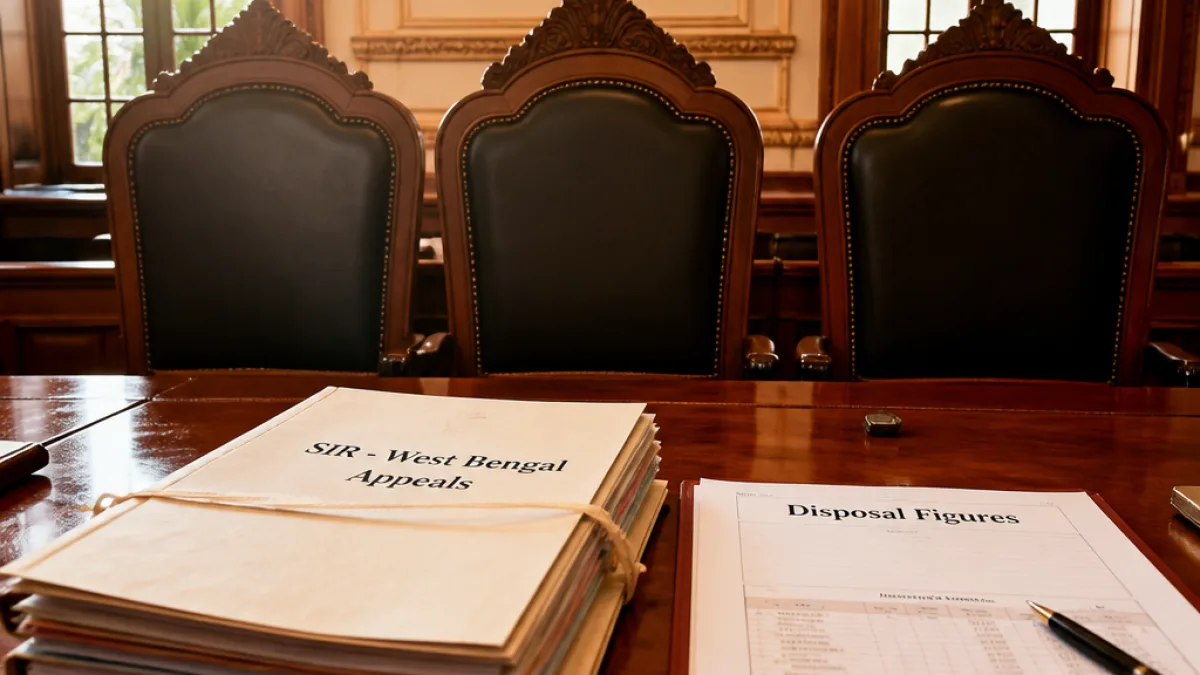
A Constitution Bench comprising Chief Justice Surya Kant and Justices Joymalya Bagchi and V. Mohana told the poll panel that mere filing of appeals was insufficient and that the court must know the quantum of disposals achieved by the tribunals so far. The bench was hearing a petition filed by Congress leader Adhir Ranjan Chowdhury seeking expedited disposal of SIR-related cases before the specially constituted appellate tribunals in the State.
"You need to give us the quantum of disposals so far because just filing an appeal is not enough. What is happening to the appeal also has to be seen,"
The court asked the EC to supply particulars of cases decided and those pending before the appellate tribunals in West Bengal and indicated that it might restrict its supervisory role to monitoring the functioning and productivity of the tribunals rather than adjudicating the lawfulness of deletions themselves.
PDS grievance flagged but court draws jurisdictional line
Counsel for Mr Chowdhury raised the issue of alleged denial of public distribution system (PDS) benefits to persons whose names were deleted in the SIR exercise, urging the court to ensure that essential welfare entitlements were not disrupted while appeals remained pending.
The bench, however, said complaints regarding denial of PDS benefits should be taken to the Calcutta High Court and that it would not enlarge the present petition to include PDS matters. Justice Bagchi observed that whether the State used deletion in the electoral list as a basis to deny PDS benefits constituted a separate cause of action for the high court.
Scope of the court’s interest: monitoring tribunals
During the hearing, the bench emphasised system-level issues, suggesting the possible modernisation of tribunal procedures — for example, by enabling online access to judges — but reiterating that the pressing concern was the rate at which appeals were being disposed of.
Senior advocate D.S. Naidu, representing the EC, sought time to compile and place before the court the requested particulars. The bench listed the matter for further hearing on August 25, according to the record.
Why the issue matters in West Bengal
The Special Intensive Revision of electoral rolls in West Bengal has been a politically sensitive exercise, as changes to the rolls can affect voters’ enrolment and, by extension, access to administrative records that are often used for welfare entitlements. Appellate tribunals were set up after the apex court’s directions to adjudicate disputes arising from the SIR deletions; the present petition focuses on the speed and transparency of those forums.
Election litigation typically involves both procedural and substantive questions — from proof of residence to claims of wrongful deletion. The Supreme Court’s interest in the tribunals’ disposal rate reflects concerns that protracted delays could amount to denial of effective remedy.
What the court asked the Election Commission to submit
- Number of appeals filed before each appellate tribunal in West Bengal arising from SIR deletions.
- Number of appeals decided (disposed) to date and the nature of disposals (allowed/dismissed/returned).
- Number of appeals currently pending and average pendency period.
| Bench | Next listing | Main focus |
|---|---|---|
| Chief Justice Surya Kant; Justices Joymalya Bagchi & V. Mohana | 25 August | Quantum of disposals by appellate tribunals |
Legal and administrative next steps
By directing the EC to provide granular data on disposals, the Supreme Court has signalled that it may confine its supervisory role to ensuring tribunals function effectively and clear backlogs. The reference to online access and future-facing procedural reforms points towards an interest in structural solutions to delays.
Meanwhile, individuals who consider themselves affected by deletions and who face disruption to welfare benefits have been advised — through the court record — to approach the Calcutta High Court for relief specific to entitlements such as PDS. The apex court made clear that its present exercise will not subsume those separate legal remedies.
The matter retains high public interest in West Bengal where electoral enrolment and welfare delivery intersect with everyday civic life; the court’s order for precise disposal data will be closely watched by political parties, civil society groups and affected voters alike.