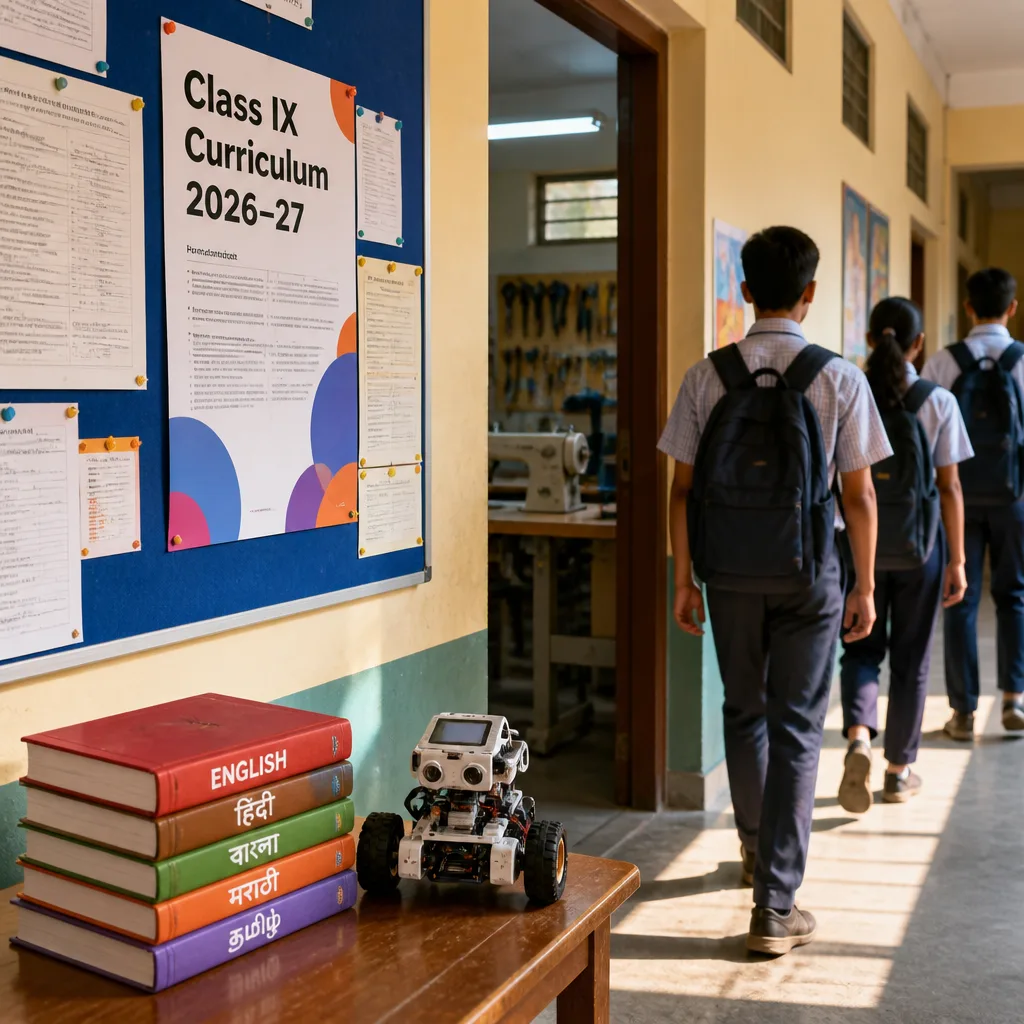
The Directorate of Education (DoE), Delhi, has unveiled a substantially revised academic and assessment structure for Class 9 that will be implemented from the 2026-27 session. The changes make vocational education and a third language (R3) compulsory, introduce advanced-level assessments in Mathematics and Science, and add modules on artificial intelligence (AI) and computational thinking, the DoE said in its notification.
Core subjects, promotion criteria and the role of vocational learning
Under the revised framework, schools will assess students on six main subjects that will determine promotion to Class 10: Language-1, Language-2, Mathematics, Science, Social Science and Vocational Education (Kaushal Vikas). Vocational Education has been made compulsory to provide early exposure to skill-based, workplace-oriented learning, reflecting the National Education Policy (NEP) 2020 emphasis on practical skills at school level.
The DoE said the aim is to move Class 9 assessment beyond conventional textbook-based testing and towards a system that values competencies, multidisciplinary learning and higher-order thinking.
- Six subjects will form the basis for promotion to Class 10.
- Vocational Education is part of the core six and will be assessed.
- Third language (R3) will be treated as a qualifying subject assessed at school level.
Third language (R3): qualifying status and implications
Students will continue with the three-language combination they followed in Class 8; one of these will be designated as the third language (R3) for Class 9. The DoE has stated that R3 will not carry the same weight as the six principal subjects. Instead, it will be recorded on the marksheet as a pass/fail (qualified/failed) entry. A student who does not qualify in R3 will not automatically lose promotion to Class 10, provided they meet all other promotion conditions based on the six core subjects.
Assessment changes: advanced-level options and new modules
The revised scheme offers advanced-level assessment options in Mathematics and Science for students who choose higher-order challenges. In addition, the DoE has included skill-oriented modules on AI and computational thinking within the Class 9 curriculum. These additions are meant to equip students with contemporary digital and problem-solving skills relevant to higher secondary study and vocational pathways.
While the DoE notification outlines the broad contours of the new system, schools will be responsible for implementing the practical aspects of vocational training and the assessment mechanics for the third language and advanced subjects.
What parents and students should note
Key operational points from the DoE advisory that parents and students should note:
- Implementation date: 2026-27 academic session.
- Subjects determining promotion: Language-1, Language-2, Mathematics, Science, Social Science, Vocational Education.
- Third language will be assessed as a qualifying subject and recorded as pass/fail.
- Advanced-level tests available in Mathematics and Science.
- New modules include AI and computational thinking.
| Subject | Role in promotion |
|---|---|
| Language-1 | Core (counted) |
| Language-2 | Core (counted) |
| Mathematics | Core (counted); advanced option available |
| Science | Core (counted); advanced option available |
| Social Science | Core (counted) |
| Vocational Education (Kaushal Vikas) | Core (counted; compulsory) |
| Third Language (R3) | Qualifying (pass/fail); does not directly determine promotion if other criteria met |
The DoE says these changes are intended to prepare students for multidimensional learning and to align school assessment with skills required in higher education and the workplace. The inclusion of vocational education at Class 9 level represents an early-stage shift towards hands-on training and employability skills.
Officials have advised schools to familiarise teachers, students and parents with the new pattern well before the 2026-27 intake. Parents seeking further details should consult the DoE notification and school circulars for exact syllabus, assessment weightages and implementation timelines.
Students and guardians anxious about the transition are advised to contact their school principal or the Directorate of Education for clarification on subject combinations, vocational options available at each school and the support systems for language learning and skill modules.