Plan cleared by L‑G, sent to Centre for final nod
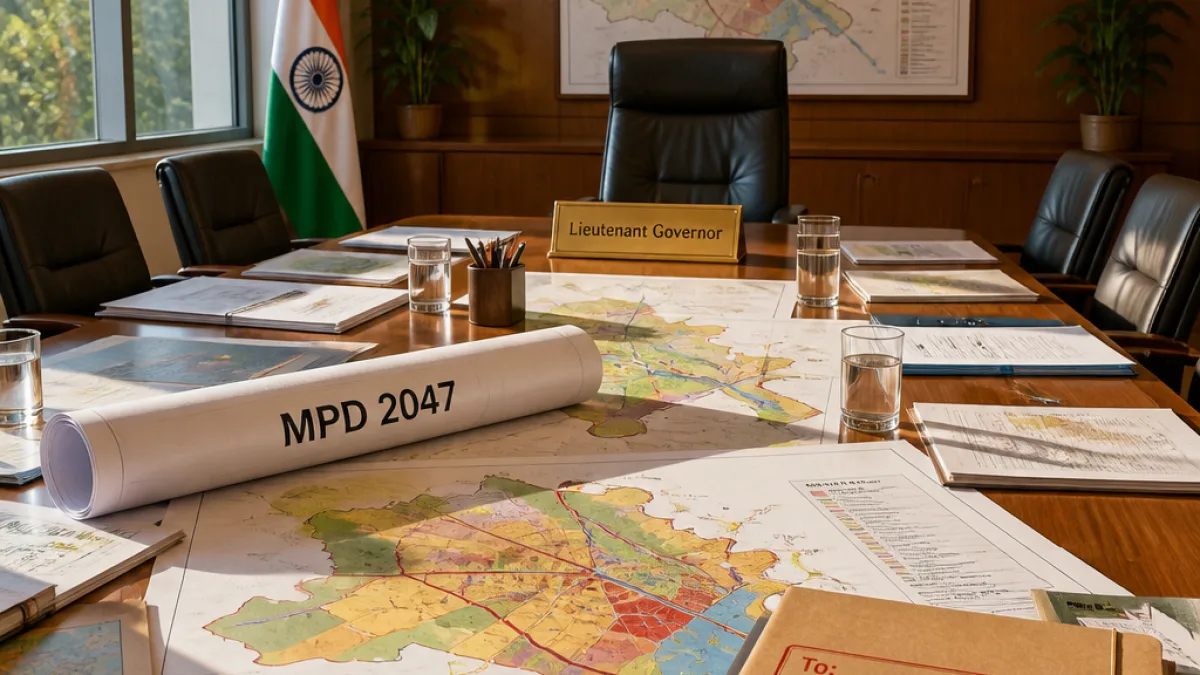
Lieutenant‑Governor Taranjit Singh Sandhu on Wednesday approved the Delhi Master Plan 2047 at a meeting of the Delhi Development Authority (DDA), officials said, marking the next long‑term blueprint for the capital’s growth and land use. The draft will now be forwarded to the Ministry of Housing and Urban Affairs for final approval and formal notification, the DDA said.
The DDA said the MPD 2047 replaces work on MPD 2041 and aligns the city’s planning horizon with the Centre’s Viksit Bharat 2047 vision. The move restores the 20‑year framing used for previous master plans, beginning with the first plan prepared in 1962 under the Delhi Development Act, 1957.
“With Delhi’s population projected to grow significantly by 2047, the Master Plan adopts an integrated approach towards housing, economic growth, mobility, environmental sustainability, infrastructure, heritage conservation, urban regeneration and citizen‑centric governance,” the DDA said.
Redevelopment rights for old DDA two‑storey units
In the same meeting, the DDA approved a policy to permit reconstruction and redevelopment of ageing two‑storey dwelling units built on individual plots in older DDA housing schemes. Several such schemes developed under MPD‑1962 contain built‑up two‑storey units that DDA officials described as more than 50 years old and structurally deficient.
- Built‑up two‑storey units will now have redevelopment rights comparable to vacant residential plots in older schemes.
- Reconstruction will be regulated by plot size and prevailing MPD provisions, including structural safety certification and compliance with the Unified Building Bye‑laws (UBBL).
- Applicable norms such as FAR, ground coverage, height and fire‑safety standards will govern redevelopment; conversion charges, betterment levy where applicable and scrutiny fees will also apply.
Land‑use change for Metro depot and other approvals
The authority also cleared a land‑use change for a Metro depot required for the Rithala‑Kundli corridor in the Narela area. The decision is expected to facilitate infrastructure work on the corridor that is part of the city’s expanding rapid transit network.
Officials said the DDA’s approvals form part of an integrated approach envisaged under MPD 2047, covering housing, mobility, economic activities, environment and heritage conservation. The plan’s proposals aim to anticipate population growth and map required investments in public infrastructure and services up to 2047.
Background and next steps
The DDA began work on MPD 2041 after MPD 2021 expired; the shift to MPD 2047 is intended to synchronise the capital’s long‑term plan with national development objectives for 2047. Historically, master plans for Delhi were prepared on roughly 20‑year cycles: 1962, 2001 and 2021.
| Master Plan | Year framed |
|---|---|
| First MPD | 1962 |
| MPD (20‑year cycle) | 2001 |
| MPD 2021 | 2021 (expired) |
| MPD 2047 | Draft approved by L‑G 2026; sent to Union ministry |
Once the Union housing ministry grants its final nod and the plan is notified, the MPD 2047 will provide the statutory framework for land‑use decisions, building regulations and redevelopment projects in Delhi. The DDA’s new policy on two‑storey built‑up units is expected to accelerate regeneration in older DDA colonies, but will require individual owners to meet technical and statutory preconditions for reconstruction.
Urban planners and resident associations will watch closely how the DDA and the Union ministry reconcile redevelopment rights with heritage conservation, open‑space retention and infrastructure capacity. The redevelopment policy also raises questions about implementation timelines, entitlement quantum for owners, and financial burdens such as conversion charges and betterment levies that the authority has retained as part of the regulatory framework.
With population growth projected to shape Delhi’s needs over the next two decades, the approved plan and accompanying policies establish the administrative route for implementing large‑scale housing, mobility and utility projects across the capital.