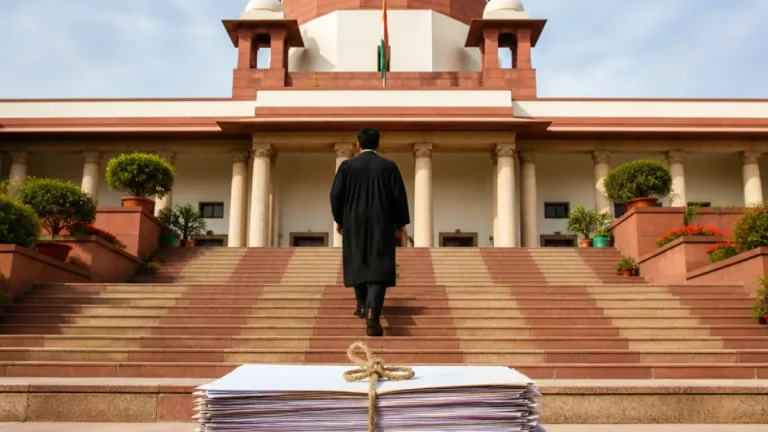

The Delhi High Court on Monday dismissed a long‑running petition that sought to declare the Rajiv Gandhi Foundation (RGF) a public authority under the Right to Information (RTI) Act, observing the petitioner had repeatedly failed to appear before the court.
Justice Swarana Kanta disposed of the suit filed in 2011 by Delhi lawyer Shanmuga Patro, who had challenged a 2010 order of the Central Information Commission (CIC) which held that the foundation did not fall within Section 2(h) of the RTI Act.
Background of the litigation
Mr Patro initially sought from RGF details including its constitution, amended by‑laws, rules and regulations and documents relating to organisational structure. The foundation declined to disclose the material in 2009, asserting it was not a public body and therefore not subject to RTI obligations.
At the CIC stage, the foundation’s position was upheld. The petitioner then moved the High Court in 2011, arguing that because RGF received government grants and conducted extensive public activity, it should be treated as a public authority and be obliged to make information available under the RTI law.
Court proceedings and the accounts directive
During the High Court’s consideration, the judges directed RGF to place its annual audited accounts on record to assist in determining whether it fell within the statutory definition of a public authority. The foundation was asked to file year‑wise audited accounts from its inception through 2010‑11.
RGF maintained before the court that it had not been constituted by a government notification nor established by statute. Its counsel told the court that government funding constituted roughly four per cent of the foundation’s overall receipts, a proportion the defence argued was insufficient to characterise the organisation as a state‑associated body for the purposes of Section 2(h) of the RTI Act.
“It was not established by the government and government funding represents an insignificant fraction of its overall resources,” the foundation’s counsel said in submissions to the court.
Reason for dismissal
Justice Swarana Kanta dismissed the petition, noting the petitioner’s repeated failures to appear on listed hearing dates. The order emphasised procedural default alongside the substantive challenge to the CIC’s determination.
The court did not issue a fresh ruling on the legal question of whether the foundation meets the statutory tests that qualify an entity as a public authority; instead, the matter was disposed of on account of the litigant’s non‑appearance and the history of the proceedings.
Legal and public‑policy implications
The decision leaves the CIC’s earlier finding intact in practice. The question of when an NGO or trust constitutes a public authority under RTI has been litigated frequently in India, often hinging on factors such as statutory creation, dominant government funding, governmental control or functional integration with public administration.
For activists and litigants seeking greater transparency from philanthropic organisations with links to the state, the ruling underscores procedural risks in protracted litigation and the evidentiary value attached to audited accounts and funding patterns.
What the court had sought
| Document requested | Period | Purpose |
|---|---|---|
| Annual audited accounts | From inception to 2010‑11 | To assess extent of government funding and determine RTI applicability |
Practical impact in Delhi and beyond
- The order preserves the CIC’s 2010 view that RGF is not a public authority, subject to future challenge on merits if properly pursued.
- Litigants seeking RTI coverage for trusts and foundations must ensure procedural compliance to keep substantive disputes alive in court.
- The case reiterates the evidential emphasis courts place on audited finances and the legal status of entities when resolving RTI claims.
The matter may be revived through a fresh petition or appeal if an aggrieved party chooses to pursue the legal tests afresh and complies with procedural requirements. For now, the High Court’s dismissal on August 17, 2026 leaves the legal status of the Rajiv Gandhi Foundation vis‑à‑vis the RTI Act unchanged.
Reporting from Delhi. — Aditya Khanna