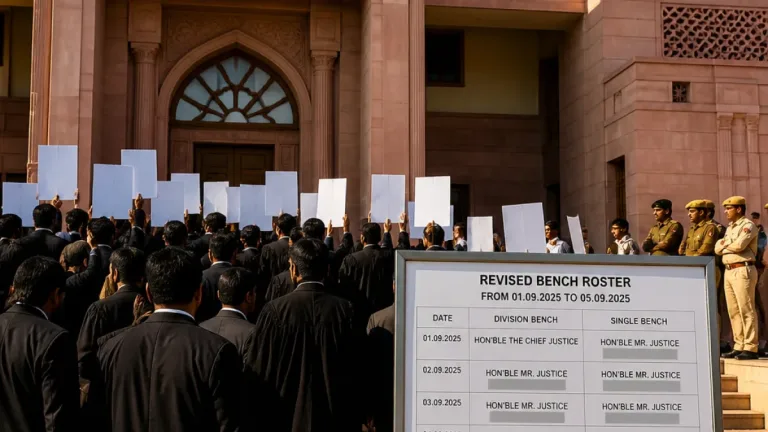
The Delhi High Court on Friday rejected a petition by All India Students’ Association (AISA) national president Neha Bora challenging a police notice that sought a personal bond of ₹10,000 for maintaining peace before a Special Executive Magistrate (SEM) under the Bharatiya Nagarik Suraksha Sanhita (BNSS).
“I am rejecting the writ petition at this juncture,”
Justice Subramonium Prasad pronounced the judgment and said the court had given directions to the SEM to furnish all material to Bora and to consider whether the bond must be produced at the first instance or later in the course of the inquiry.
Court finds material before magistrate; safeguards ordered
The judge observed there were “sufficient safeguards” built into the process and that the SEM must ensure compliance with principles of natural justice. The court noted that it could not substitute its assessment for the magistrate’s subjective satisfaction at the stage when the notice was issued.
The police notice, issued on October 17 under Section 126 of the BNSS, required Bora to appear before the SEM on October 19 to explain why she should not execute a personal bond of ₹10,000 with one surety “for keeping peace for a period of enquiry”. Section 126 empowers an executive magistrate to require a bond where there is credible information that a person is likely to breach peace, disturb public tranquillity or commit wrongful acts that may cause disturbance.
Material cited by authorities
The court noted that material placed before the SEM included several entries and documents that, in the magistrate’s view, supported initiation of proceedings. During hearings, the police relied on FIRs, general diary entries and prohibitory orders relating to incidents and large demonstrations in the Mandi House area.
| Item | Description (as recorded in court) |
|---|---|
| FIRs | Six FIRs mentioning Neha Bora |
| General diary entries | Records of incidents at various locations |
| Prohibitory orders | Orders in the Mandi House area cited by police |
The court observed that the area where Bora was detained and where she was alleged to have encouraged others to join her protest is a commercial zone with heavy footfall and important connecting roads, and said this context weighed in the SEM’s assessment.
Arguments for both sides
Additional Solicitor General Chetan Sharma, appearing for the Delhi Police, questioned the maintainability of Bora’s writ petition and defended the material relied upon by the SEM. Senior advocate Gopal Sankaranarayanan, representing Bora, contended that the SEM’s notice was issued without independent application of mind and described the notice as effectively a “cut-and-paste job”.
Counsel for Bora also disputed the police allegation that the student leader had hoisted the national flag without permission, arguing citizens are not required to seek official approval for such an act — a point raised during submissions before the court.
Next steps and procedural safeguards
While dismissing the writ petition, the court left open the avenue for Bora to challenge the proceedings at an appropriate stage, including after the SEM delivers a final order. The high court specifically directed that:
- All materials relied upon by the police and the SEM must be furnished to Neha Bora during the inquiry.
- The SEM must ensure compliance with the principles of natural justice before passing any order.
- The SEM should decide whether requiring the bond immediately is necessary or whether it can be considered during the enquiry.
The ruling clarifies how courts will approach judicial review of SEM action under the BNSS, indicating deference to the magistrate’s early-stage satisfaction where material has been placed on record, while insisting on procedural fairness going forward.
The case will now proceed before the SEM, with the statutory notice framework under Sections 126 and 130 of the BNSS providing the statutory basis for preventive bonding in situations considered likely to disturb public order.
No further orders were issued by the high court on Friday beyond the directions to the SEM and police to furnish materials and to adhere to natural justice safeguards.