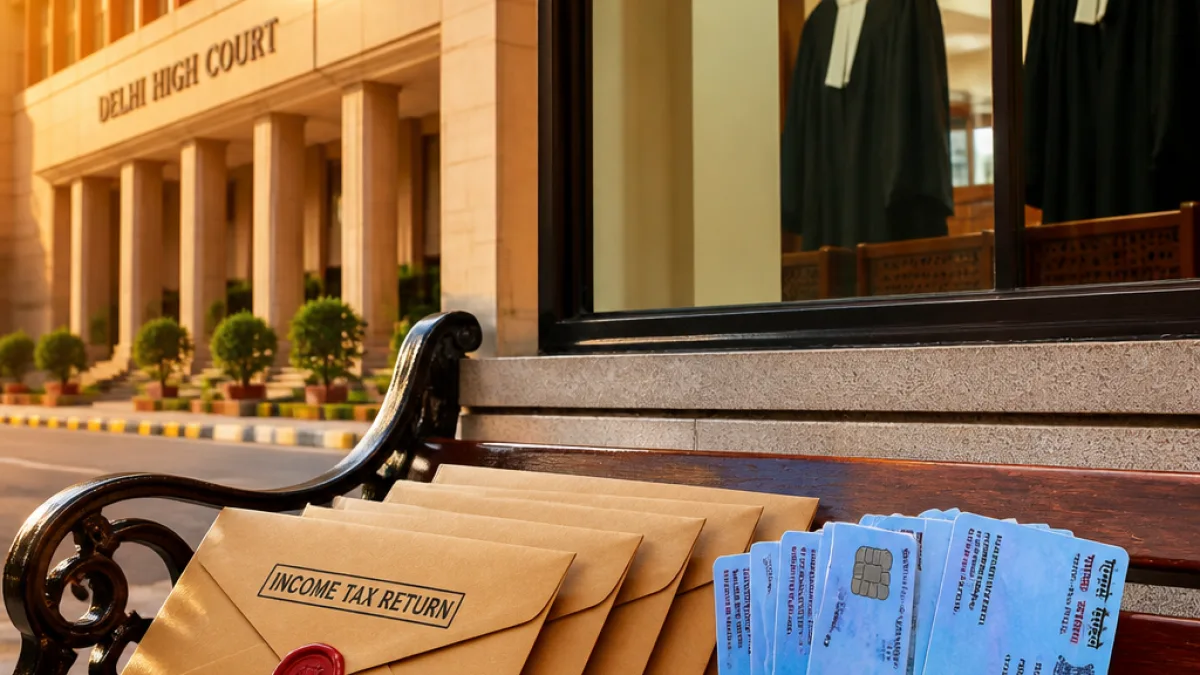
The Delhi High Court has instructed the income tax department not to process income-tax returns filed by judges of the Supreme Court and various high courts who have opted for the new tax regime, pending resolution of a legal challenge over the tax treatment of certain judicial allowances.
Bench flags statutory override, asks for details
A bench comprising Justices Dinesh Mehta and Rajneesh Kumar Gupta issued the directions in two orders, dated July 22 and August 10, on a petition filed by the Delhi Tax Bar Association, according to a PTI report. The court told private secretaries of the judges to share particulars, including Permanent Account Number (PAN), with the income-tax authorities. The direction applies to judges who have filed their income-tax returns under the new regime.
"Prima facie, sections 22D and 23D override all the provisions of the Income-Tax Act and the issue raised in the petition required consideration," the court observed in the July 22 order.
The petition contests a Central Board of Direct Taxes (CBDT) communication of 12 September 2025, which took the view that certain allowances available to judges would not be exempt under the new tax regime. The allowances cited include rent-free official residence, conveyance allowance, sumptuary allowances and leave travel concession.
Legal issue: statutory exemptions vs new tax regime
The crux of the dispute is whether the exemptions contained in statutes governing judicial service — specifically Section 22D of the High Court Judges (Salaries and Conditions of Service) Act, 1954 and Section 23D of the Supreme Court Judges (Salaries and Conditions of Service) Act, 1958 — continue to operate where a judge has opted for the new income-tax regime which, by design, restricts most deductions and exemptions in exchange for concessional tax rates.
The petitioner contended that the CBDT memorandum is inconsistent with law and amounts to interference with the independence of the judiciary. It argued the memorandum deprives judges of vested rights conferred by statute.
Practical directions to tax authorities
By staying processing of the returns of affected judges, the court has effectively paused any assessment or refund actions that would proceed under the new regime until the legal questions are resolved. The administrative step of collecting PAN and related details from private secretaries indicates the court's interest in ensuring compliance and facilitating any required examination once the issue is decided.
- Court bench: Justices Dinesh Mehta and Rajneesh Kumar Gupta
- Petitioner: Delhi Tax Bar Association
- Relevant CBDT communication: 12 September 2025
- Court orders: 22 July and 10 August (year not specified in orders as per report)
| Statute / Provision | Relevance |
|---|---|
| Section 22D (High Court Judges Act, 1954) | Exempts certain allowances from computation of income for high court judges |
| Section 23D (Supreme Court Judges Act, 1958) | Exempts certain allowances from computation of income for Supreme Court judges |
Implications and next steps
The matter raises wider questions about the interaction between specific statutory exemptions and the architecture of the new tax regime that forgoes many deductions. Legal experts and tax practitioners have previously noted that where a statute specifically grants an exemption, that provision may prevail over general provisions of the Income-Tax Act; the court's observation that the sections may "override" income-tax provisions points to the necessity for judicial interpretation.
The stay on processing returns does not amount to a final ruling on the merits. The court will consider the petitioner's arguments and the CBDT's position before deciding whether the allowances retain their exempt status for judges who choose the new regime. No timeline for final adjudication was indicated in the reported orders.
The order also has administrative consequences for the Income Tax Department which must now hold off on processing affected returns and coordinate with the court to obtain the requested details from private secretaries. Any refunds, adjustments or assessments contingent on processing of these returns will remain in abeyance until the legal position is settled.
The development is likely to attract attention both within judicial circles and among tax policy observers, as it tests the interface between statutory service conditions for a constitutionally independent branch and the general fiscal code enacted by Parliament and administered by the CBDT.