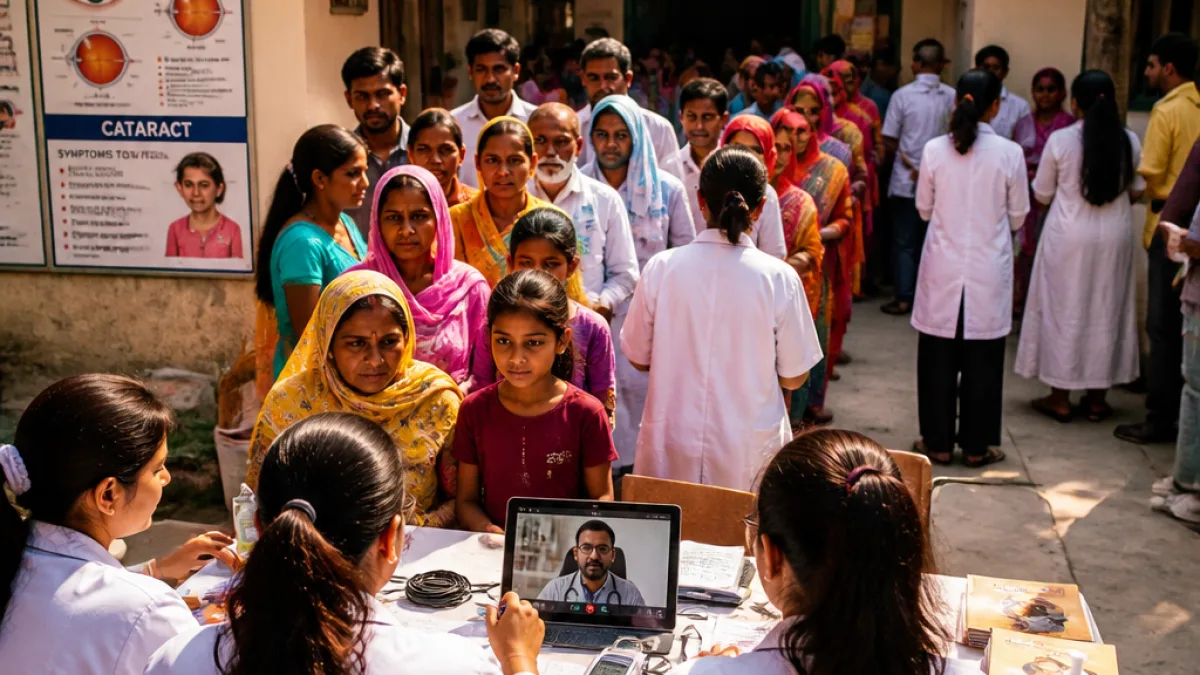
Doctors across Delhi have launched “2 Ghante Desh Ke Naam”, a volunteer-driven healthcare movement in which participating physicians commit to provide two hours of free consultations each week for poor and underserved patients. The campaign, started this week, brings together specialists from ophthalmology, orthopaedics, oncology, psychiatry, paediatrics, cardiology, gynaecology and general medicine.
Scope and delivery
The initiative aims to combine in-person and video consultations so patients in slums, rural belts and low‑income households can access medical advice without consultation fees. According to organisers, the model is designed to offer initial diagnosis, treatment guidance and follow‑up support free of charge.
Organisers said participating hospitals and individual doctors will host the free sessions and also make teleconsultation slots available to patients who cannot travel. A team of eight senior ophthalmologists, led by an eye specialist identified in the public advisory as Dr Ikeda Lal, will run dedicated eye clinics covering cataract, glaucoma, retinal conditions and other vision‑threatening problems.
“Patients across India will be able to receive absolutely free consultations, either via video consultations or in person at participating hospitals, especially aimed at patients in rural and underserved areas,” the public statement attributed to Dr Ikeda Lal said.
Participating specialties and access details
The organisers listed a wide range of specialities taking part, emphasising the multi‑disciplinary nature of the drive. Volunteers include senior clinicians in ophthalmology, orthopaedics, oncology, psychiatry, paediatrics, cardiology, gynaecology and general medicine.
- Free consultations will be offered both offline and online.
- Appointment and follow‑up support will be provided at no cost.
- The campaign is intended to expand beyond Delhi to other parts of India in due course.
Dr Lal provided a contact number for the ophthalmology team: 9990666872. The public advisory said the group aims to empower patients who cannot afford quality medical advice by removing consultation fees and simplifying access to specialists.
Voluntary model and patient segments
Organisers described the movement as volunteer‑driven and not tied to a single hospital or trust. The stated focus is on vulnerable populations — slum dwellers, those in remote rural pockets and low‑income families — who face barriers in accessing timely specialist care.
Dr L Tomar, a senior orthopaedic surgeon and founder of a foundation mentioned in the advisory, underlined the importance of access to orthopaedic care as part of the drive. The statement from organisers highlighted that the programme would attempt to cover a broad spectrum of conditions from paediatric to geriatric needs, including surgical referrals where required.
Practical implications and limitations
While free consultations can improve early diagnosis and referral, the programme as described covers consultation fees only; it does not explicitly promise subsidised or free diagnostics, medicines or procedures beyond clinical advice and follow‑up. Patients requiring investigations, hospital admissions or surgery may still incur costs unless separate arrangements are made at participating centres.
Organisers said they plan to scale the model nationally, but details on institutional partnerships, funding for logistics or a centralised appointment platform were not specified in the initial advisory.
| Feature | Details (as announced) |
|---|---|
| Consultation duration | Two hours per doctor/participant each week |
| Modes | In-person and video consultations |
| Specialities | Ophthalmology, orthopaedics, oncology, psychiatry, paediatrics, cardiology, gynaecology, general medicine |
| Contact for eye team | 9990666872 |
What patients should know
- Confirm participating hospital or doctor's schedule in advance to avoid unnecessary travel.
- Ask at the time of booking whether investigations, medicines or procedures are included or would require payment.
- Use the teleconsultation option if travel is difficult; keep prior medical records and a list of current medications handy for the consultation.
The organisers said they will publicise the names of participating institutions and clinicians as the campaign expands. The movement reflects a growing trend of senior clinicians offering pro‑bono services to bridge gaps in access to specialist care, but its long‑term impact will depend on sustained volunteer participation, coordination with hospitals and clarity on funding for ancillary services.
Reporting from New Delhi.