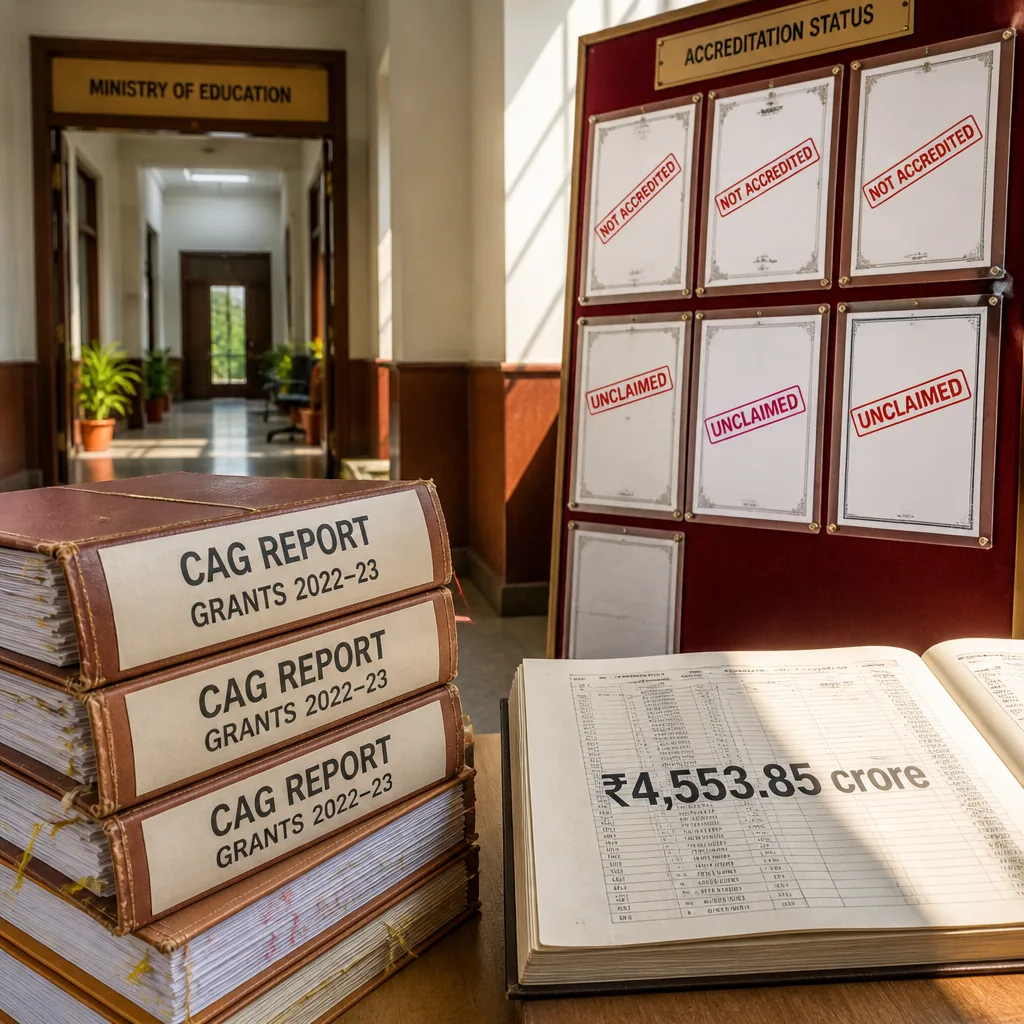
The Comptroller and Auditor General (CAG) has informed Parliament that autonomous bodies under the Union Ministry of Education reported a total of ₹4,553.85 crore in unutilised grants during 2022–23, making the ministry the largest contributor to overall non-utilisation of central grants, the auditor's report tabled on 13 August 2026 said.
Scale and context of unspent grants
According to the CAG, the overall grants released to Central autonomous bodies (CABs) during 2022–23 amounted to ₹1,13,012 crore. Of this, the Ministry of Education accounted for the largest share — ₹54,732.16 crore — and its CABs declared ₹4,553.85 crore as unspent by the end of the financial year. This unutilised amount represents 33.82% of the total unutilised grants reported across all ministries, which aggregated to ₹12,464.22 crore.
The audit notes that the education ministry had 198 central autonomous bodies under its administrative control during the period under review.
Accreditation and compliance concerns
The CAG report also raised concerns about accreditation coverage and compliance with rules governing allowances and reimbursements. The National Assessment and Accreditation Council (NAAC) — established to assess and accredit higher-education institutions — was specifically examined. The report recorded that,
"As of March 2022, 31.92% of Higher Educational Institutions (HEIs) were accredited, but 56.26% and 76.22% of Universities and Colleges respectively were not accredited though eligible for accreditation."
In addition to accreditation shortfalls, the audit flagged instances of irregular reimbursements. It cited examples where institutions reimbursed staff for purchases that were not permitted under the relevant regulations:
- Several institutes — including the Central Institute of Technology, Kokrajhar, IIT-Guwahati and IIT-Bombay — reimbursed faculty for purchases such as notebooks, laptops, desktops and tablets from the Cumulative Professional Development Allowance for the period 2016–23, contrary to rules, the report said.
- The Central University of Kashmir, Ganderbal, was found to have irregularly reimbursed leave encashment to its hiring agencies, resulting in a reported loss of ₹76.31 lakh, the audit noted.
Implications for funding, oversight and institutional quality
The CAG findings carry implications on multiple fronts: budgetary execution and accountability, the pace of accreditation of eligible institutions, and adherence to norms on staff allowances. Unspent grants at scale can indicate delays in project implementation, insufficient absorptive capacity of recipient bodies, or planning and sanctioning mismatches between ministries and autonomous institutions.
Accreditation shortfalls are equally consequential for higher-education quality assurance. The report’s figures suggest that while some HEIs have obtained NAAC accreditation, a substantial proportion of universities and colleges that were eligible remained unaccredited as of March 2022.
Key figures at a glance
| Item | Amount / Percentage |
|---|---|
| Total grants to CABs (2022–23) | ₹1,13,012 crore |
| Grants to CABs under Education Ministry | ₹54,732.16 crore |
| Unutilised grants reported by Education CABs | ₹4,553.85 crore (33.82% of total unutilised) |
| NAAC-accredited HEIs (as of March 2022) | 31.92% |
| Universities eligible but not accredited | 56.26% |
| Colleges eligible but not accredited | 76.22% |
What students, parents and policymakers should note
- Unspent grants of this magnitude may slow planned infrastructure, research and student-support projects that affect colleges and universities across states.
- The accreditation gap points to institutions that should prioritise quality-improvement measures and complete NAAC processes; students and parents may wish to check an institution’s accreditation status when making choices.
- Irregular reimbursements highlighted by the audit underline the need for stricter internal controls at autonomous institutions and clearer implementation guidance from the ministry.
The CAG report has been tabled in Parliament and will typically prompt responses from the Ministry of Education and the autonomous bodies concerned. Stakeholders seeking the full text of the audit may refer to the CAG website or official parliamentary records for the detailed report and appendices.
Further administrative action, corrective measures and follow-up audits are likely as departments and institutions respond to the observations made by the auditor general.