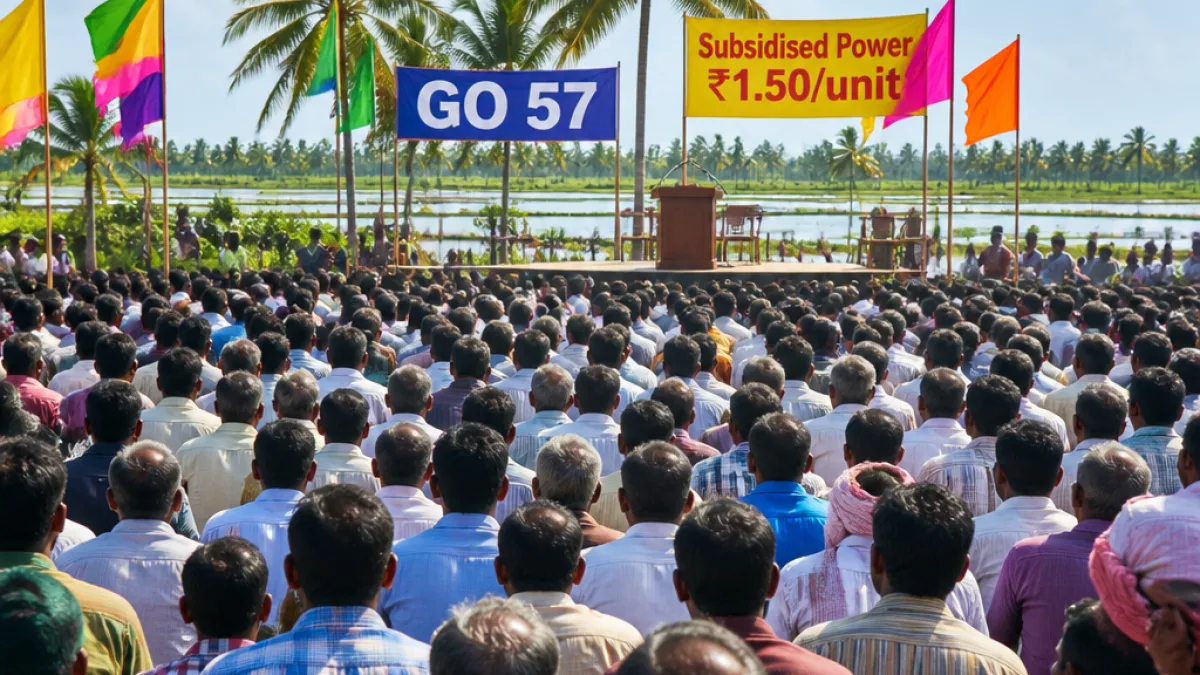
AMARAVATI/PALAKOLLU: The Andhra Pradesh government on Tuesday issued Government Order (GO) 57, providing eligible aquaculture farmers electricity at a subsidised rate of ₹1.50 per unit, removing earlier zone, non‑zone and 10‑acre ceiling restrictions, officials said.
Order unveiled at large public meeting in West Godavari
The order was released at a public gathering in Palakollu in West Godavari district, where thousands of aqua farmers were present, Agriculture Minister Kinjarapu Atchannaidu said. Energy Minister Gottipati Ravikumar described the relief as significant for the sector, noting the administration’s broader electricity policy stance.
Officials said the GO targets eligible aqua ryots across the State and lifts previous restrictions based on zones or an upper limit of 10 acres for subsidy eligibility. The government also confirmed that it had not raised domestic power tariffs for two years and will not impose true‑up charges on consumers.
Atchannaidu described aquaculture as the Chief Minister's "brainchild" and said Andhra Pradesh would be developed as a role model in the blue economy.
What the order does and immediate implications
The main provisions announced by ministers at the Palakollu meeting are:
- Supply of electricity to eligible aqua farmers at a subsidised rate of ₹1.50 per unit.
- Removal of previous zone / non‑zone distinctions for subsidy eligibility.
- No ceiling of 10 acres for eligibility under this scheme.
Energy Minister Ravikumar said the subsidy will provide relief to aqua farmers and reiterated that the government had avoided tariff hikes for two years. Officials present at the meeting also noted that the State provides free power to nearly 22 lakh farmers in the agriculture sector, a broader electricity support measure maintained by the administration.
Political context and official statements
Atchannaidu framed the move as fulfilment of an election promise by the coalition government, citing the leadership of Chief Minister N. Chandrababu Naidu and Deputy Chief Minister Pawan Kalyan, and referring to support from the Prime Minister. The Agriculture Minister described the policy as part of the State's push to strengthen aquaculture within its stated blue economy goals.
The Energy Minister emphasised that the government had resisted recent pressures to raise tariffs and would not seek retrospective true‑up charges, signalling a continued policy of electricity price stability for consumers and farmers.
What farmers and stakeholders should note
The GO as announced removes previous area and zone limits, potentially widening the pool of beneficiaries among aqua farmers. Stakeholders should watch for the following procedural details to be issued by the government in coming days:
- Official eligibility criteria and documentation required to claim the ₹1.50 per unit supply.
- Administrative process and timelines for implementation at the local distribution level.
- Clarification on whether the subsidy will be limited to specific connections or extend to all aquaculture electricity use.
The government statement at the meeting did not provide a detailed implementation timetable or an estimated fiscal cost for the subsidy. Those details are expected to be communicated by the State energy and agriculture departments as the order is put into effect.
Sectoral outlook
Ministers presenting the order highlighted aquaculture as a priority sector within the State's development agenda. By removing acreage and zone restrictions, the order could alter the economics of aquaculture operations for many farmers, though precise impacts will depend on the final operational guidelines and how distribution companies implement the subsidy at the feeder and connection levels.
| Item | Detail |
|---|---|
| Government Order | GO 57 |
| Subsidised rate | ₹1.50 per unit |
| Restrictions removed | Zone / non‑zone, 10‑acre ceiling |
| Farmers receiving free power (Statewide programme) | Nearly 22 lakh (agriculture sector) |
Officials have said further guidelines will follow. Aqua farmers and district officials are likely to seek clarity on roll‑out mechanics, meter segregation where required, and the interface with existing agricultural power schemes.
As the GO is implemented, its reach and fiscal implications will become clearer when the energy and agriculture departments publish detailed eligibility lists and operational instructions.