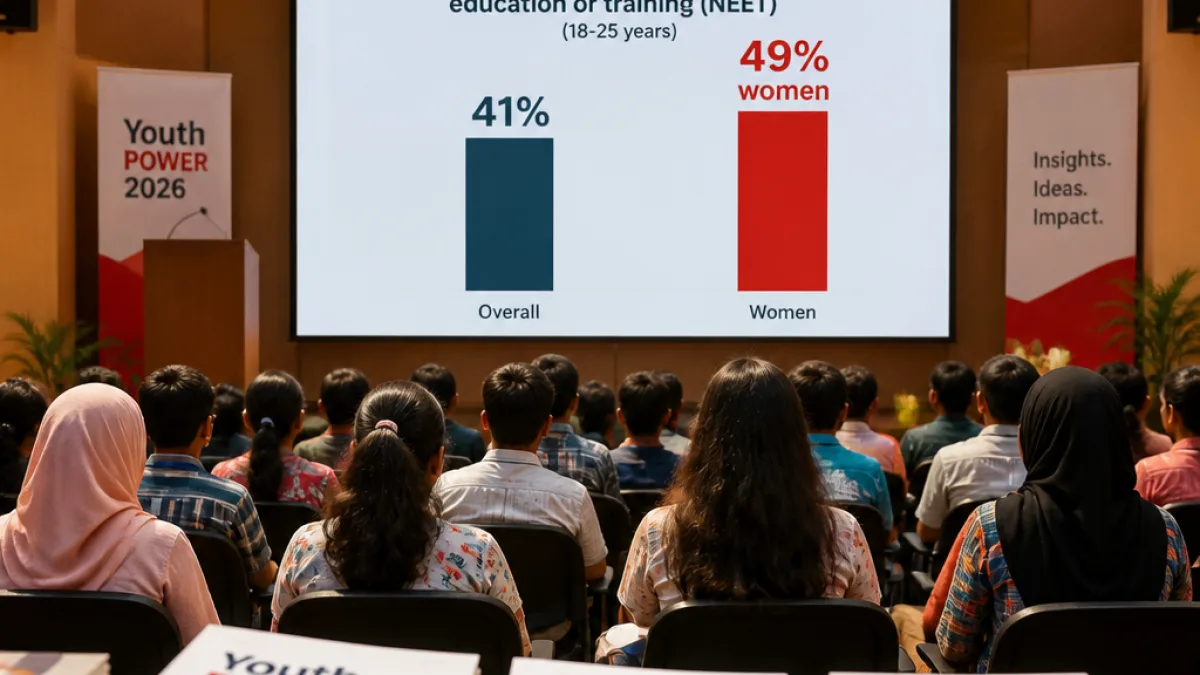
VISAKHAPATNAM: Andhra Pradesh is facing a severe mismatch between graduate supply and job opportunities, with unemployment among graduates recorded at 41%, according to the YouthPOWER 2026 State Handbook released on Monday at the Vizag FutureReady for Viksit Bharat 2047 event.
Key findings and overall youth picture
The handbook, presented by the Future of India Foundation at GITAM Deemed University, places Andhra Pradesh's YouthPOWER score at 45.3, below the median state score of 47.8. Of the state's estimated 1.23 crore young people, 46.4% are in the labour force and overall youth unemployment stands at 16.2%. Some 28.4% of youth are neither in work, education nor training (NEET).
The report underlines a clear paradox: while access to education has expanded, graduates are finding it hard to secure employment at expected rates. The unemployment rate rises with educational attainment — 3% for those with secondary education or below, 12% for higher secondary, and sharply to 41% for graduates.
Gender gaps and participation
Young women in the state are disproportionately affected. Among graduates, unemployment is 49% for women compared with 37% for men. The state has also seen a decline in labour-force participation among young women, falling from 33% to 30% over eight years.
At the same time, the report records notable gains in women’s access to technology and financial inclusion between 2021 and 2024: internet use rose from 21% to 64%; mobile ownership from 49% to 64%; and the share of women with a bank account they use personally increased from 82% to 92%.
Education inputs: better infrastructure, worrying learning outcomes
Andhra Pradesh has achieved substantial improvements in school infrastructure, the handbook notes. About 99% of schools have electricity, usable girls’ toilets and internet facilities. Nutrition indicators have also improved: the share of women with below-normal weight declined from 15% to 11%, and stunting among under-five children fell from 31% to 25%.
Despite these gains, learning outcomes remain a concern. Only 48% of Class 6 pupils reached the expected standard in language and 41% in mathematics. The report also highlights shortages of teaching staff: roughly one-third of primary schools have a single teacher, and one in five schools across levels functions with a single teacher.
Why graduate unemployment may be high
- Mismatch between curriculum and market skills — graduates without job-relevant technical or soft skills struggle to find employment.
- Quality and learning shortfalls at school level may mean higher education entrants lack foundational competencies.
- Sectoral shifts — a falling share of youth in agriculture (from past levels) and an evolving services sector that demands specialised skills.
The handbook does not assign causes but the patterns align with national debates about higher education expanding faster than quality and employability improvements.
What this means for students, parents and policymakers
For students and parents, the report underscores the importance of career planning and skills training alongside degree choices. Short-term steps that could improve prospects include vocational courses, industry internships, certification programmes in digital skills and entrepreneurship training.
For policymakers and institutions, the findings point to priorities: strengthen school learning (especially in primary grades), align higher-education curricula with local and national labour-market demand, scale up apprenticeship and on-the-job training, and target interventions to raise young women’s labour-force participation.
Snapshot: selected statistics from YouthPOWER 2026
| Indicator | Andhra Pradesh |
|---|---|
| YouthPOWER score | 45.3 |
| Total youth population | 1.23 crore |
| Youth labour-force participation | 46.4% |
| Overall youth unemployment | 16.2% |
| Graduate unemployment | 41% |
| Women graduate unemployment | 49% |
| Class 6 expected standard — language | 48% |
| Class 6 expected standard — mathematics | 41% |
Officials, educators and training providers will likely refer to this handbook when planning interventions aimed at employability and learning recovery. The handbook’s data suggest a dual approach: remedial focus on foundational learning in schools and accelerated, market-linked skilling for graduates.
Parents and students seeking immediate options should check state and central skill-mapping portals, short-term certificate courses recognised by industry bodies, and government schemes offering apprenticeships and placement support. Institutional reforms and scaled training are needed for a longer-term reduction in graduate unemployment.