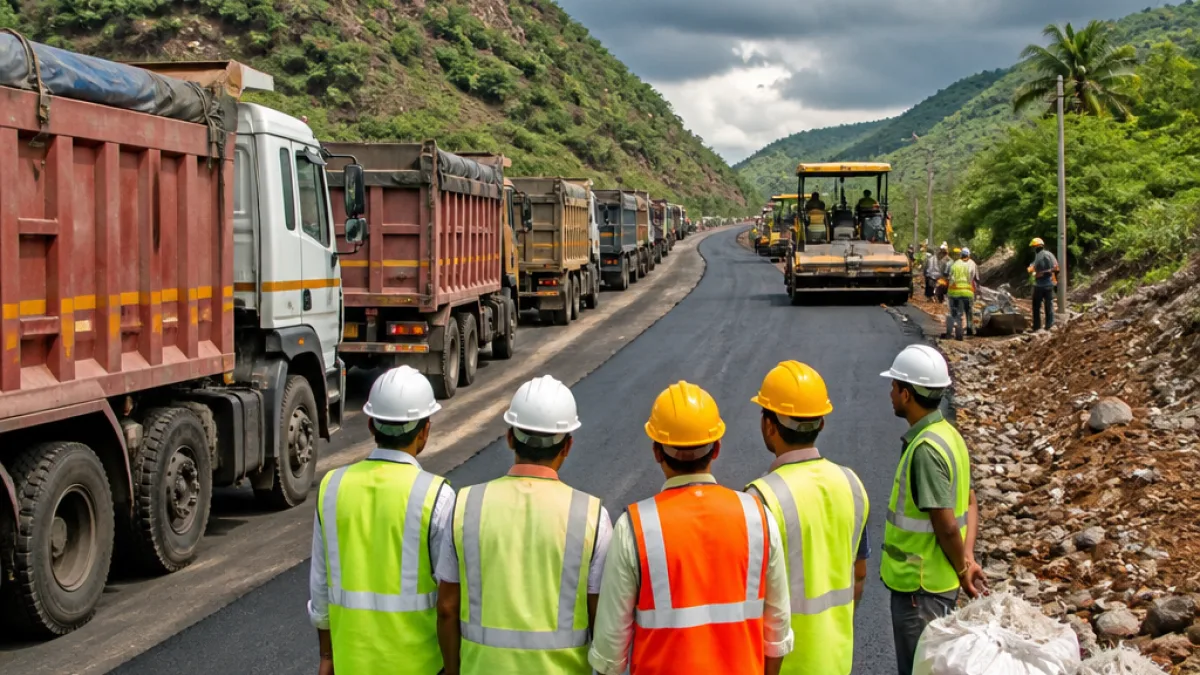
The Andhra Pradesh Roads and Buildings Department has launched a pilot using Danish fibre technology on the Mudigedu–Sanjamala road in Nandyal district to test whether fibre-reinforced asphalt can reduce potholes and extend pavement life on a freight-heavy route.
What the pilot involves
The trial uses Wiking asphalt fibres supplied by Danish Fibres A/S. According to published material about the technology, the fibres combine aramid and polyolefin to form a web-like reinforcement within the asphalt matrix. The fibres are added to hot bitumen at a low dosage — less than 1 kg per tonne — and are intended to distribute tensile stresses across the pavement rather than allowing stress to concentrate at single points that later develop into cracks.
The pilot stretch was chosen because it carries heavy freight traffic, notably from the region’s cement and granite industries, and lies in the Nallamala foothills, where monsoon conditions can aggravate pavement deterioration. The project was inaugurated on 4 July 2025 by the Roads and Buildings Department. Officials have said the technology could be expanded across Andhra Pradesh if the trial performs well through the monsoon season.
How the fibre reinforcement is claimed to work
Fibre-reinforced asphalt differs from conventional flexible pavements by incorporating short, discrete fibres into the binder mix. The published description of the Wiking system indicates that, once distributed in the asphalt, the fibres form a three-dimensional network that helps transfer and spread tensile stress. This reduces the likelihood of a localised crack propagating into a pothole and is intended to improve resistance to rutting under heavy loads.
- Material used: Wiking asphalt fibres (aramid + polyolefin).
- Dosage: Less than 1 kg per tonne of asphalt mix.
- Pilot site: Mudigedu–Sanjamala road, Nandyal district.
- Inauguration: 4 July 2025 by the Andhra Pradesh Roads and Buildings Department.
The low material dosage is a key selling point of the technology: a small quantity of fibres is claimed to produce macro-scale reinforcement, without major changes to standard mixing and paving processes.
| Parameter | Details (from disclosed information) |
|---|---|
| Manufacturer | Danish Fibres A/S |
| Product | Wiking asphalt fibres (aramid + polyolefin) |
| Dosage | < 1 kg/tonne of asphalt |
| Pilot location | Mudigedu–Sanjamala road, Nandyal district (Nallamala foothills) |
| Reason for selection | Heavy freight traffic from cement and granite industries; monsoon exposure |
Why authorities are testing the technology
Road agencies in Andhra Pradesh face recurring maintenance burdens on stretches that carry heavy commercial traffic and that are exposed to seasonal rains. The pilot aims to establish whether pre-emptive reinforcement — strengthening the pavement before cracks form — can offer a cost-effective alternative to repeated patching and reconstruction.
Officials have framed the Mudigedu–Sanjamala trial as a real-world test of the technology under India-specific conditions: heavy axle loads, variable construction practices and pronounced monsoon cycles. If the pilot demonstrates measurable benefits through the monsoon and in subsequent monitoring, authorities say the method could be considered for wider use in the state.
What this means for road users and contractors
For commuters and freight operators, the potential upside is fewer potholes and reduced disruption from repairs — provided the technology performs as intended. For contractors and state engineers, the low fibre dosage suggests the technology can be introduced without major changes to established hot-mix production and paving operations, although longer-term performance and cost-benefit analyses will be needed before scale-up.
Independent, local validation under seasonal stress is important because performance in other countries does not automatically translate to Indian field conditions. The pilot on the Mudigedu–Sanjamala road will allow engineers to observe rutting, cracking and surface behaviour under heavy use and monsoon exposure.
Authorities caution that the trial is a test and that expansion will depend on observed outcomes. If successful, fibre-reinforced asphalt could become another tool in the state’s road-maintenance repertoire, potentially reducing the cycle of frequent repairs on freight corridors and other high-stress stretches.