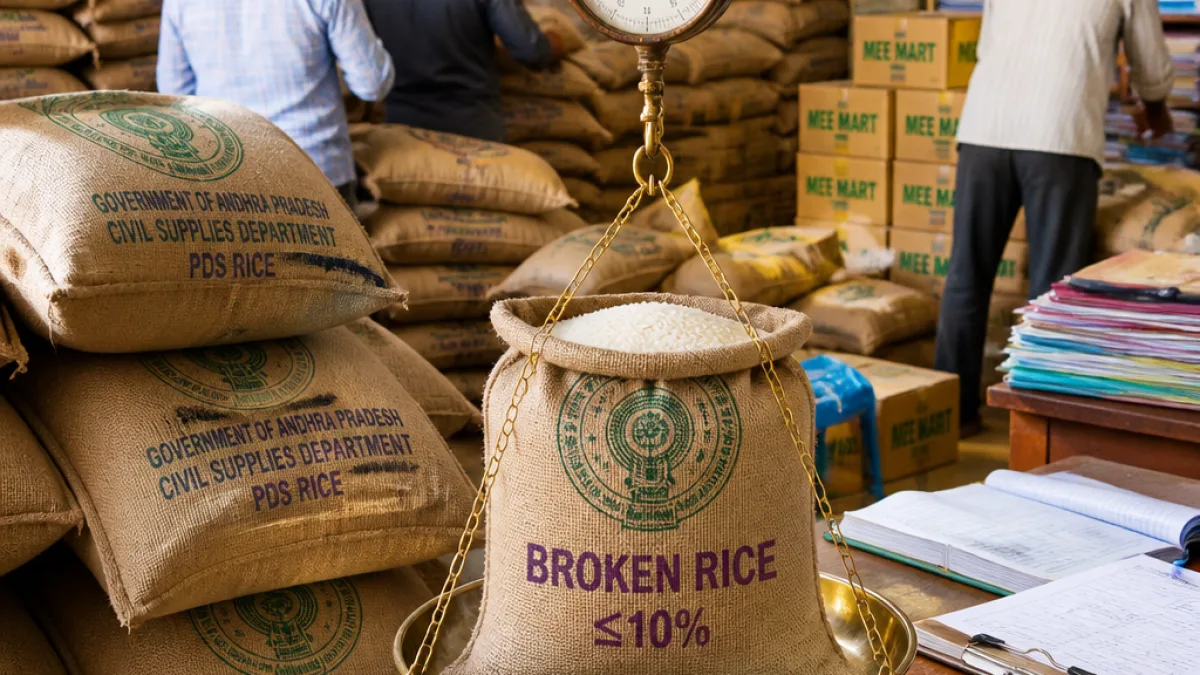
The Union government will implement a policy limiting broken rice to 10% in rice issued under the public distribution system (PDS) nationwide from next month, Andhra Pradesh Civil Supplies Minister N Manohar said on Tuesday.
Pilot adopted for national roll-out
Manohar, who was on a two-day visit to Delhi, said Andhra Pradesh had introduced the cap as a pilot project and that the Centre would issue orders next month for its adoption by all states under the PDS. He added the decision represents a substantial modification to the rice distribution mechanism that has operated for about three decades.
"We successfully implemented in the state, as a pilot project, the policy of reducing the quantity of broken rice in the rice supplied to people through fair price shops to 10 per cent... The Centre is going to issue orders from next month to implement this policy across all states under the public distribution system."
The minister said officials from the Union Ministry of Consumer Affairs, Food and Public Distribution and the National Cooperative Consumers' Federation of India (NCCF) had responded positively during his meetings in the capital. Manohar also reported progress on arrangements to supply subsidised onions, toor dal and palm oil to Andhra Pradesh.
Complementary measures and state plans
Alongside the PDS quality change, the minister noted the state government is preparing to expand low-cost retail outlets known as Mee Marts and is making arrangements for Kharif paddy procurement. He said that the NDA government is monitoring prices of essential commodities in the open market and taking steps to maintain availability at affordable rates.
Manohar highlighted that onion prices had risen in the open market due to El Niño-related conditions and other factors, and said the government was working to provide relief to consumers during such periods. The minister described the wider adoption of Andhra’s broken-rice cap as a matter of pride for the state.
What the change implies
- Quality standardisation: A 10% cap on broken rice aims to ensure households receive a higher proportion of whole grains in PDS rations.
- National procurement and logistics: Central implementation will require coordination with state agencies, procurement agencies and fair price shop distributors.
- Complementary subsidised items: The move is coupled with arrangements to supply essential cooking items — onions, toor dal and palm oil — at subsidised rates to Andhra Pradesh, with potential further roll-outs dependent on central decisions.
| Item | Announced action | Implementation timeframe |
|---|---|---|
| Broken rice in PDS | Cap at 10% nationwide | From next month (October) |
| Subsidised essentials | Supply of onions, toor dal, palm oil to Andhra Pradesh | Under review/ongoing |
| Mee Marts | Expansion of low-cost retail network in-state | State-level planning stage |
Officials at the Union Ministry of Consumer Affairs and agencies such as NCCF will have to finalise operational guidelines, the minister indicated. The change to the rice mix distributed through fair price shops will require adjustments along the procurement, milling and allocation chain.
Context: PDS and rice quality
The public distribution system is a central mechanism for providing subsidised foodgrains to eligible households. Rice supplied under the PDS typically includes a mix of whole kernels and broken grains; changing the permitted share of broken rice alters both perceived quality at the household level and the logistics of procurement and milling for agencies that supply rations.
By describing the Andhra initiative as a pilot, Manohar underlined that the state’s experience formed the basis for the national decision. He said the move is expected to increase rice consumption by offering rations with a higher proportion of whole rice kernels.
Further details on modes of enforcement, testing of grain quality and how existing stock with higher broken-rice content will be managed were not provided in the press release. The Centre and state agencies will need to issue operational orders and guidelines before the October roll-out.
Manohar’s comments follow his engagements in Delhi with central officials and agencies involved in food and consumer affairs. The full text of the state press release was issued late on Tuesday, summarising the outcomes of those discussions.