State panel OKs 25 projects totalling ₹2.08 lakh crore
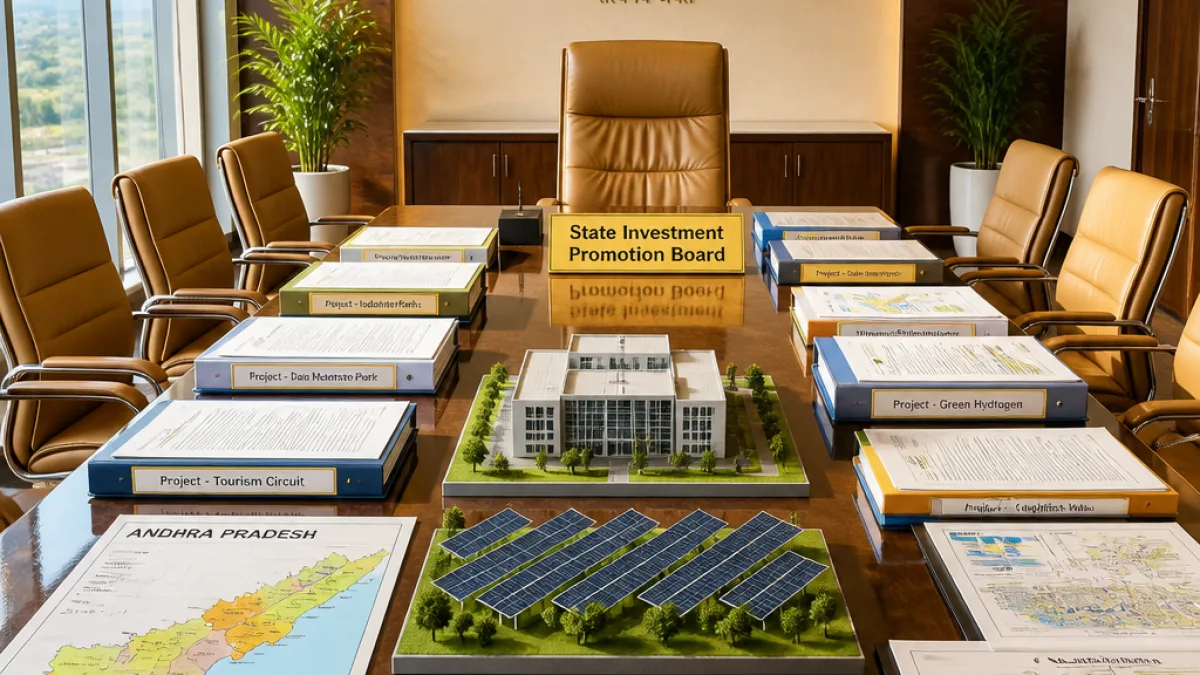
Andhra Pradesh’s State Investment Promotion Board (SIPB) on Tuesday approved 25 investment proposals amounting to ₹2.08 lakh crore, with the portfolio spanning green energy, data centres, lithium battery manufacturing, electronics, hospitality, logistics, agro‑processing and defence manufacturing. The projects are expected to provide 21,627 direct employment opportunities, the government said.
The SIPB meeting was chaired by Chief Minister N Chandrababu Naidu. Officials said the approvals form part of the government’s push to decentralise industrial development and take manufacturing and services beyond major urban centres into rural areas and smaller towns.
Major projects and job estimates
Among the largest proposals cleared were multi‑thousand‑crore data‑centre investments and green‑energy projects. Key approvals include:
- ReNew AP Green Data Center: ₹85,200 crore project in Anakapalli; estimated to create 1,880 direct jobs.
- Data Center Holdings India: ₹58,743 crore investment in Visakhapatnam; projected 1,250 jobs.
- AM Intelligence Labs: proposal of ₹31,387 crore in Visakhapatnam.
- Waaree Clean Energy Solutions: ₹15,000 crore investment planned in Kakinada; expected to generate 1,500 jobs.
- AIL Dixon India: ₹450 crore project at the Kopparthi Cluster in Kadapa; expected to deliver the largest single‑project employment figure of 7,000.
- VPR Mining Infrastructure: ₹500 crore private industrial park in Nellore; projected 2,000 jobs.
| Project | Location | Investment | Direct jobs (est.) |
|---|---|---|---|
| ReNew AP Green Data Center | Anakapalli | ₹85,200 crore | 1,880 |
| Data Center Holdings India | Visakhapatnam | ₹58,743 crore | 1,250 |
| AM Intelligence Labs | Visakhapatnam | ₹31,387 crore | — |
| Waaree Clean Energy Solutions | Kakinada | ₹15,000 crore | 1,500 |
| AIL Dixon India | Kopparthi (Kadapa) | ₹450 crore | 7,000 |
| VPR Mining Infrastructure | Nellore | ₹500 crore | 2,000 |
Agenda beyond approvals: timelines, MSME parks and incentives
Following the clearances, Chief Minister Naidu directed officials to hasten execution of projects already approved and those for which investment agreements have been signed over the past year. He set a target of September for completion of the remaining 37 MSME parks, stressing the objective of establishing industrial parks in all of the state’s 175 Assembly constituencies.
Naidu also asked officials to prioritise emerging sectors such as green ammonia, lithium‑ion batteries and robotics. Specific geographic directions were given to facilitate defence manufacturing near Puttaparthi and to encourage aerospace investment around Hindupur, according to the government release.
On fiscal support, the administration signalled a move to streamline incentives. It plans to begin crediting industrial incentives into escrow accounts from December, subject to a determination of sustainable incentive levels, officials said. The measure is intended to provide timely support to investors while maintaining fiscal prudence.
Local impact and implementation challenges
Officials framed the approvals as a push to spread industrial activity beyond the Greater Visakhapatnam and Vijayawada urban belts into smaller towns and rural areas, which could alter local land use and employment patterns. Several projects are large in scale and will require clearances on land acquisition, environmental approvals and power and water supply arrangements before construction can proceed.
Analysts and local administrators said translating approvals into operational projects will hinge on timely provision of infrastructure, labour skilling and coordination between departments. The government’s timeline for MSME parks and the move to channel incentives through escrow accounts aim to address some of these execution risks.
With significant investments concentrated in data centres, green energy and battery manufacturing, the state is signalling a focus on technology‑intensive and clean‑energy sectors. How quickly employment benefits accrue and whether the projects catalyse wider supplier networks in rural districts will depend on follow‑through by state agencies and private investors.
Officials stated the SIPB clearances mark the beginning of a new phase of industrial expansion planned to reach smaller constituencies, while continuing to attract large private capital into coastal and inland districts.