Administration pulls back EOI amid environmental and local concerns
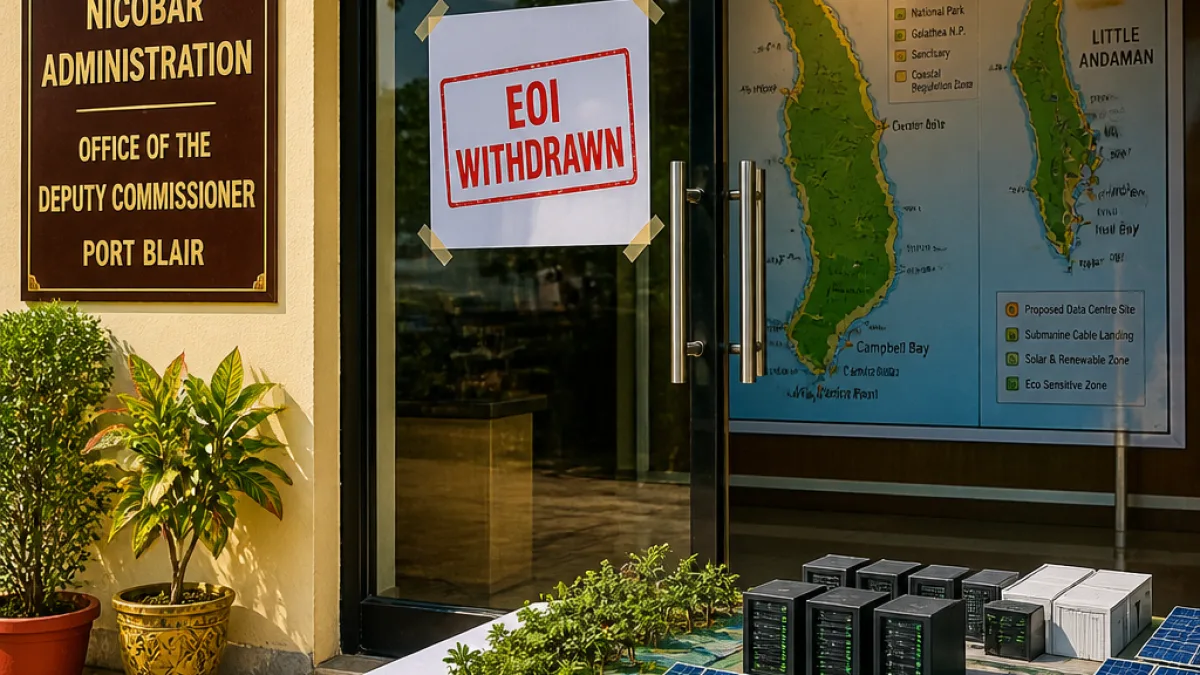
The Andaman and Nicobar Islands administration has withdrawn an expression of interest issued earlier this month to assess private-sector development of a so-called green AI/data centre vertical in Great Nicobar and Little Andaman. The notice, dated 14 August, said the EOI issued on 10 August "stands withdrawn with immediate effect" on administrative grounds.
"[T]he invitation of Expression of Interest (EOI) for setting up of a Private Sector-led Green AI/Data Centre in Great Nicobar/Little Andaman stands withdrawn with immediate effect due to administrative reasons."
The earlier EOI sought to gauge market interest, technology options and feasibility for a data-centre ecosystem described as energy-efficient and environmentally sustainable. Proposals under consideration had included high-performance computing hardware such as graphics processing units, renewable energy supply, and innovative cooling strategies including seawater-based or freshwater-free systems.
Officials had identified multiple coastal locations in both islands as potential sites, areas that are also referenced in the draft master plan for the wider Great Nicobar project. Those locations included bays around Great Nicobar and the primary settlement in Little Andaman.
Project context and environmental stakes
The EOI was linked to the broader Great Nicobar Project, a large-scale plan that envisages a transhipment port, an integrated township, a civil and military airport, and a power complex projected to include a 450-MVA gas- and solar-powered plant. The master plan under discussion covers about 166 sq km of Great Nicobar and has attracted scrutiny from conservationists and local communities.
Independent reporting has placed the estimated investment for the Great Nicobar scheme in the range of ₹91,000 crore. Environmentalists have flagged the island's placement within the Sundaland Biodiversity Hotspot, warning that large infrastructure works could fragment habitats and affect endemic species as well as coastal and marine ecosystems.
Tribal groups, notably the Shompen and Nicobarese communities, have been central to concerns about displacement, loss of livelihood and cultural disruption. The administration has been conducting consultations with tribal representatives while finalising the draft master plan.
Locations named in earlier EOI
| Island | Named coastal areas / bays |
|---|---|
| Great Nicobar | Campbell Bay Sea, Anderson Bay Sea, Vijay Nagar Bay Sea, Gandhi Nagar Bay Sea |
| Little Andaman | Hutbay Sea, Netaji Nagar Sea |
Many of the Bays cited in the EOI overlap with zones in the draft master plan earmarked for wildlife corridors, agriculture, biodiversity tourism, coastal and business tourism, residential zones and administrative buildings. That overlap helped crystallise concerns among conservationists and local stakeholders.
What the withdrawal means and what remains open
- The administration characterised the withdrawal as an administrative decision; the notice did not cite environmental or social objections as the reason.
- The EOI had been described by officials as a market-sounding and technology-assessment exercise rather than a commitment to development on specific sites.
- Work on the master plan for the wider Great Nicobar Project is ongoing, with meetings held between administration officials and tribal representatives.
Conservation groups welcomed the pause, but said a withdrawn EOI does not resolve substantive issues related to ecological impact assessments, statutory clearances or community consent. Independent observers and environmentalists have repeatedly called for comprehensive, publicly available environmental impact assessments (EIAs) and meaningful consultation with tribal groups before any irreversible land-use changes.
The administration has not released a timeline for reissuing the EOI or for when further decisions on digital infrastructure might be taken. For now, the immediate administrative withdrawal removes a public signal that private players were being actively invited to evaluate data-centre opportunities in ecologically sensitive coastal zones.
Port Blair is the administrative base for the Union Territory, and officials there will be central to any future clarifications. Local stakeholders and environmental experts say future proposals should explicitly spell out environmental safeguards, energy sourcing plans, water-use strategies and measures to avoid disruption of wildlife corridors and tribal livelihoods.
The pause on the green AI/data centre EOI underscores the tension between ambitions for strategic and economic development in the islands and the ecological and social responsibilities that accompany projects in one of the country's most biodiverse and culturally sensitive territories.