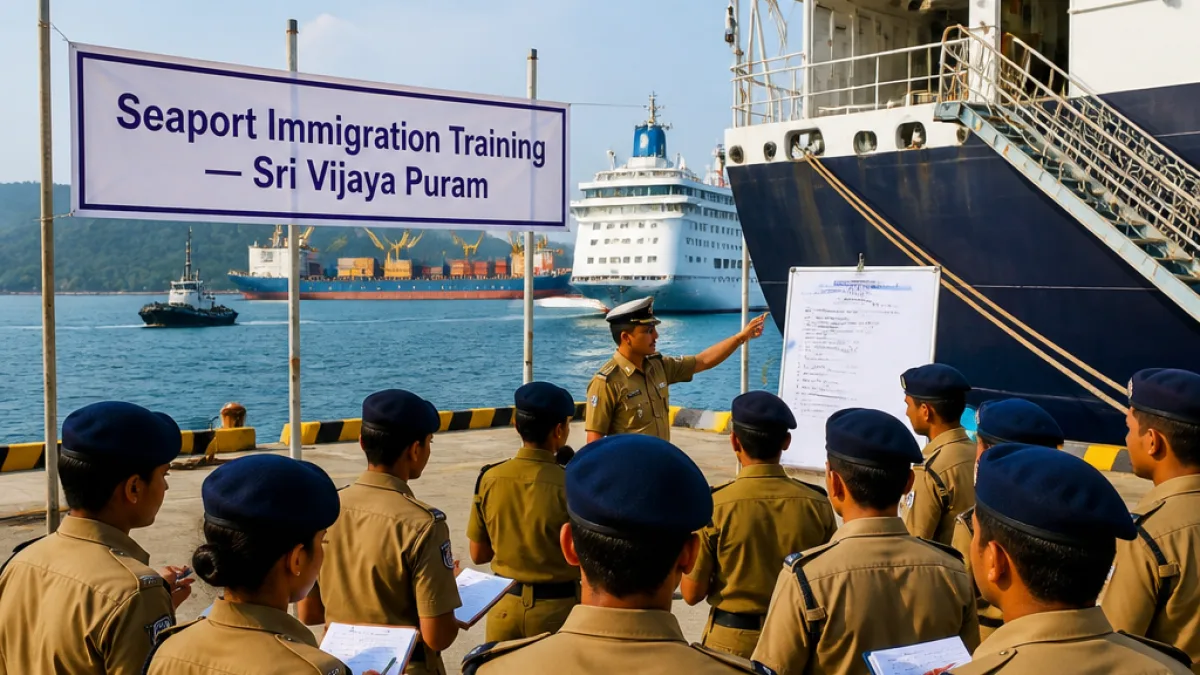
Sri Vijaya Puram: Twenty members of the Andaman and Nicobar Islands Police have completed a focused five-day training programme aimed at improving operational preparedness for seaport immigration duties, officials said on Thursday.
Practical exposure to seaport immigration procedures
The course, held from 31 August to 4 September, was organised under the supervision of DGP Ravindra Singh Yadav and was designed to provide practical and operational knowledge to police personnel tasked with immigration and foreigners-related responsibilities at seaports, police sources said.
Officials said the training sought to move beyond theoretical instruction by emphasising field-level execution and inter-agency coordination necessary for dealing with arrivals of foreign nationals and foreign-flagged vessels.
“Effective handling of immigration-related responsibilities requires not only knowledge of rules and procedures, but also practical understanding, professional competence and coordinated field-level execution,” DGP Ravindra Singh Yadav said.
Support from Bureau of Immigration, focus areas
The Bureau of Immigration (BoI), Chennai, provided experienced officers who contributed to the programme, offering hands-on guidance on seaport immigration protocols, document scrutiny and other operational facets, according to police statements.
Police identified several operational priorities addressed during the training, including passenger and crew processing, verification of travel and identity documents, liaison with port and customs authorities, and procedures for managing foreign vessels calling at island ports.
- Duration: 5 days (31 Aug–4 Sep)
- Participants: 20 police personnel
- Resource support: Officers from Bureau of Immigration, Chennai
- Geographic focus: Seaport immigration across the islands with emphasis on southern group
Why the islands need enhanced seaport immigration capacity
Police officials highlighted rising maritime activity in the Andaman and Nicobar archipelago as the rationale for upgrading capabilities. They said the southern group of islands has growing potential for cruise tourism, yacht tourism and charter vessels, and is already receiving significant shipments of construction material, machinery and other logistics by sea.
Specific locations cited where imports and foreign arrivals are expected to increase include Nicobar, Nancowry and Campbell Bay. The flow of foreign crew and vessels directly into these islands, officials said, calls for robust seaport immigration systems to ensure compliance with immigration laws and to facilitate legitimate movement.
Operational outcomes and next steps
Police said the programme aimed to strengthen professional competencies so that personnel can provide efficient seaport immigration services. The DGP framed the training as part of broader efforts to equip frontline staff with the skills needed to inspect documentation, identify irregularities and coordinate with central agencies.
While the recent module covered practical exposure, police did not provide details on follow-up measures such as refresher courses, expansion of trained cadres, or specific equipment procurement. Officials said the training was a preparatory step towards more advanced seaport immigration operations as traffic increases.
| Item | Details |
|---|---|
| Training period | 31 August–4 September |
| Number of personnel trained | 20 |
| Lead official | DGP Ravindra Singh Yadav |
| Supporting agency | Bureau of Immigration, Chennai |
| Key geographic focus | Southern group — Nicobar, Nancowry, Campbell Bay |
Context for residents and stakeholders
Local administrators and stakeholders in the tourism and logistics sectors have repeatedly sought stronger on-the-ground immigration processes to cope with seasonal and project-related inflows. Better trained police personnel at seaports can expedite legitimate arrivals while reducing the risk of irregular migration and documentation fraud.
For residents and businesses, enhanced inspection and coordination may mean smoother clearance of imported materials and clearer procedures when foreign crew or tourists arrive. The police and BoI involvement suggests closer cooperation between local enforcement and central immigration authorities.
Officials added that as maritime traffic increases, the islands will need sustained investment in human resources, training and inter-agency protocols to maintain secure and efficient seaport operations.
Police said the recent training was intended to be a building block in that direction and will be followed by operational deployment of the trained personnel at key seaport entry points across the territory.