
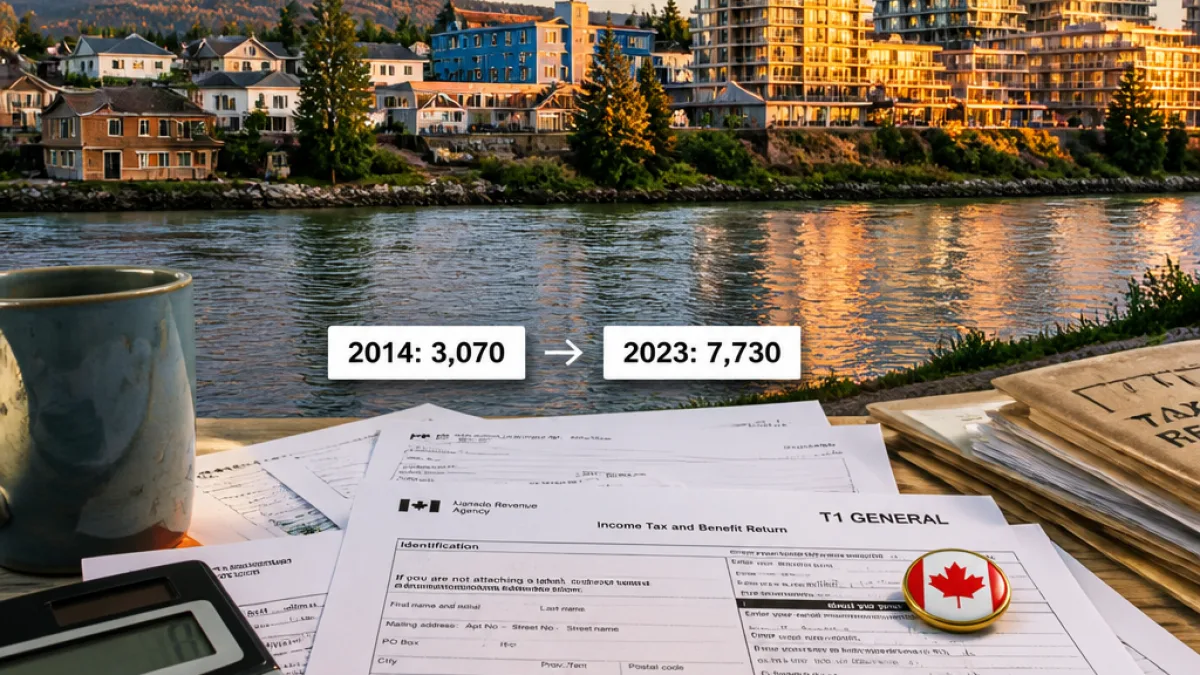
New data from the Yukon Statistics Bureau reveal a notable reshaping of reported incomes in the territory over the decade from 2014 to 2023. The cohort of taxpayers reporting more than $100,000 annually grew from 3,070 people in 2014 to 7,730 in 2023 — rising from roughly 11 per cent to 24 per cent of all filers.
What the numbers show
The raw rise in six-figure earners is striking, but the bureau’s analysis also adjusts for inflation. Using purchasing-power parity, an income of about $81,000 in 2014 would have the equivalent purchasing power of $100,000 in 2023. Even with that adjustment, the populous group of higher earners nearly doubled, increasing by a factor of about 1.9.
At the same time, some lower-income categories saw modest improvements. Filers reporting under $20,000 dropped as a share of taxpayers from 36 per cent in 2014 to 31 per cent in 2023 after inflation is taken into account. Those reporting under $40,000 fell from 46 per cent to 42 per cent over the same period.
| Year | People reporting >$100,000 | Share reporting <$20,000 | Share reporting <$40,000 |
|---|---|---|---|
| 2014 | 3,070 (11%) | 36% | 46% |
| 2023 | 7,730 (24%) | 31% | 42% |
Why these shifts matter in the North
The Yukon economy has particular pressures: high household costs, acute housing shortages and a labour market influenced by resource projects, government employment and seasonal work. In this context, a rising number of six-figure earners can reflect both higher-paid jobs and wage inflation in some sectors. But the data do not show the whole story for families struggling with basic needs.
Importantly, tax-line statistics exclude certain supports. The Canada Child Benefit — which in 2023 could provide up to $7,437 per child under six — is not taxable and therefore does not appear on Line 15000 of the tax return, the field used for assessed income in the bureau’s report. That means the financial position of some low-income families has improved in ways the tax-line numbers do not capture.
- Number reporting >$100K: 3,070 in 2014 → 7,730 in 2023
- Share under $20K (inflation-adjusted): 36% → 31%
- Share under $40K (inflation-adjusted): 46% → 42%
Gaps and limitations in the data
The bureau notes that some of the territory’s most marginalised residents do not appear in the tax records because they do not file returns, even when their income is effectively zero. Those people therefore fall outside the dataset, understating the true number experiencing extreme poverty. In short, while the headline figures show a growing group of higher earners and fewer low-income filers on paper, they do not remove the lived realities of food and housing insecurity for many Yukoners.
Local service providers and community organisations have long cautioned that statistics based on tax filings miss non-filers, temporary residents and people whose incomes are informal or intermittent. Those absences can skew both average-income measures and policy responses if not considered.
Practical implications for Yukoners
For households and community groups, the report suggests several practical steps: ensure eligible families are accessing non-taxable benefits such as the Canada Child Benefit; confirm tax filing status so people can access credits and supports tied to tax returns; and press for policies that address housing and food affordability specifically in Northern contexts.
Policymakers face a challenge: balancing support for economic growth and well-paid employment with targeted help for people left out of the formal tax and benefit systems. For reporters and citizens, the bureau’s figures are an invitation to dig deeper into which sectors added high-paying jobs, who benefited, and who remains unseen.
The territory’s income landscape appears to be shifting, but the numbers also underline a simple point: statistical improvements on paper do not always translate into universal economic security. More detailed, inclusive data and community-informed policy will be needed to ensure prosperity is shared across Yukon’s diverse communities.