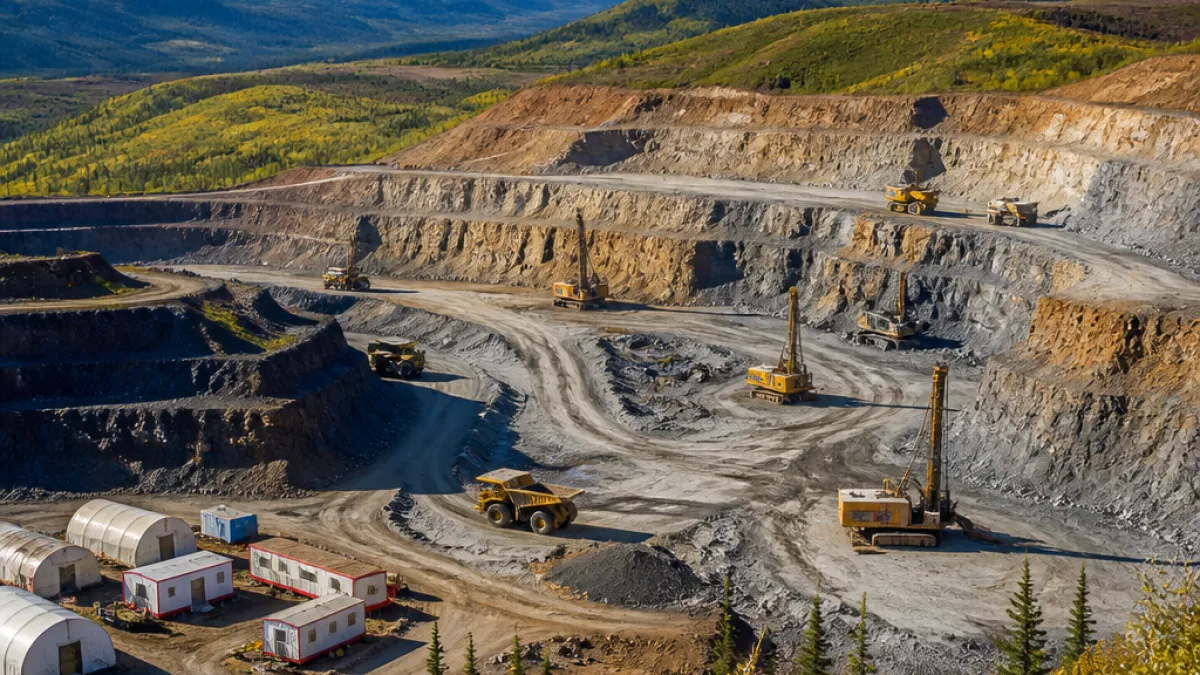
The latest Preliminary Economic Assessment (PEA) for the White Gold Project in Yukon presents a development scenario that would see an open‑pit gold mine operating for 9.4 years and producing an average of 188,000 ounces of gold a year. The study, released by White Gold Corp, also models robust economics under different gold price assumptions, underlining the project’s potential scale and financial strength.
Key economic metrics
According to the PEA, at a gold price of US$3,600 per ounce the project yields an after‑tax net present value of C$1.856 billion and an internal rate of return of 41%. At a higher gold price scenario — US$4,500 per ounce — the assessed after‑tax NPV increases to C$2.911 billion with an IRR of 57%. These figures form the financial backbone of the company’s proposed open‑pit development.
| Gold price (US$/oz) | After‑tax NPV (C$) | After‑tax IRR |
|---|---|---|
| 3,600 | C$1,856,000,000 | 41% |
| 4,500 | C$2,911,000,000 | 57% |
Resource coverage and upside potential
The PEA only models four deposits and uses roughly 60 per cent of the project’s current resource base. That partial coverage leaves scope for additional value through resource expansion and technical studies. The document explicitly notes further potential from:
- additional drilling to grow known resources;
- study of underground mining options beyond the open‑pit plan;
- follow‑up on more than 25 regional exploration targets across the district.
By relying on a fraction of the overall resource, the PEA positions the project as a starting point rather than a final development plan. If exploration results or more detailed engineering increase contained ounces or lower operating costs, the economics could improve further.
Local context: infrastructure and engagement
White Gold Corp highlights the advantages of operating in Yukon, noting a favourable jurisdiction, existing infrastructure and what the company describes as strong community engagement. Those elements are material in the far north, where logistics, access to power and meaningful consultation with First Nations and local communities shape timelines and permitting.
For residents and municipal leaders, the PEA’s timeline and output figures will focus attention on potential employment, contracting and municipal impacts, but also on environmental assessment and monitoring requirements that accompany large mining developments.
What the PEA does and does not show
Preliminary Economic Assessments are an early step in project evaluation: they combine geological estimates with conceptual mine plans and cost inputs to indicate whether more detailed work is warranted. They are not feasibility studies and rely on assumptions that can change materially with further engineering, changes in commodity prices, or new environmental and regulatory requirements.
That distinction matters in Yukon, where communities and Indigenous governments expect extensive engagement and scrutiny before projects move into permitting and construction phases.
Next steps and considerations
White Gold Corp’s PEA sets a benchmark for the project’s potential but leaves several avenues to be addressed in follow‑up studies: detailed environmental assessment, updated resource estimates using expanded drilling, permitting plans that reflect regional consultation outcomes, and economic sensitivity studies across a broader range of metal prices and cost scenarios.
For Yukoners tracking northern resource development, the study offers both cause for economic interest — significant production and strong modelled returns — and a reminder that community, environmental and technical processes will determine whether the project advances beyond the PEA stage.
As the company and local stakeholders digest the study, attention will turn to how exploration can convert unmodelled resources into mineable ounces and how planning will balance economic opportunity with stewardship of the northern landscape.