The record 2026 wildfire season that ravaged parts of Ontario and the Northwest Territories was not simply a natural fluke, according to a new analysis from Imperial College London's World Weather Attribution initiative. Researchers found that human-caused warming has made the combinations of heat, drought and wind that fuel extreme fire weather about two or more times more likely today than they would have been in a pre-industrial climate.
What the study found
Using observational data and event-attribution methods, researchers examined the conditions that produced the rapid, intense wildfire growth seen through July and early August 2026. They concluded that repeated bouts of heat and dryness — together with high lightning activity — pushed fire weather into an unusually intense state.
- The analysis estimated that conditions comparable to the 2026 season now occur roughly every 2 to 6 years in the Northwest Territories.
- In Ontario, similar fire weather now appears about every 6 to 15 years.
- Without the influence of climate change, these same conditions would be expected less than once every 40 years.
Those changed odds, the authors warned, are not a small shift. The study emphasises that even a doubling of probability can produce non-linear impacts on ecosystems and communities when wildfires move from occasional to frequent extremes.
"The doubling might sound very little, but the impacts of that are really, really strongly non-linear, so a small change makes a huge difference for an ecosystem, and a community."
— Friederike Otto, co-author, Imperial College London Centre for Environmental Policy (as reported by The Energy Mix)
Scale and local impacts
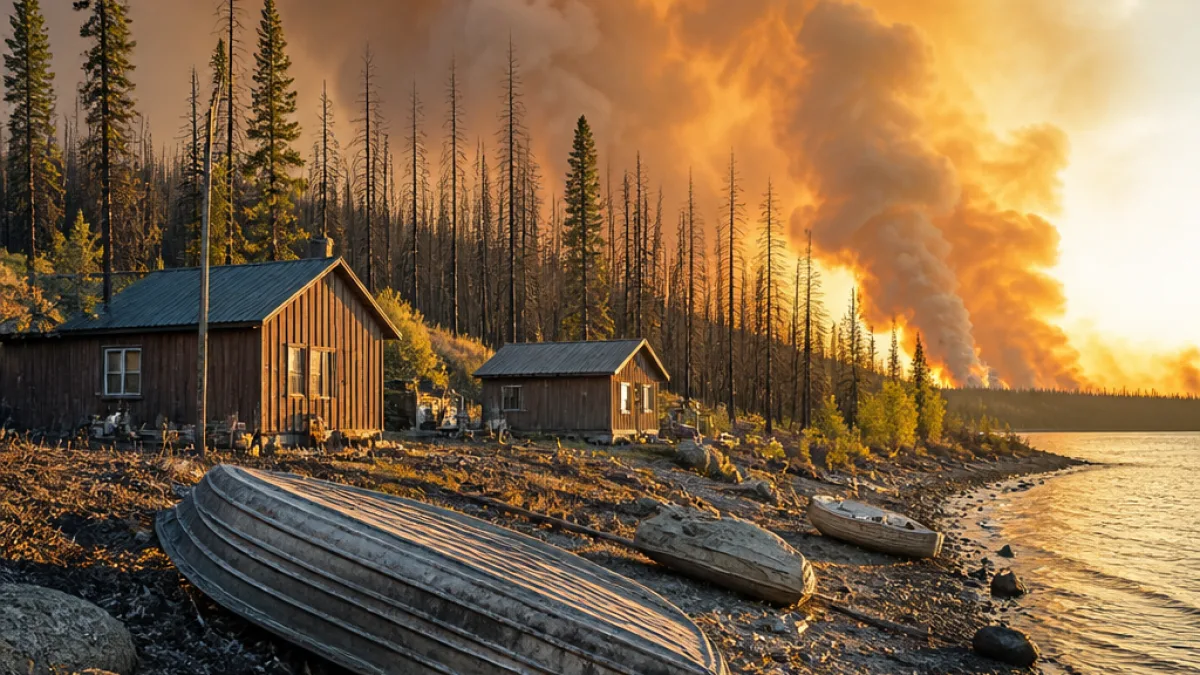
By early August 2026, roughly 9.4 million acres had burned across Canada, far exceeding the 30-year average of 6.7 million acres (1994–2023). The report draws attention to the speed at which burned area accumulated, particularly during abrupt blowups in northwestern Ontario, and notes that the effects fell unevenly on communities.
First Nation communities were identified as disproportionately affected: many are small, remote and reliant on land-based livelihoods. During the 2026 season, 13 Ontario communities — most small, remote First Nations — were placed under evacuation orders. The report outlines how evacuations can cause intense social and psychological stress for Indigenous populations, disrupting access to hunting grounds, cultural sites and local economies.
What this means for the Northwest Territories
For people and governments in the Northwest Territories, the findings underline a new baseline for planning. Emergency-response systems, evacuation planning, community fuel management and public-health preparations must now account for fire weather that is both more frequent and more extreme.
In northern jurisdictions where distances are large and resources are limited, the strain of repeated evacuations and long-duration smoke events can multiply. The report’s focus on rapid burned-area accumulation is particularly relevant to the North, where logistics for firefighting and relief are more complex than in southern regions.
Data summary
| Region | Return period now | Return period without climate change |
|---|---|---|
| Northwest Territories | 2–6 years | <40 years |
| Ontario | 6–15 years | <40 years |
Broader implications
The study adds to a growing body of attribution science showing that many extreme weather events — heat waves, heavy rainfall and now extreme fire seasons — are being made substantially more likely by fossil fuel-driven warming. For northern communities, the consequences reach beyond immediate danger from flames: prolonged smoke exposure harms respiratory health, infrastructure can be damaged or isolated, and cultural practices tied to land access can be disrupted.
While the report focused on the statistical link between warming and fire weather, it also highlighted social vulnerabilities. Emergency planning that does not centre the needs of remote Indigenous communities risks repeating the disproportionate impacts observed in 2026.
As fire seasons lengthen and intensify, local authorities and residents will need to weigh mitigation and adaptation strategies that reflect a new, higher baseline of risk. That includes investments in community-scale preparedness, improved monitoring and communications, and policies that reduce greenhouse gas emissions at national and global scales.
For residents of the Northwest Territories, the message is clear: extreme fire weather is no longer a rare event to be prepared for once in a generation — it is now part of a near-term reality that will shape land, health and community decisions for years to come.