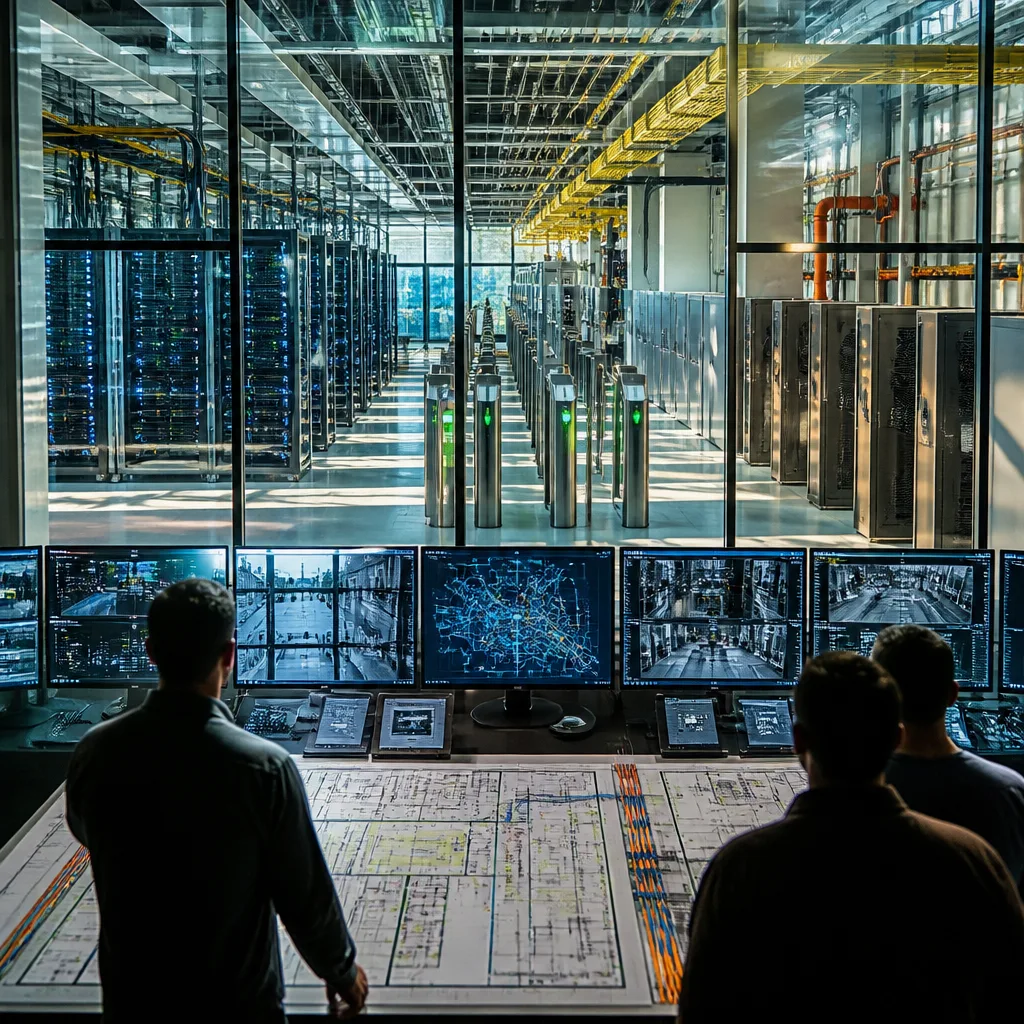
Designers of next-generation, AI-centric data centres are treating security as a coordinated, multilayered endeavour rather than a collection of connected systems, reflecting a shift from technology integration to operational orchestration.
From connected systems to coordinated resilience
Security practitioners and infrastructure designers are increasingly applying a systems-of-systems approach to the facilities that host critical compute and data. The approach recognises that linking cameras, access control, network monitoring and incident response — while necessary — is not sufficient. What matters is how those elements are coordinated so they operate as an adaptable, dependable whole.
That distinction between integration and orchestration is central to a recent treatment of the topic by Chris Hills, program manager for North America — Architects, Consultants & Engineers at Brivo, in his book Data Center Security: The Blueprint for Resilient Infrastructure (available on Amazon). Hills argues that the leadership challenge is to ensure teams responsible for physical plant, IT operations, cloud services, compliance and emergency response "operate not in silos, but as an orchestra with a shared score."
“Leadership in this context is about orchestration. It is about ensuring that the myriad teams responsible for physical plant, IT operations, cloud services, compliance, and emergency response operate not in silos, but as an orchestra with a shared score. The conductor’s task is not to play every instrument, but to ensure that each contributes to the symphony of resilience.”
Why orchestration matters for AI-centric facilities
AI workloads place unusual demands on data centres: dense compute racks, heavy power and cooling needs, and high-value intellectual property stored and processed on-site. Those characteristics raise the stakes for both cyber and physical threats. The systems-of-systems perspective treats security controls as coordinated contributors to well-defined objectives — continuity of operations, data protection and rapid recovery — rather than isolated tools providing discrete protections.
- Resilience: Orchestration emphasises adaptable, layered defences that can respond to blended cyber-physical attacks.
- Accountability: It requires defined roles and shared processes across operations, IT and security teams.
- Practical integration: Technologies still must exchange information, but the focus is on how they jointly fulfil incident-handling and recovery plans.
Where this thinking applies beyond data centres
Authors and practitioners note that the same orchestration mindset is relevant for other critical industries: manufacturing, supply chains and utilities. These sectors are increasingly digitised and hence exposed to blended threats that target both operational technology and traditional IT systems. Designing security as a coordinated capability helps organisations manage complexity and reduce single points of failure.
| Aspect | Integration | Orchestration |
|---|---|---|
| Primary goal | Connect systems and enable information exchange | Coordinate capabilities, people and processes toward defined security purposes |
| Emphasis | Technical interoperability | Operational outcomes and adaptability |
| Organisational impact | Often siloed teams | Cross-functional collaboration and shared procedures |
Moving from integration to orchestration is not purely a technology project. It requires governance, tabletop exercises, joint incident playbooks, and senior leadership that prioritises shared objectives across disparate teams. The analogy of an orchestra — where a conductor ensures each instrument contributes to a single performance — captures the idea that leaders need to coordinate rather than micromanage each component.
Implications for policymakers and industry
For national governments and operators of critical infrastructure, the shift carries practical consequences. Procurement and regulatory frameworks built around checklists of connected systems may need updating to evaluate whether suppliers can support coordinated detection, response and recovery. Similarly, workforce development must focus on cross-domain skills and joint exercises that break down institutional silos.
The increasing prevalence of AI workloads only accelerates these needs. As data centres scale to meet model training and inference demands, their physical and cyber risk profiles change. Adopting orchestration-oriented design and governance helps ensure that resilience keeps pace with capability.
Understanding security as orchestration — not merely integration — reframes where investments should go: toward joint planning, shared playbooks and the organisational habits that make technology-driven protections dependable in real-world crises.