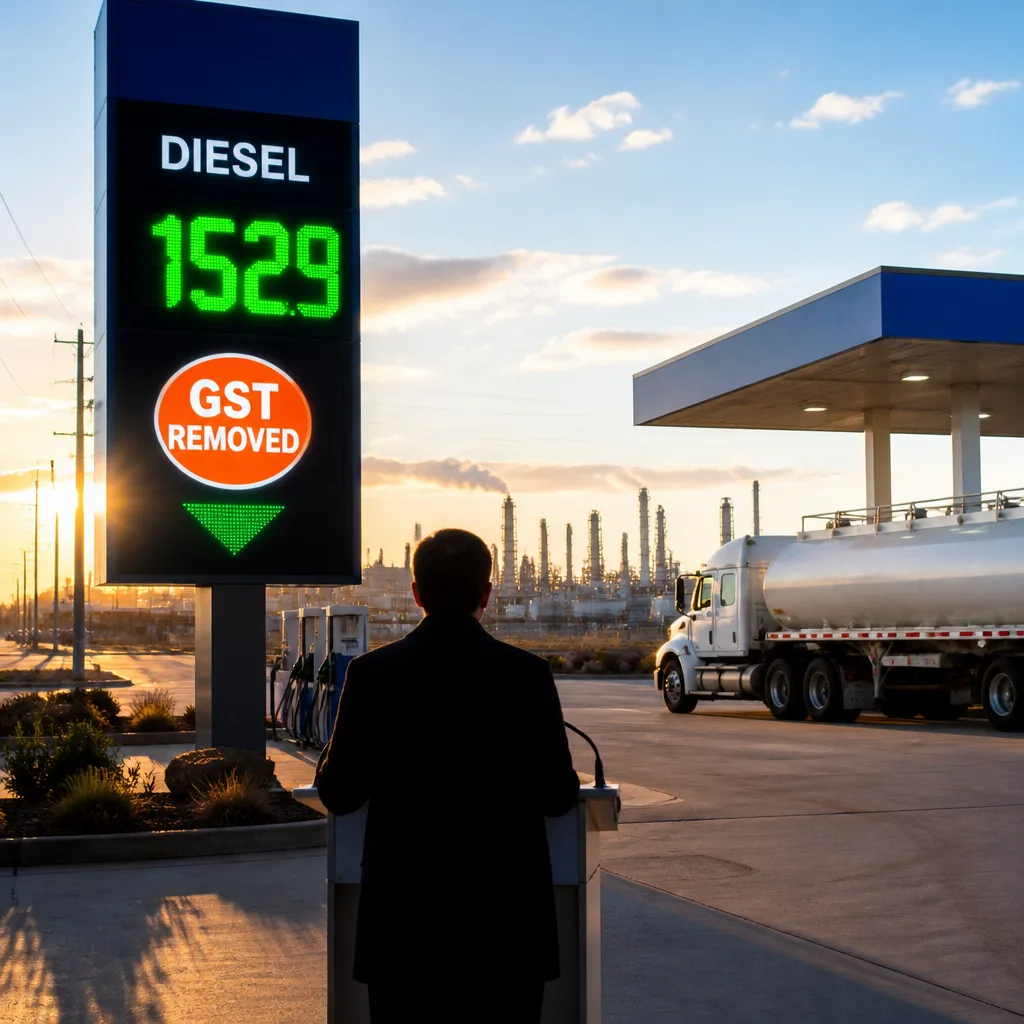
Conservative Leader Pierre Poilievre has proposed eliminating federal taxes on diesel sales until at least Canada Day and scrapping federal rules he says raise production costs, arguing the measures would make fuel more affordable and shore up Canada’s domestic supply.
Roadmap of the proposal
Speaking at a suburban Ottawa gas station, Poilievre set out measures that combine immediate tax relief with longer-term changes to energy policy and regulation. The plan would:
- Extend the full federal fuel excise tax cut so it runs until July 1 of next year (Canada Day).
- Remove the goods and services tax (GST) on the purchase of fuel.
- Permanently repeal the federal industrial carbon tax and the Clean Fuel Standard, which the Conservatives say add costs to diesel production and deter refinery investment.
Rationale and immediate effects
Poilievre argued Canada already produces enough diesel to meet national demand but that distribution and transport bottlenecks force some regions to rely on U.S. imports. The Conservative leader said tax relief would ease prices at the pump while regulatory changes would encourage investment in refining capacity and the infrastructure needed to move and store fuel across the country.
"[The Clean Fuel Standard] adds costs to the production of diesel and discourages new investment in refineries,"
The proposal blends short-term relief with policy shifts aimed at increasing domestic refining and logistics capacity: Poilievre said the plan would expand refining capacity, help refineries process more Canadian crude and build transportation and storage infrastructure to supply every region.
Policy trade-offs and political context
The package raises immediate fiscal and regulatory questions. Eliminating the federal excise tax and the GST on fuel would reduce federal revenues — the proposal did not include estimates of the cost to the treasury — while repealing the industrial carbon tax and the Clean Fuel Standard would mark a substantial change in federal environmental policy. Those rules were designed to reduce greenhouse gas emissions from industry and transport fuel over time; removing them would affect the government’s emissions-reduction framework and likely draw scrutiny from climate advocates and provincial governments that favour carbon pricing measures.
Poilievre presented the plan from the political centre of Ottawa less than a week after rising in Question Period. The Conservatives framed the move as addressing affordability concerns for households and businesses that rely on diesel — including transportation and agricultural sectors — while also promoting greater domestic energy security by prioritizing Canadian refining and logistics.
| Measure | Intended effect |
|---|---|
| Extend fuel excise tax cut to July 1 | Lower retail diesel prices in short term |
| Remove GST on fuel | Further reduce consumer fuel costs |
| Repeal industrial carbon tax and Clean Fuel Standard | Reduce production costs; aim to spur refinery investment |
How Ottawa would balance the competing priorities of affordability, revenue and climate commitments remains unanswered in the Conservative outline. The proposal does not include fiscal costings, nor does it spell out how regulatory repeal would proceed or how the federal government would support the upfront capital investment required to expand refining, transportation and storage infrastructure.
Any move to remove or alter federal environmental regulations would also require consultation with industry and likely provoke debate with provinces that have their own approaches to carbon pricing and fuel policy. For regions that now import U.S. diesel because of bottlenecks, the plan offers a promise of greater domestic supply — but achieving that will depend on the pace and scale of private-sector investment and on resolving logistical constraints that the Conservatives say currently limit distribution.
The Conservatives cast the package as both an affordability measure and a strategy to strengthen energy sovereignty. The federal government’s response and further details on implementation will determine whether the plan stays a short-term price intervention or becomes a blueprint for lasting change to Canada’s fuel production and regulatory landscape.