MIT doctoral student Mack Cleveland is using computational materials science to investigate how nuclear fuels might be made to achieve higher burnup — enabling reactors to extract more energy from each fuel element and leaving less fissile material as waste.
Why burnup matters
Higher burnup rates mean a larger fraction of the fissile content in a fuel rod is consumed before the rod is removed from service. That can reduce the volume of unspent fissile material that becomes long‑term radioactive waste and can lower the frequency with which reactors need to replace fuel, with knock‑on effects for operating costs and fuel‑cycle logistics.
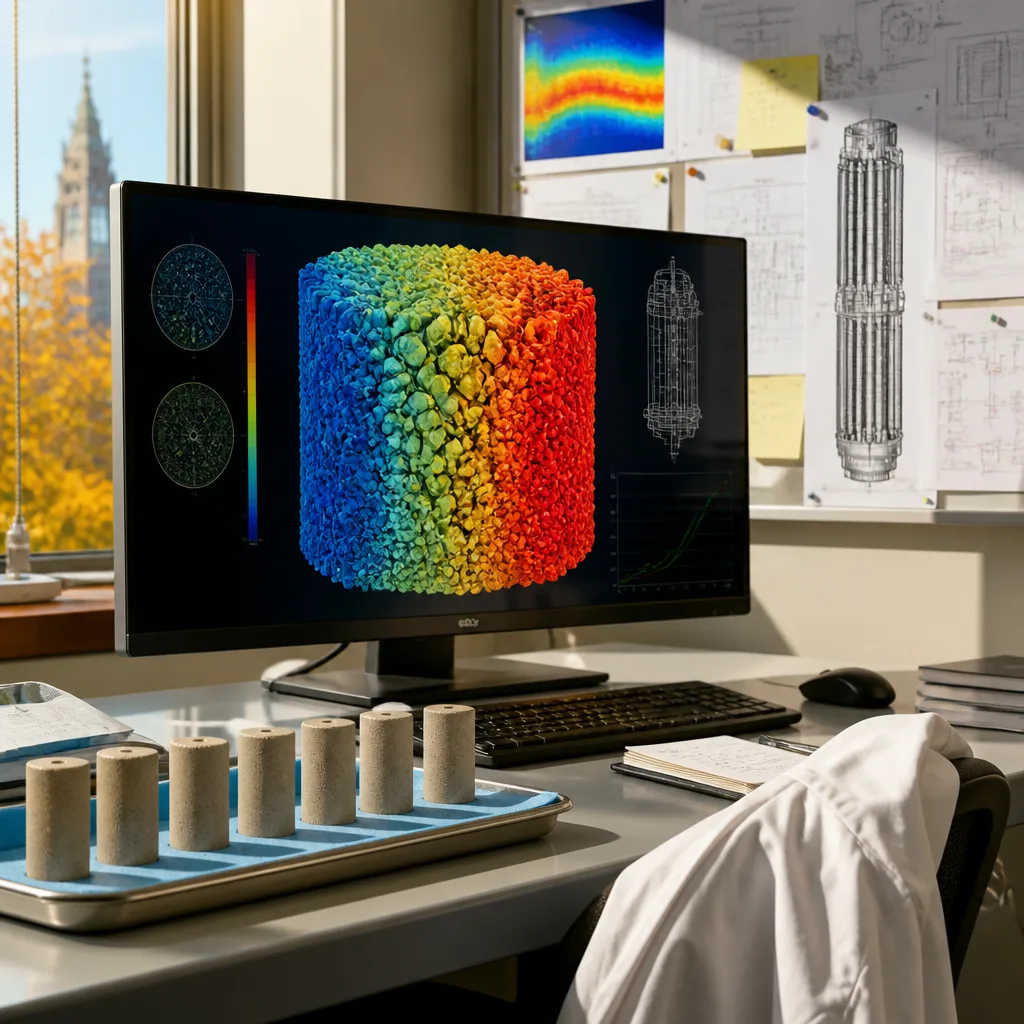
The research highlights that the chemistry and microstructure of nuclear fuel at granular length scales are more complex than conventional models assume. Cleveland, a third‑year doctoral candidate in the Department of Materials Science and Engineering at MIT, is exploring those complexities using computational methods.
Approach and academic context
Cleveland conducts his work in the Department of Nuclear Science and Engineering at MIT under the advisement of Ericmoore Jossou and John Clark Hardwick, whose titles are given in MIT materials as affiliated with nuclear science and electrical engineering and computer science.
His trajectory blends a longstanding interest in the abstract rigour of mathematics and philosophy with practical questions about materials. As an undergraduate at Texas A&M University he gravitated to computational materials work, first studying disordered systems such as amorphous silicon and its structural defects. That background gave him tools to describe apparently chaotic microstructures in mathematical terms — an approach he now applies to irradiated nuclear fuel.
"It was really neat to bring together the language of math and its beautiful abstractions to the table to explain physical material realities and properties,"
That quotation, from Cleveland reflecting on his undergraduate experience, encapsulates the methodological through‑line of his doctoral work: using models and computation to connect atomic‑scale processes to macroscopic performance.
Potential impacts and open questions
The promise of higher burnup is significant but not automatic. Practical deployment requires resolving multiple materials and engineering challenges, including:
- how microstructural evolution under irradiation affects thermal conductivity and swelling;
- the chemistry of fission products and their migration within fuel grains;
- integrating computational predictions with experiment and reactor safety requirements.
The source material notes that only around 6 per cent of fuel rods may be fully utilised under conventional regimes — a figure that frames the scale of opportunity if fuel utilisation can be improved. Any pathway to higher burnup must also preserve reactor safety margins and meet regulatory scrutiny, so the computational work is a first step in a longer translational process.
| Person | Role / Affiliation (as given) |
|---|---|
| Mack Cleveland | Third‑year doctoral student, Department of Materials Science and Engineering, MIT |
| Ericmoore Jossou | Adviser, Department of Nuclear Science and Engineering |
| John Clark Hardwick | Adviser; listed with titles linking Nuclear Science and Engineering and Electrical Engineering and Computer Science |
Computational materials science offers a cost‑effective route to explore many chemical and microstructural scenarios that would be time‑consuming or expensive to reproduce experimentally. By simulating irradiation effects, defect formation and mass transport at small scales, researchers can prioritise the most promising fuel chemistries and microstructures for laboratory testing.
For Canada and other nations with substantial nuclear fleets, such advances matter: improved fuel utilisation could reduce the burden of long‑term waste management and influence the economics of both existing reactors and prospective new technologies. Translating computational findings into licensed fuel designs, however, will require collaboration between materials scientists, reactor engineers, regulators and industry.
Cleveland’s work is an example of how interdisciplinary training — in mathematics, materials science and nuclear engineering — is being marshalled to address practical energy challenges. The research remains at a development stage, but it underscores a broader trend: using high‑fidelity simulation to illuminate microscopic processes that determine macroscopic performance in critical energy materials.