Researchers at Westlake University have described a fabrication technique that directly produces nanoporous carbon structures with finely controlled pores and intricate geometries — and does so without the high-temperature carbonisation steps typical of existing methods.
How the method works
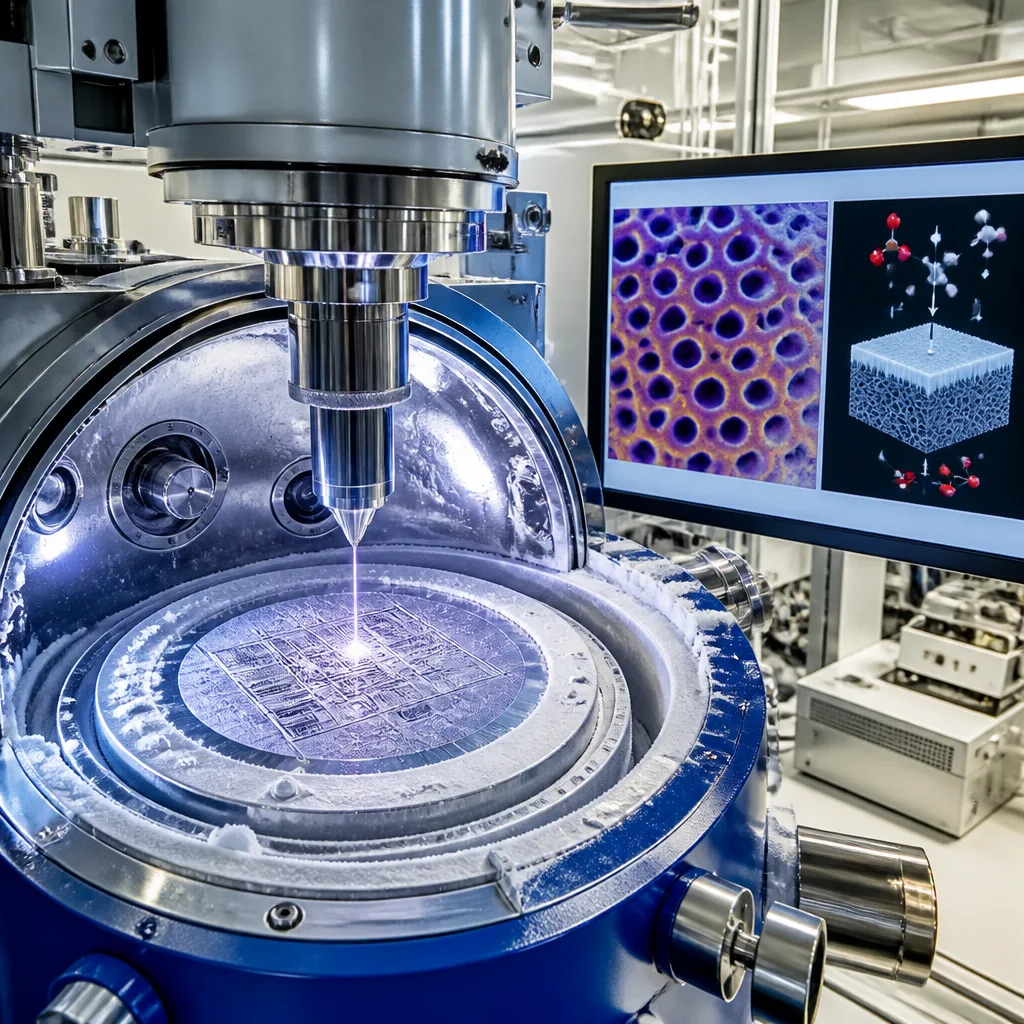
The approach, called Mix-ice lithography (Mix-IL), uses a frozen resist made from a mixture of water and anisole. Under low-temperature electron-beam irradiation, the two ingredients play distinct roles: the water component is selectively decomposed and removed to form nanoscale voids, while anisole molecules reorganise into an amorphous carbon matrix that becomes the structural backbone.
| Component | Function in Mix-IL |
|---|---|
| Water ice | Electron-induced decomposition creates nanoscale pores |
| Anisole | Molecular restructuring forms the amorphous carbon framework |
By integrating these two transformations in a single irradiation step, the team achieves simultaneous pattern definition and pore formation without chemical developers or high-temperature pyrolysis. The researchers report control of pore sizes down to the sub-10 nanometre range and the ability to tune overall porosity and pattern complexity across micro- and nanoscale length scales.
Why this matters
Nanoporous carbons are prized for a combination of attributes — low density, chemical resilience, electrical conductivity and tuneable mechanics — that make them attractive for applications ranging from lightweight structural components to microelectromechanical systems and bio-integrated devices. However, conventional fabrication routes often force trade-offs between precise patterning, controllable pore architecture and mechanical performance, and typically require multiple processing steps including harsh chemical treatments or high-temperature carbonisation.
Mix-IL offers several potential advantages:
- Single-step processing: patterning and pore creation occur in the same irradiation step, simplifying fabrication workflows.
- Low-temperature operation: avoids the need for high-temperature pyrolysis, enabling compatibility with temperature-sensitive substrates or integrated devices.
- Tunable structure: pore size, porosity and geometry can be adjusted to meet application-specific requirements, including pores below 10 nm.
Beyond tailoring pore architecture, the resulting materials reportedly show a combination of mechanical strength and elasticity that is challenging to obtain with many existing nanoporous carbons — a trait that could expand the range of practical uses.
Potential applications and limitations
The method’s immediate promise is in contexts where fine control of pore size and patterning matters: microdevices, sensors, electrodes for energy storage or conversion, and bio-integrated platforms where material compliance and electrical function are both required. The avoidance of chemical developers and high-temperature steps may also reduce contamination risks and broaden substrate choices.
However, the report is a laboratory demonstration. Important questions remain about throughput, scalability and integration with industrial manufacturing processes. Electron-beam strategies, while precise, can be serial and slow compared with lithographic techniques used in large-scale production. The pathway from a flexible research method to commercial adoption will depend on engineering solutions that preserve Mix-IL’s structural control while improving yield and speed.
Still, by combining pore generation and carbon framework formation in a unified, low-temperature step, the technique opens a fresh route to engineer carbon architectures with a degree of control that could be important for both scientific experiments and future devices.
Future reporting will track efforts to scale the method and independent evaluations of the mechanical, electrical and chemical properties of Mix-IL carbon in application-relevant settings.