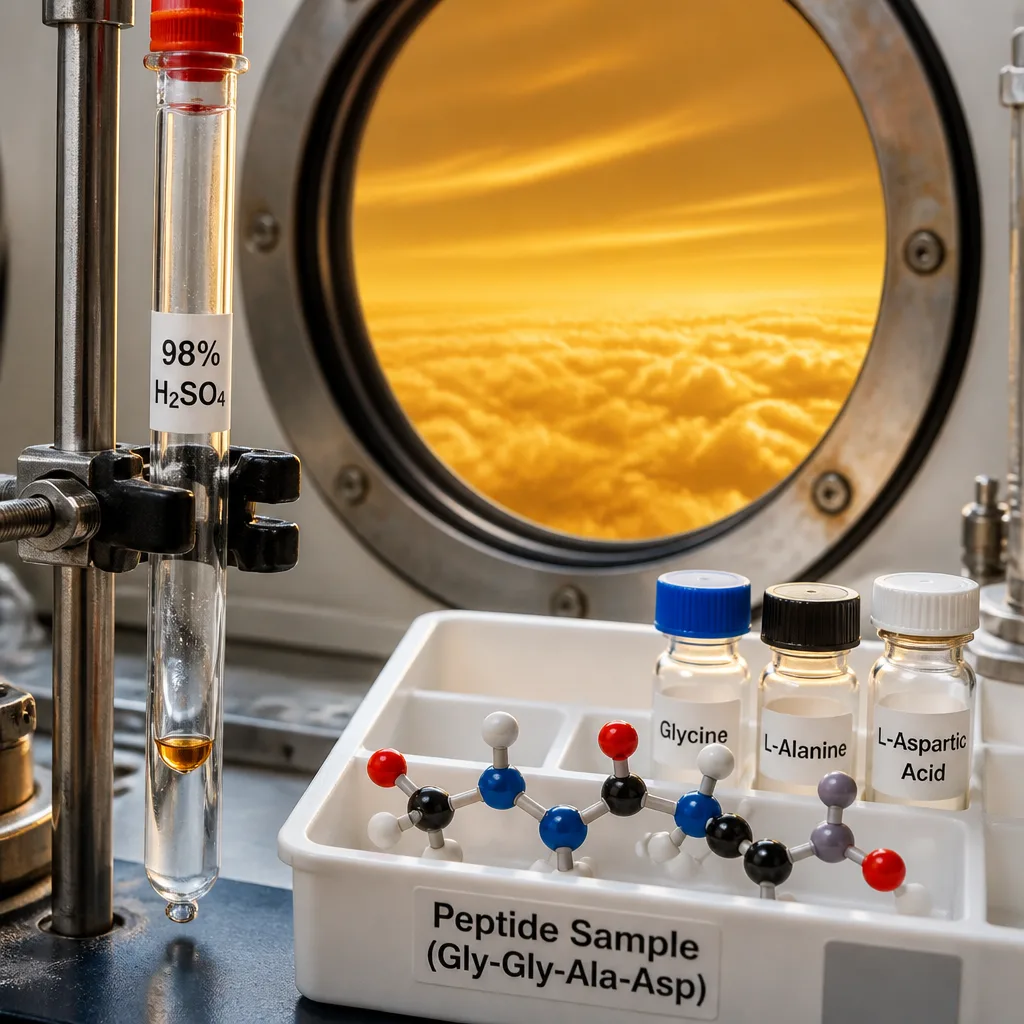
Laboratory experiments reveal that short peptides can persist and take on defined three‑dimensional structures in an environment designed to mimic the cloud droplets of Venus, challenging long‑held assumptions about the fragility of biological molecules in extreme acid.
Peptides endure in almost pure sulfuric acid
Researchers led by Massachusetts Institute of Technology chemistry professor Mei Hong and planetary scientist Sara Seager used nuclear magnetic resonance spectroscopy to follow the fate of three short peptides suspended in a solution that was 98 per cent sulfuric acid. Contrary to expectations, the molecules remained intact for weeks. The team reports this resistance to breakdown is largely due to the near absence of water, which prevents hydrolysis — the chemical reaction that normally severs peptide bonds.
Beyond simple survival, the peptides folded into a distinct conformation called an omega loop. Molecular shape governs potential function, so this structural stability suggests these sequences could, in principle, perform chemical roles within acid droplets high in Venus’s atmosphere.
“Before this, people thought that peptides couldn’t survive in sulfuric acid, so showing peptides are not only stable, but also fold, is a really big deal.”
Why this matters for Venus and astrobiology
Surface conditions on Venus are famously inhospitable: temperatures around 860°F and an atmospheric pressure about 93 times that of Earth render the ground deadly to life as we know it. But the planet’s cloud deck, roughly 30 to 40 miles above the surface, offers much milder temperatures while containing droplets dominated by sulfuric acid. Those droplets are continuously seeded by material delivered from meteorites, including organic molecules such as peptides.
The new findings complicate earlier conclusions. A 2024 study from members of the same group found that dipeptides — pairs of amino acids — decomposed rapidly in concentrated sulfuric acid. The contrast suggests molecular chain length and complexity could be decisive in whether organic molecules survive and remain functional in Venusian clouds.
- Method: nuclear magnetic resonance spectroscopy to monitor molecular structure.
- Environment modelled: 98% sulfuric acid, representative of Venus cloud droplets.
- Key observation: three short peptides remained intact for weeks and adopted omega‑loop folds.
Context, caveats and next steps
Laboratory simulations are indispensable but limited: they cannot fully reproduce the dynamic chemistry, radiation environment and microphysics of real Venusian aerosols. The experiments focused on a small set of peptides and probed stability over weeks; whether similar molecules could arise, persist and partake in more complex reaction networks within actual cloud droplets remains an open question.
The results do, however, broaden the range of chemical scenarios that astrobiologists must consider. If longer peptides or particular folded structures can resist acid‑driven decomposition, they might serve as scaffolds for further chemistry or catalysis inside droplets. That possibility reframes how scientists interpret both in‑situ measurements and remote observations aimed at detecting biosignatures or unusual chemical disequilibria in Venus’s atmosphere.
| Tested material | Acid concentration | Observed outcome |
|---|---|---|
| Three short peptides | 98% sulfuric acid | Remained intact for weeks; folded into omega loop |
| Dipeptides (2024 study) | Concentrated sulfuric acid | Broke down quickly |
Future work will need to expand the diversity of molecules tested, explore longer timescales and investigate how additional factors — such as trace water, oxidants, or ultraviolet irradiation — influence stability and folding. Those efforts will be crucial to judge whether the chemistry observed in the lab could plausibly be sustained in Venus’s acidic clouds.
For planetary scientists and mission planners, the takeaway is clear: the chemistry of extreme environments can be subtler than assumed. That nuance will inform both the design of instruments destined for Venus and the interpretation of any anomalous chemical signals those instruments may detect.