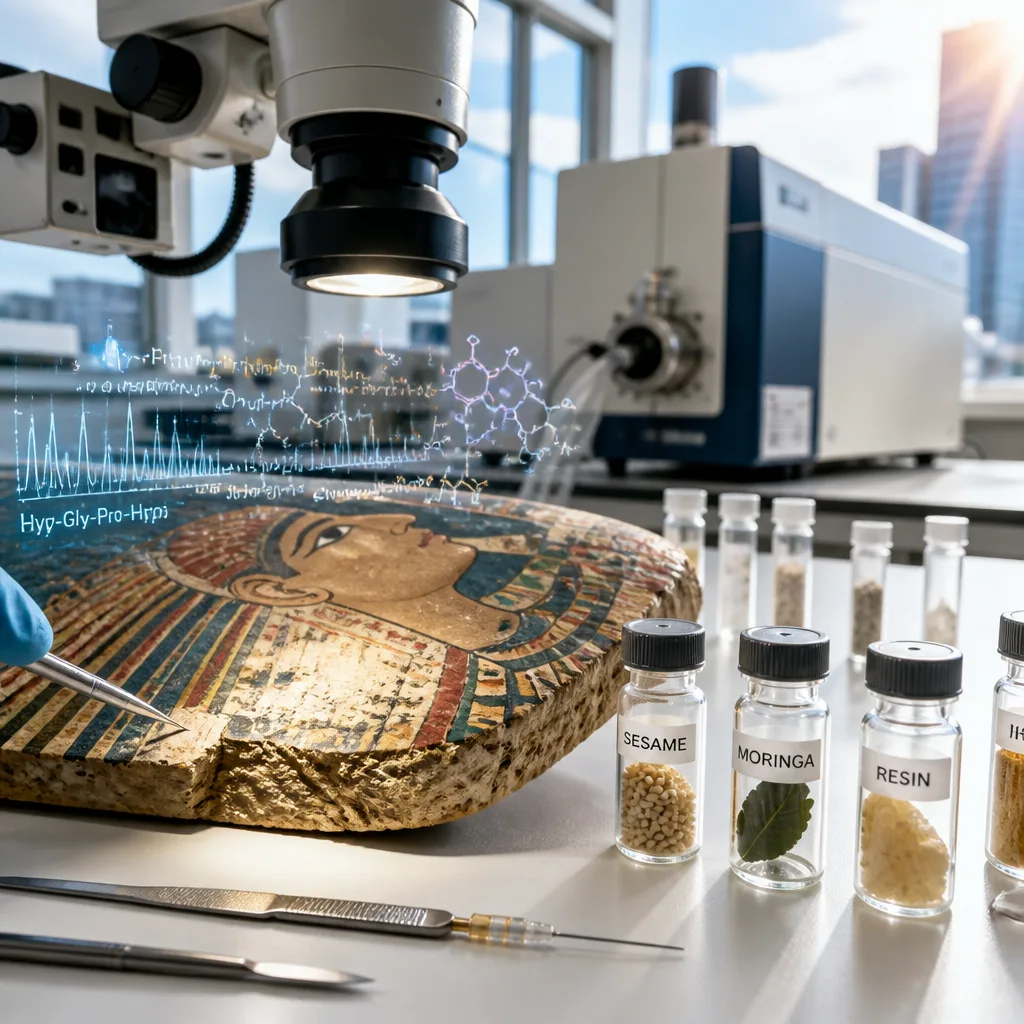
Scientists have decoded the organic recipes behind ancient Egyptian paints, finding a mix of animal-derived glues and unexpected plant additives such as sesame and moringa in microscopic samples taken from painted objects spanning more than a millennium.
Reading molecules left by artists
The research, published Aug. 26 in Science Advances, used paleoproteomics — the recovery and analysis of ancient proteins — coupled with mass spectrometry to break surviving proteins into peptides that act as biological fingerprints. The team examined 28 microsamples taken from 14 painted objects dated between about 1425 BCE and 400 CE, held in museum collections in London, Stockholm and Copenhagen.
Previous work on Egyptian colour focused heavily on pigments; this study turned attention to the substances artists added to make pigments adhere, prepare surfaces and glue pieces together. While animal glue long had been suspected, the protein-level analysis made it possible to identify which categories of animals were used and to detect non-animal components that have been largely overlooked.
Unexpected ingredients and their implications
Among the organic compounds detected were collagen-based glues consistent with heating hides, bones or other connective tissues. Alongside those expected animal products, the analysis revealed plant proteins consistent with sesame and moringa — ingredients that are not common in modern conservation narratives for Egyptian objects.
Those findings raise questions about the craftspeople’s choices. Were some additives selected for practical reasons, such as workability, drying properties or adhesion? Or did certain plant-derived materials carry symbolic or ritual associations — for example, a link between moringa and particular deities or workshop traditions? The study does not claim to resolve motives, but it opens new lines of inquiry for archaeologists and conservators.
- Method: Mass spectrometry of protein fragments (peptides) to identify biological sources.
- Material scope: 28 microsamples from 14 objects dated c. 1425 BCE–400 CE.
- Institutions: Objects drawn from the British Museum (London), Medelhavsmuseet (Stockholm) and Ny Carlsberg Glyptotek (Copenhagen).
| Parameter | Value |
|---|---|
| Number of microsamples | 28 |
| Painted objects examined | 14 |
| Date range of objects | c. 1425 BCE–400 CE |
Why this matters for science and conservation
Identifying the binders and adhesives used by ancient artists has practical consequences. Conservation treatments depend on knowing original materials so restorers can select compatible adhesives and cleaning methods. Misidentifying an organic component can lead to interventions that accelerate deterioration or obscure authentic surfaces.
Beyond conservation, the molecular inventory enriches our understanding of ancient workshops and their supply networks. Detecting sesame and moringa suggests either the use of locally available plant resources or trade in botanical materials; it may also reveal recipes transmitted within artisan communities. Because the protein evidence survives where other organic traces do not, paleoproteomics provides a powerful new window into the everyday technologies of the past.
The study demonstrates how modern biochemical tools can answer questions long framed by art historians and archaeologists. By decoding the ingredients that made pigments stick, researchers can more accurately reconstruct both the technical know‑how and the cultural choices of ancient craftsmen — and better protect their work for future generations.
The findings do not claim to settle whether certain ingredients had ritual meaning. Instead, they establish a chemical baseline that specialists can now test against archaeological, textual and iconographic evidence to explore links between material practice and belief.