VANCOUVER — Gold Strike Resources Corp. has finished its 2026 field program on the Gold Strike One (GS1) property in the Yukon, collecting hundreds of samples and completing a large airborne geophysics survey as the company seeks to sharpen drill targets near Snowline Gold’s Valley deposit.
Field work and a new outcrop
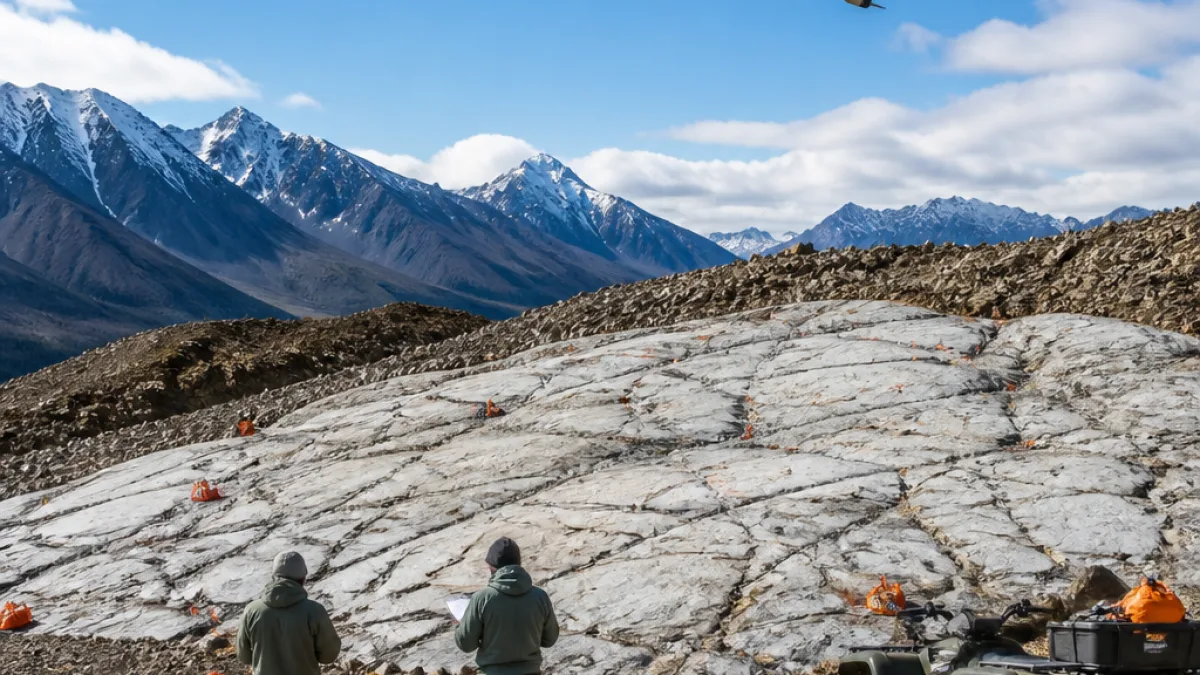
Between July and early August, Gold Strike crews gathered 134 rock and 374 soil samples across GS1, providing property-wide geochemical coverage. Field teams also uncovered a previously unmapped intrusive outcrop in the southeast corner of the claim block, about 100 metres by 100 metres in size. The company says it sampled the exposed outcrop where accessible and collected material from the talus apron for float analysis; laboratory results have not yet been released.
The intrusion is described in company material as plagioclase-rich with euhedral, lathy phenocrysts. It contains rare biotite and generally lacks mafic minerals. Trace to a few percent of subhedral interstitial pyrite is typical in the groundmass, with fractures showing 1-cm iron-oxide weathered selvages. Because much of the contact is obscured by scree and talus, the precise margins of the intrusion remain uncertain pending further mapping.
“Gold Strike has been busy over the past two months with some 40 people working on advancing our five properties in Yukon... GS1 is an important property for Gold Strike given its proximity to Snowline's Valley gold deposit and we are pleased that our field crews have completed our 2026 program on GS1 which includes the discovery of an intrusive outcrop that we have sampled. Results are pending.”
The comment was provided by Peter Miles, chief executive officer of Gold Strike Resources, in the company’s August update.
Airborne geophysics and next steps
Complementing the surface sampling, the company completed a 289.34 line-kilometre airborne survey flown on 100-metre line spacing. The survey included magnetic and radiometric sensors intended to augment both geological mapping and the geochemical data collected on the ground. As with the assays, interpretation and final products from the airborne work are still pending.
Gold Strike’s 2026 program at GS1 is part of a wider push across five Yukon properties the company is advancing this season: GS1, GS2, Florin, RJ and FLR. The firm said roughly 40 people were involved in field operations over the summer.
- Samples collected: 134 rock, 374 soil
- Airborne survey: 289.34 line-km, 100 m line spacing, magnetic and radiometric
- New discovery: ~100 × 100 m intrusive outcrop (southeast corner of GS1)
- Assays/geophysics: Results pending
Local context and significance
The GS1 property sits in a region that has seen renewed exploration interest following Snowline Gold’s discovery at the Valley deposit. Proximity to an active, nearby deposit tends to increase attention on surrounding tenure: exploration companies often seek similar host rocks, structural corridors and geochemical signatures that could indicate additional mineralisation.
In this case, the discovery of a previously unmapped intrusive with pyrite-bearing groundmass may be important for vectoring future work. The presence of plagioclase-rich intrusions and pyrite can be associated, in some geological settings, with hydrothermal systems that may localize gold. However, until assays and geophysical interpretation are returned, the significance of the outcrop for mineral potential remains unconfirmed.
What to expect from Gold Strike
Gold Strike told investors it expects an increase in news flow over the coming months as laboratory and airborne data are compiled and interpreted. Typical next steps in a program of this type would include detailed follow-up mapping, targeted trenching where permitted and, if warranted by geochemistry and geophysics, definition drilling to test subsurface continuity.
| Item | 2026 GS1 Program |
|---|---|
| Rock samples | 134 |
| Soil samples | 374 |
| Airborne survey | 289.34 line-km (100 m spacing) |
| New outcrop | ~100 × 100 m intrusive |
For communities and stakeholders in Yukon, updates such as this signal active fieldwork and potential for future exploration activity. Companies working on the land must continue to engage with local governments and Indigenous partners as projects evolve and more data becomes available.
Lab assays and the processed airborne survey will be key to judging whether the GS1 discovery warrants follow-up drill testing. Until those results are released, interpretations must remain provisional.
Reporting for WE NEWS, Kaylee Johns, Yukon Correspondent.