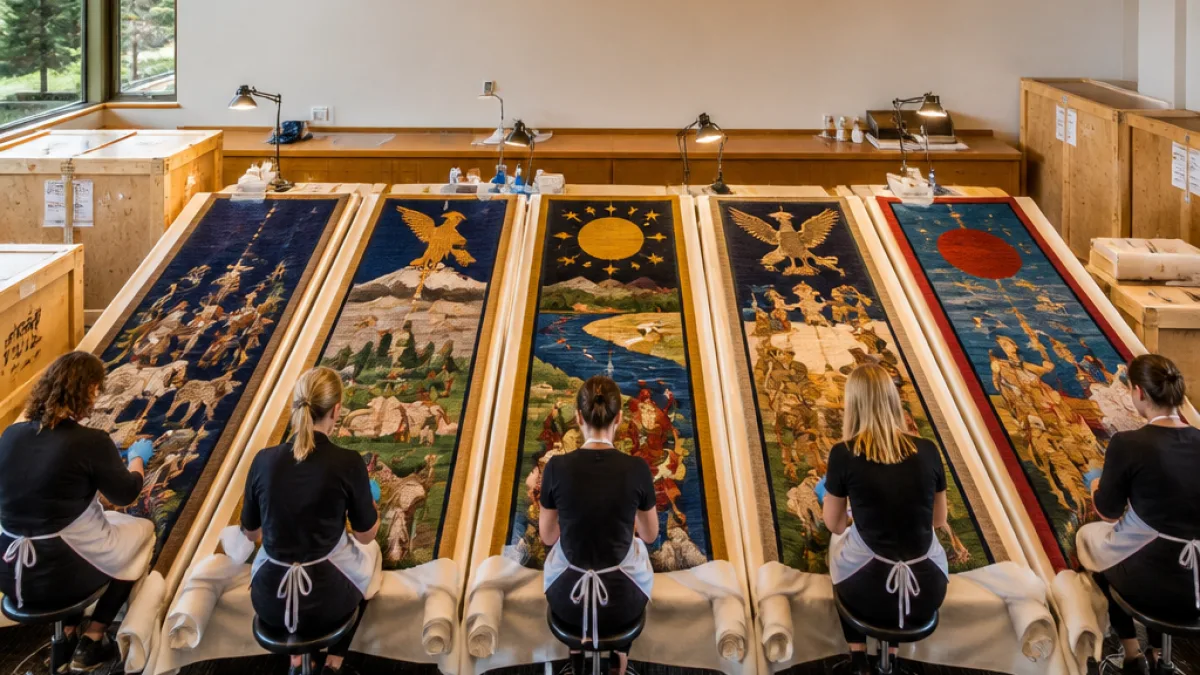
The five large, community-made panels known as the Women’s Tapestries have been removed from the Yukon Legislative Assembly’s members’ lounge for restoration, prompting the artists and volunteers who created them in the 1970s to call for broader public access once the conservation work is complete.
A community legacy taken down for protection
The territorial government confirmed the tapestries, which have hung on the lounge wall in Whitehorse since the 1970s, were taken down in late June when repairs were needed to the members’ lounge wall. Officials say the move presented an opportunity to clean and restore the woollen panels.
Each of the five panels measures about 2.1 by 3.9 metres and was stitched by thousands of volunteers from communities across the territory. The designs, led by artist Eve McBride, were intended to portray the strength of northern women: four panels depict the seasons and a fifth represents the period of breakup.
“These are works of art. They’re legacy. They’re a history of women that hasn’t been defined before,”
The comment came from McBride, who recently sought to view the tapestries in person and learned they had been removed for conservation. She was the lead designer of the project when it was created roughly 50 years ago.
Conservation work and what it involves
To clean the heavy woollen textiles, conservators place a screen over the tapestries and vacuum dust through the barrier — a method that reduces surface abrasion while removing accumulated particles. Officials have said the tapestries will be returned to display once the needed restoration and the lounge repairs are complete.
Details on the timeline for conservation and reinstallation were not provided by the legislature. The removal was framed as necessary protection while structural work proceeded on the assembly building.
Creators seek more public visibility
Those involved in designing and stitching the panels said the works are not only decorative but document a chapter of Yukon history centred on women’s lives and community effort. Because the tapestries have hung in the members’ lounge — an area not always open to the general public — some makers feel more Yukoners should be able to see them.
McBride and others emphasize the democratic, grassroots nature of the project: thousands of volunteers across the territory took part in producing the large-scale panels, a fact they say underlines the works’ communal significance.
Why the tapestries matter to Yukon
Artworks created through mass volunteer involvement become social archives as much as aesthetic objects. The Women’s Tapestries are both community-made and publicly owned, giving them a rare status as folk history preserved within a legislative setting. Their removal for conservation sparked conversation about stewardship and access — who gets to see and interpret this shared cultural heritage.
- Size of each panel: 2.1 x 3.9 metres
- Number of panels: Five
- Themes: Four seasons plus breakup
- Location until June: Members’ lounge, Yukon Legislative Assembly, Whitehorse
- Created: 1970s, by thousands of volunteers across Yukon
| Panel | Theme | Approx. size |
|---|---|---|
| 1 | Seasonal — Spring | 2.1 x 3.9 m |
| 2 | Seasonal — Summer | 2.1 x 3.9 m |
| 3 | Seasonal — Autumn | 2.1 x 3.9 m |
| 4 | Seasonal — Winter | 2.1 x 3.9 m |
| 5 | Breakup | 2.1 x 3.9 m |
Next steps and public interest
The territorial government says the artworks remain in its care and will be back on display after restoration. Creators hope that when they are rehung, arrangements will be made for easier public viewing or travelling exhibitions so that more Yukoners can connect with the project’s social history.
For now, the removal has revived conversations about how community-made art in public collections is conserved, displayed and interpreted. The tapestries are both a material object requiring careful preservation and a symbol of collective memory that many argue should be shared widely rather than confined to a restricted area of the legislative building.
As conservation proceeds, the questions raised by the makers — about access, interpretation and the place of community art in public institutions — remain central to how Yukon preserves and presents its recent cultural history.