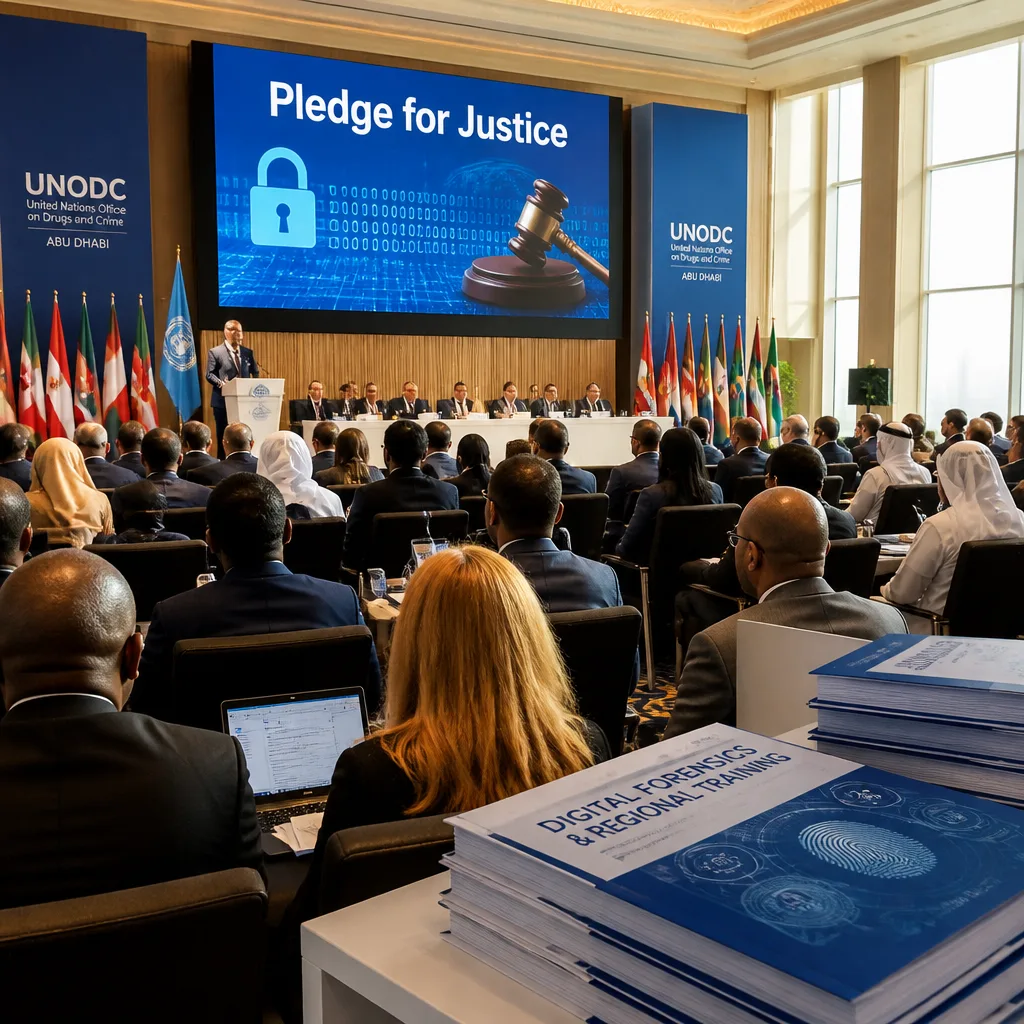
Counselor Mahmoud Helmy El‑Sherif, Egypt’s minister of justice, used the opening session of the United Nations Congress on Crime Prevention and Criminal Justice in Abu Dhabi to set out a comprehensive, five‑year framework aimed at bolstering criminal justice capacity and confronting emerging threats such as cybercrime and organised fraud.
New national framework for 2026–2031
Speaking at the conference convened by the United Nations Office on Drugs and Crime (UNODC), the minister described a plan labelled the “Pledge for Justice” for the Abu Dhabi cycle running from 2026–2031. The pledge outlines a range of legislative and institutional measures, including targeted strategies against organised crime and cybercrime, an expansion of digital forensics capacity, and the preparation of a legislative framework to address organised fraud.
El‑Sherif also highlighted domestic judicial reforms already under way, including the adoption of a new Code of Criminal Procedure, the digital transformation of court facilities, wider use of remote litigation, and strengthened protection measures for vulnerable groups. These initiatives, he said, dovetail with the presidential Hayah Karima (Decent Life) human development programme and are intended to advance both crime prevention and human‑rights objectives.
Regional centres and international partnerships
A central element of the pledge is capacity building through two proposed regional hubs. The plan would establish the Egyptian‑African Center for Training on Cybercrime Prevention and Combating and a Regional Training Center for Combating Illicit Trafficking in Cultural Property. Those centres are framed as platforms for regional cooperation and training in specialised areas of criminal investigation and preservation of cultural heritage.
El‑Sherif also said Egypt intends to conclude ratification procedures for the UN Cybercrime Convention and to strengthen ties with international bodies, including the European Union Agency for Criminal Justice Cooperation (Eurojust). He announced plans to update the Riyadh Arab Agreement for Judicial Cooperation and to expand coordination in fights against money laundering and terrorist financing.
| Key element | Primary focus |
|---|---|
| Pledge for Justice (2026–2031) | Organised crime, cybercrime, digital forensics |
| Regional training hubs | Cybercrime prevention; illicit trafficking in cultural property |
| Legislative steps | Ratification of UN Cybercrime Convention; new laws on organised fraud |
- Emphasis on modernizing penal and rehabilitation philosophy across correctional centres.
- Commitments to enhance protections for vulnerable populations and to expand remote litigation.
- Plans to deepen cooperation with international partners and judicial agreements in the region.
On the margins of the congress, the minister held bilateral discussions with UNODC Executive Director Ghada Waly and other international counterparts, according to Egypt’s account of the event.
Context and implications
The measures announced by Egypt align with a broader global focus at the congress on how digital technologies reshape both criminal activity and criminal‑justice responses. Member states at the session have been debating how to reconcile human‑rights safeguards with stronger technical capacity to investigate cross‑border cybercrime, and how best to support developing countries in building forensics and investigative infrastructure.
Egypt’s pledge — combining domestic legal reform, investment in digital forensics and regional training hubs — signals an approach that mixes internal modernisation with external cooperation. The proposed ratification of the UN Cybercrime Convention would further integrate Egypt into international legal instruments governing digital investigations, while partnerships with agencies such as Eurojust are aimed at improving operational co‑ordination on transnational cases.
Delegates at the congress will be watching how pledged programmes are funded and implemented, and whether regional training centres can translate into measurable improvements in cross‑border investigations and protection of cultural property — an issue of growing concern as illicit trafficking continues to threaten heritage sites.
The UNODC‑led congress continues through the week, providing a venue for member states and agencies to negotiate technical cooperation, adopt political commitments and map out legal frameworks for the next five years.