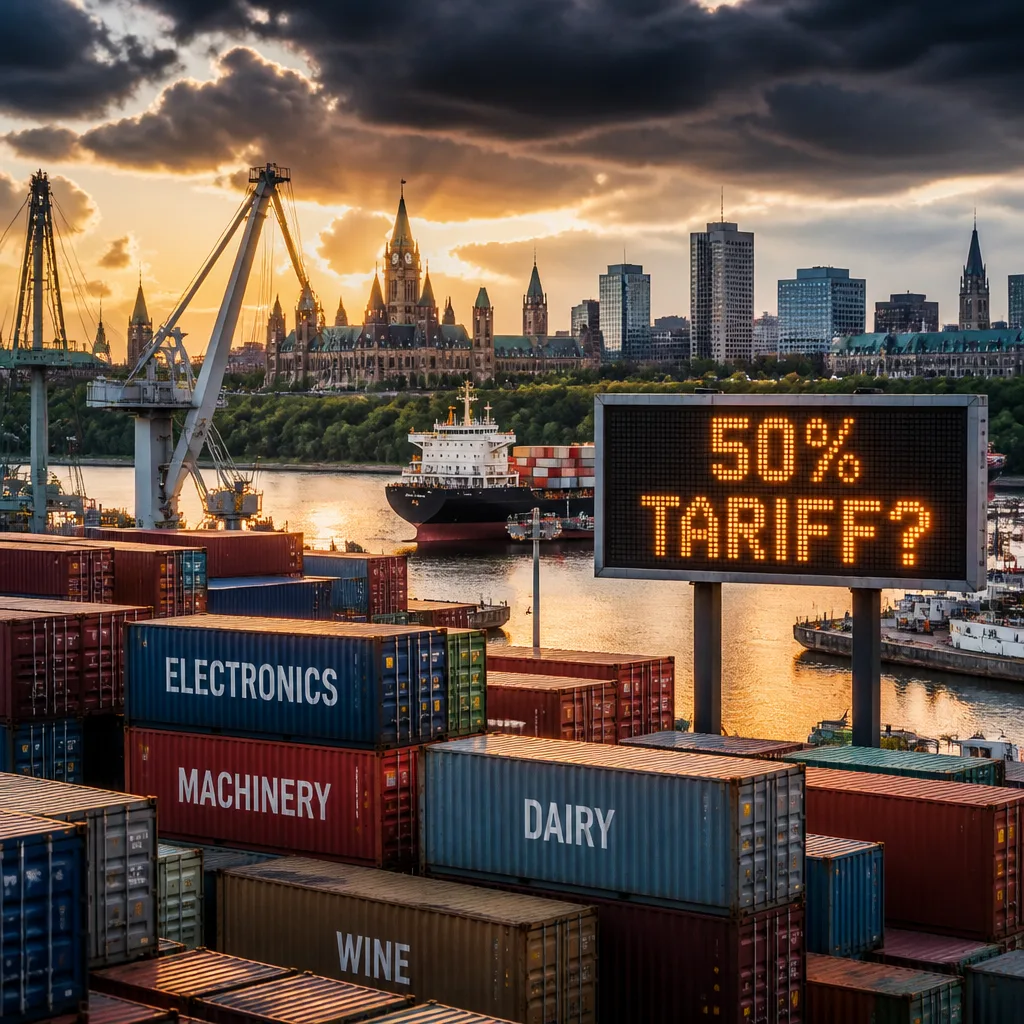
Canada is locked in urgent negotiations with the United States to try to prevent steep tariffs that, if implemented, would impose a 50-per-cent duty on a wide swath of Canadian exports, including electronics, machinery, furniture, dairy and wine.
Scope and stakes
The proposed measures, launched by the U.S. under a rarely used legal authority, would apply to goods that currently qualify for duty-free treatment under the United States–Mexico–Canada Agreement (USMCA). About $20.2 billion of Canadian exports — roughly 5 per cent of what the United States imports from Canada — are said to be at risk, according to the Center for Strategic and International Studies.
| Metric | Value |
|---|---|
| Estimated value of affected Canadian exports | $20.2 billion |
| Share of U.S. imports from Canada | ~5% |
| Proposed tariff rate | 50% |
Who would feel the impact
Analysts warn the tariffs would not be limited to a narrow set of manufacturers. The Ottawa-based domestic fallout could reach small businesses and self-employed Canadians whose sales depend on U.S. buyers.
- Electronics and industrial machinery manufacturers
- Furniture producers
- Dairy and alcoholic beverage exporters, including wine
- Smaller producers such as flower bulb growers and beekeepers
Julian Karaguesian, a trade lecturer at McGill University, said the proposed duties, if put in place, would make hundreds of Canadian goods uncompetitive in the U.S. market.
“Tariffs of 50 percent would effectively price hundreds of Canadian goods out of the US market.”
Legal and political context
The tariffs are tied to an invocation of Section 338 of the Tariff Act of 1930, marking the first use of that provision in this manner. Their application to USMCA-covered goods is notable because the three-party trade deal — ratified during the previous U.S. administration — preserved tariff-free treatment for large swathes of North American trade, allowing an estimated 85 per cent of U.S.–Canada commerce to remain duty free despite earlier punitive measures on steel and autos.
Ottawa is simultaneously managing a diplomatic and commercial response: negotiations to avert the duties are proceeding under a tight timetable, and officials face the dual challenge of protecting market access while avoiding a sharp escalation with the United States at a politically sensitive moment.
Economic consequences and vulnerabilities
Because the tariffs would be applied broadly, effects could cascade through supply chains. Industries that rely on cross-border inputs and just-in-time logistics could see higher costs and lost orders. The hit would not be uniform: medium-sized enterprises and exporters with thin profit margins are likely to be most vulnerable, but larger firms and sectoral clusters could also suffer sustained market-share losses if access to U.S. buyers is curtailed.
At the national level, the pressure on federal trade and industry policy will intensify as negotiators push for exemptions or a last-minute accord. The outcome will shape not only near-term export revenues but also longer-term confidence among investors and producers who depend on integrated North American supply chains.
For now, Ottawa and Washington are racing against a deadline. The result will test both the resilience of Canadian exporters and the durability of the trade frameworks that have governed the bilateral relationship for decades.