
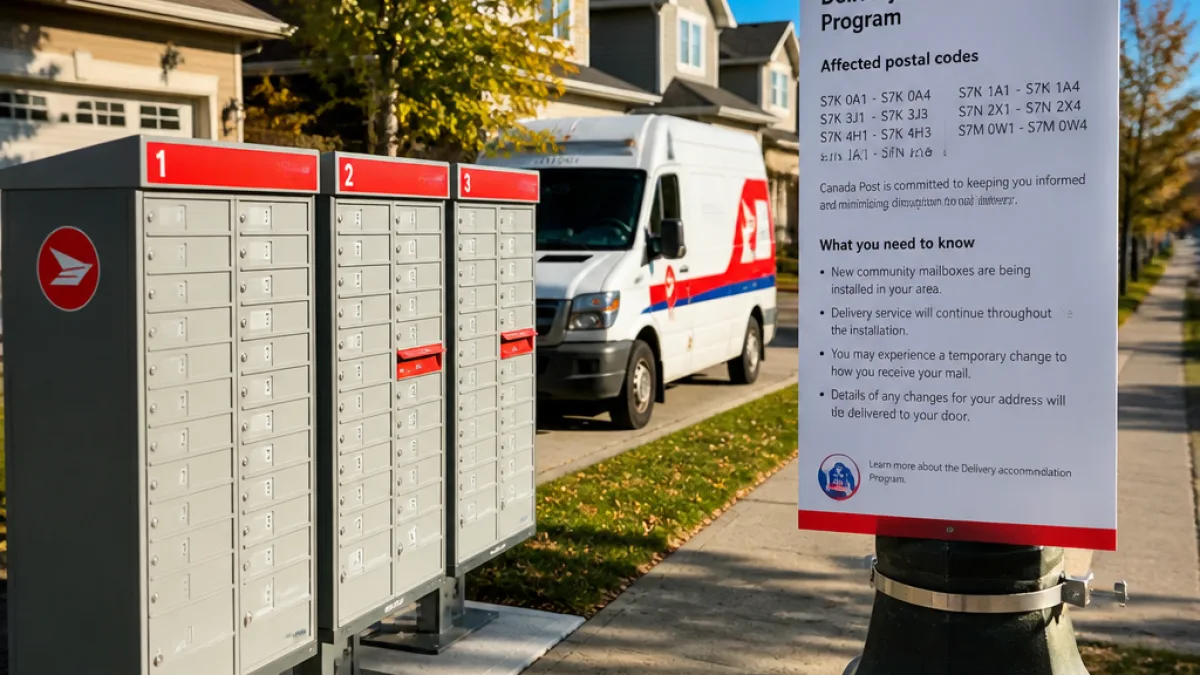
Canada Post says door-to-door delivery in Saskatchewan’s two largest cities will be replaced with community mailboxes, affecting a combined total of roughly 45,000 addresses in Saskatoon and Regina as part of a nationwide conversion that will touch four million Canadian locations.
What is changing
Under the announced plan, approximately 21,000 addresses in Saskatoon (postal codes starting with S7L and S7M) and about 24,000 addresses in Regina (postal codes beginning with S4V, S4N and S4S) will move from home delivery to community mailboxes. Canada Post expects the transitions in those two cities to occur by October 2027.
Reasoning from Canada Post
In its statement, Canada Post framed the conversions as part of a broader effort to modernize the postal service and improve financial sustainability. The Crown corporation said the switch would improve security by keeping most mail and parcels locked and would reduce costs because doorstep delivery is costlier than delivery to cluster boxes.
“The move to community mailboxes will increase security by putting nearly all mail and parcels delivered by Canada Post under lock and key. It will also reduce costs, as delivering to the door costs significantly more than to a community mailbox.”
The company’s public materials call the conversions a key element of its plan to modernize the postal service and help return the organisation to financial self-sustainability.
How residents will be notified and who gets help
Canada Post says affected households will be notified as the conversion approaches. The Crown corporation also pointed to the Delivery Accommodation Program for people with “functional limitations,” allowing those residents to apply for alternate delivery arrangements.
That program is intended to ensure accessibility for people who cannot reasonably retrieve mail from community boxes. Canada Post has previously required documentation and assessment for such accommodations; the company says it will continue to offer those services as conversions proceed.
Numbers at a glance
| Location | Estimated addresses moved |
|---|---|
| Saskatoon | 21,000 |
| Regina | 24,000 |
| Canada (total) | 4,000,000 |
Local context and concerns
The conversion follows a wave of changes at Canada Post as it tries to cut costs following years of financial pressure. For residents, the move will mean walking to a community mailbox to pick up letters and parcels rather than receiving deliveries at the front door.
Community mailboxes are already common in many neighbourhoods, but the scale of the planned conversions in Saskatoon and Regina means whole swathes of residential streets will see their delivery model replaced. Practical questions for residents include where new cluster boxes will be sited, whether there will be lighting or shelter at those locations, and how delivery schedules for parcels will be managed.
Officials also say the shift will affect parcel security: lockable cluster boxes and parcel lockers aim to reduce theft. But some residents worry about safety walking to boxes at night, distance for older adults or people with mobility issues, and how the change will interact with winter conditions in the Prairies.
What residents should do now
- Watch for official notification from Canada Post outlining timelines and locations for new community mailboxes.
- If you have mobility or other functional limitations, consider applying to the Delivery Accommodation Program to see if alternate arrangements are available.
- Raise local concerns with municipal councillors if you want information about mailbox siting, lighting or access in your neighbourhood.
Canada Post has said the conversions will roll out in phases across 55 Canadian communities. As the process moves forward, Saskatoon and Regina residents will be watching for specifics about mailbox placement, timelines and the accommodation process to ensure vulnerable residents are not left behind.
This change represents a significant shift in daily routines for tens of thousands of people across Saskatchewan’s two largest cities. The coming months should clarify how the Crown corporation will manage the logistics and address community concerns as it implements the nationwide plan.