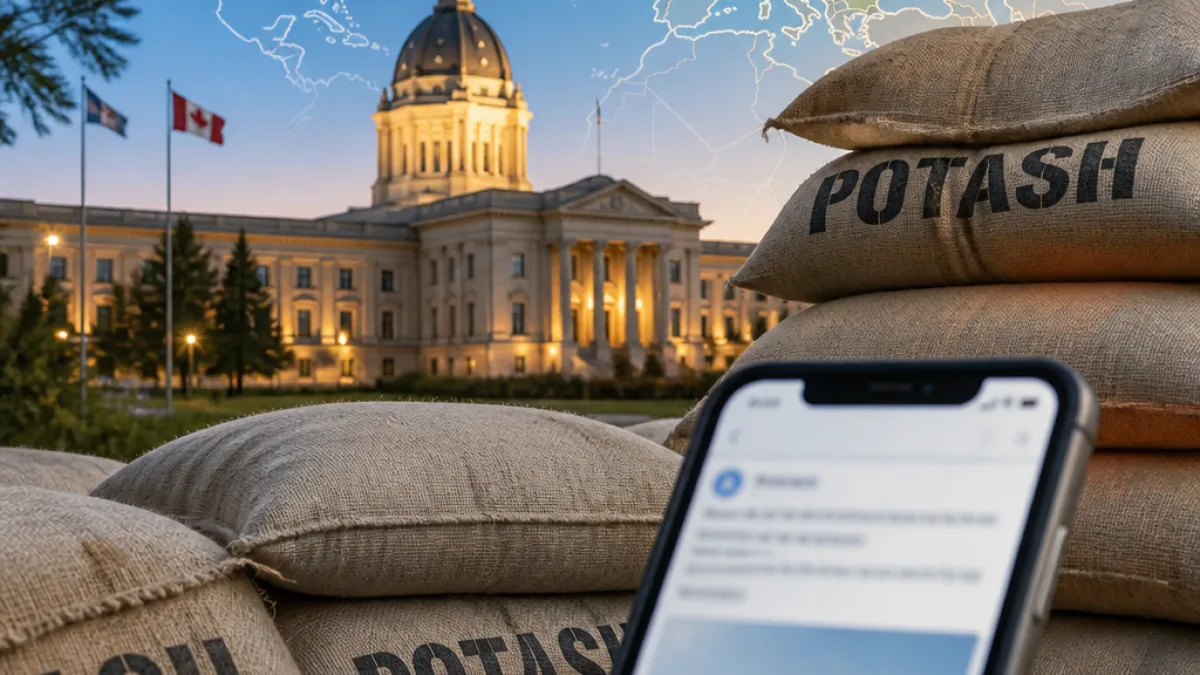
Saskatchewan Premier Scott Moe publicly challenged recent comments by U.S. President Donald Trump about buying fertilizer-grade potash from Belarus, saying such purchases would support aggression and would not be in the interests of North American farmers.
Premier frames the issue as both moral and practical
Moe posted on social media Monday that buying what he called "blood potash" from Belarus would amount to supporting Russian aggression. The premier argued the decision would be neither ethical nor economically sensible when potash is readily available from Saskatchewan, where all of Canada’s active potash mines operate.
"The United States is working on a massive Deal with respect to the purchase of Potash from Belarus,"
The quoted comment was made by President Trump on Truth Social earlier the same day as Moe’s response. In his post, Trump said the pricing from Belarus would be "substantially less" than what the U.S. pays Canada and called the potential deal "very good news for our Farmers and Ranchers."
Why potash matters to Saskatchewan
Potash is a primary ingredient in fertilizer and a major export commodity for Saskatchewan. According to federal figures cited by Moe, nearly a third of global potash production in 2024 came from Canada, and the nation’s 10 active potash mines are all located in Saskatchewan.
Major companies named in provincial reporting include Nutrien Ltd., The Mosaic Company, Compass Minerals and K+S Potash Canada, which together account for Canadian production and exports. Moe used those facts to underline his argument that North American supply chains can meet farmers’ needs without turning to countries under sanctions.
Sanctions and geopolitical context
Moe noted that more than 40 countries, including Canada and its allies, have imposed sanctions on Belarus for its role backing Russia’s invasion of Ukraine. He suggested sourcing potash from Belarus — potentially shipped through Russia — would contradict those sanctions and the broader policy of isolating governments accused of supporting aggression.
- Ethics: Moe framed the choice as supporting or abetting a sanctioned regime.
- Economics: He questioned whether Belarusian product could actually be cheaper, more sustainable or more reliable than Saskatchewan supply.
- Supply chains: The premier emphasised the advantages of North American production and proximity for farmers.
What the provincial message means for producers and buyers
The premier’s comments put a spotlight on the intersection of trade policy and geopolitics for an industry that underpins fertilizer availability worldwide. Saskatchewan producers supply a significant share of global potash, and the province’s labour and equipment sectors are closely tied to those operations.
While Moe did not outline specific policy actions in his post, his remarks are likely aimed at both protecting domestic producers and signalling to international buyers that Saskatchewan product comes from a market not encumbered by the sanctions that many Western countries have placed on Belarus and Russia.
| Fact | Detail |
|---|---|
| Canadian share of global potash (2024) | Almost one-third |
| Active potash mines in Canada | 10 (all in Saskatchewan) |
Questions left unanswered
The federal government and international buyers decide trade deals, and the premier’s statement stops short of any formal request to Ottawa. It also does not address the specifics of how a Belarus deal would be carried out logistically or legally, or whether sanctions enforcement would be implicated depending on the routing and ownership of the product.
For Saskatchewan residents, the exchange between the province’s top elected official and the U.S. president underscores the global importance of a resource dug and processed largely on the prairies. The statement is likely to be watched closely by potash companies, union representatives, farm organisations and trade partners as the discussion over supply and sourcing continues.
Any further developments from the federal government, U.S. officials or the potash companies themselves will shape how this dispute over supply, price and principle unfolds.