
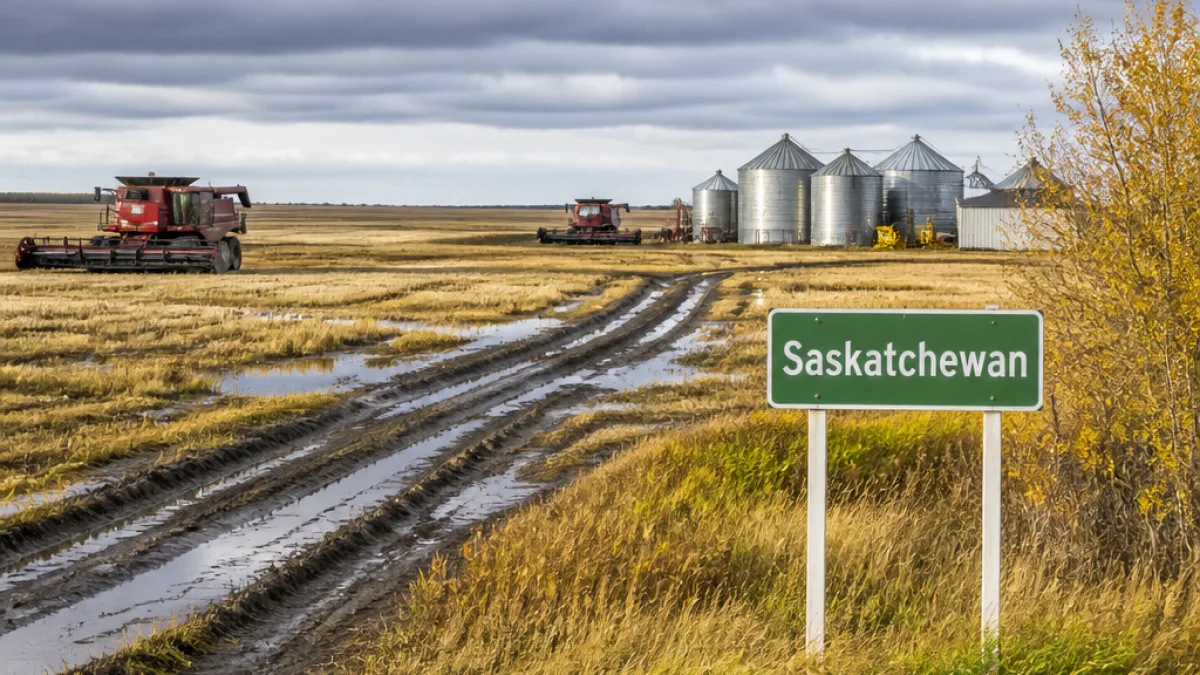
Widespread rain across Saskatchewan pushed harvest progress back this week, with provincial figures showing just 32 per cent of crops combined as of the week ending Sept. 14 — a pace well behind recent years.
Harvest well behind
The provincial crop report said harvest advanced only modestly, increasing by about five percentage points over the previous week. That places this year’s progress 21 points behind the same time last year and 39 points below the five‑year average.
Rainfall varied widely across the province. The Rural Municipality of Sarnia, northwest of Moose Jaw, reported the heaviest single‑site accumulation at 97 millimetres for the week.
Where the combines are
Progress differed sharply by crop. Early and winter cereals are mostly off the fields while spring cereals, oilseeds and pulses show a broad range of completion.
| Crop | Per cent harvested |
|---|---|
| Fall rye | 98% |
| Winter wheat | 93% |
| Triticale | 89% |
| Barley | 47% |
| Durum | 46% |
| Oats | 19% |
| Canary seed | 18% |
| Spring wheat | 17% |
| Canola | 15% |
| Soybeans | 7% |
| Flax | 5% |
| Lentils | 88% |
| Field peas | 84% |
| Chickpeas | 26% |
Regional variation
Harvesting is considerably further along in the southwest compared with the north. Regional completion rates were reported as:
- Southwest: 60% complete
- Southeast: 36%
- West‑central: 27%
- East‑central: 18%
- Northwest: 12%
- Northeast: 9%
Quality and grading
Quality is uneven across the province as differences in moisture through the growing season show up in grading results. Several key pulse and cereal classes are grading below their 10‑year averages.
- Field peas: 30% graded as 1 Canada, versus a 10‑year average of 42%.
- Lentils: 17% graded as 1 Canada, compared with a 10‑year average of 31%.
- Durum: 23% graded as 1 Canada Western versus a 10‑year average of 39%.
- Barley: 18% graded as malt compared with a 31% average; 53% graded 1 Canada Western (near the 51% average).
Soil moisture and implications
Topsoil moisture improved after the rains, with the report indicating most cropland now rated adequate or surplus. The provincewide breakdown for topsoil reads:
| Land type | Surplus | Adequate | Short |
|---|---|---|---|
| Cropland | 34% | 63% | 3% |
| Hayland | 21% | 74% | 5% |
While extra moisture can aid late‑season crop fill and benefit pastures, it also slows combining and raises the risk of quality loss from sprouting, staining or disease in standing crops. For many producers the immediate challenge is timing: balancing the benefits of waiting for better dryness against the hazards of more rain.
What this means for farmers and markets
With harvest trailing both last year and the five‑year norm, bin space, delivery scheduling and crop storage will move to the forefront for many operations. Grain companies and co‑ops could face tighter delivery windows once combines return to more continuous work, and spot premiums or basis values may shift as flows change.
For producers, keeping close contact with buyers, watching local grain moisture and quality numbers, and planning logistics for trucking and drying remain practical steps. The abrupt regional contrasts in maturity and harvest progress mean neighbours can be in very different positions from one another this fall.
Provincial crop reports will continue to track progress and quality as crews push through fields in the weeks ahead.