
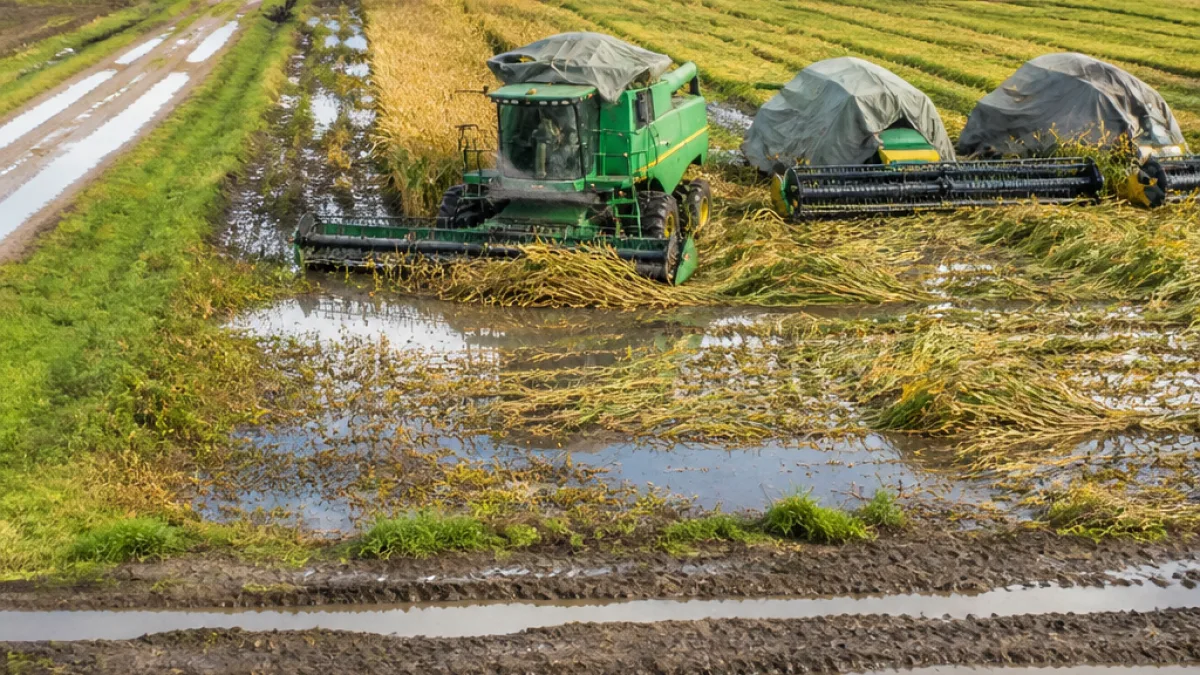
Widespread rain across Saskatchewan last week nudged seasonal harvest forward only slightly, leaving producers well behind the usual pace and creating a mixed picture for crop quality, according to the provincial crop report for the week ending Sept. 14.
Harvest pace far behind average
The report shows the provincial harvest was 32 per cent finished — a gain of five percentage points from the previous week but still 21 points behind this time last year and 39 points below the five‑year average. The slow advance reflects wet conditions that delayed fieldwork across most of the province.
One area, the Rural Municipality of Sarnia (about an hour north of Moose Jaw), recorded the heaviest rainfall with 97 millimetres during the period — a reminder that totals varied widely and so did the ability of producers to get into fields.
Progress differs sharply by commodity
Harvest progress by crop showed wide variation depending on crop type and region. Hardier winter cereals and pulses led the way, while many spring cereals, oilseeds and flax remained largely in the field.
| Crop | Per cent complete |
|---|---|
| Fall rye (winter cereals) | 98% |
| Winter wheat (winter cereals) | 93% |
| Triticale (spring cereal) | 89% |
| Barley | 47% |
| Durum | 46% |
| Oats | 19% |
| Canary seed | 18% |
| Spring wheat | 17% |
| Canola | 15% |
| Soybeans | 7% |
| Flax | 5% |
| Lentils | 88% |
| Field peas | 84% |
| Chickpeas | 26% |
| Mustard | 51% |
Regional differences reflect wet and dry pockets
Regionally, the southwest reported the most advanced progress at 60 per cent complete. Other regions trailed considerably:
- South‑east: 36%
- West‑central: 27%
- East‑central: 18%
- North‑west: 12%
- North‑east: 9%
The contrasting regional numbers underscore how local weather — particularly heavy rains in certain RMs — shaped who could harvest and who had to wait. Even a short bout of rain can close fields where soils have been softened, and that slows a large portion of harvest activity in short order.
Quality uneven; some grades below long‑term averages
Grain quality also varied. The report indicates yields and grading have been affected by uneven moisture through the season:
- Field peas: 30 per cent graded 1 Canada, versus a 10‑year average of 42 per cent; 61 per cent graded 2 CAN versus a 51 per cent average.
- Lentils: 17 per cent graded 1 CAN compared with a 10‑year average of 31 per cent; 70 per cent graded 2 CAN versus an average of 52 per cent.
- Durum: 23 per cent graded 1 Canada Western and 28 per cent 2 CW; the 10‑year average for 1 CW is 39 per cent.
- Barley: Only 18 per cent graded as malt versus a 31 per cent average; 53 per cent graded 1 Canada Western compared with a 51 per cent average.
These shifts in grade distribution matter for farm revenue. Lower malt barley and durum grades can shift product into lower‑value markets, and pulses graded down from top grades can affect contracts and pricing.
Soil moisture mostly adequate after the rain
The rains increased topsoil moisture across the province. On cropland, the report listed 34 per cent as surplus, 63 per cent adequate and three per cent short. Hayland showed 21 per cent surplus, 74 per cent adequate and the remainder short.
For producers, the immediate questions will be whether fields dry enough for combines and whether quality erosion continues where crops were mature when wet weather arrived. With harvest lagging the five‑year average by nearly 40 points, the calendar is now a part of the calculation as harvest and frost risk overlap into the autumn weeks ahead.
Provincial figures provide a broad snapshot; local conditions remain the deciding factor for individual farms. Farmers and elevator operators are watching weather reports closely over the coming days as they plan equipment and marketing moves to protect yield and quality.
— Hayley Friesen, WE NEWS Saskatchewan correspondent