
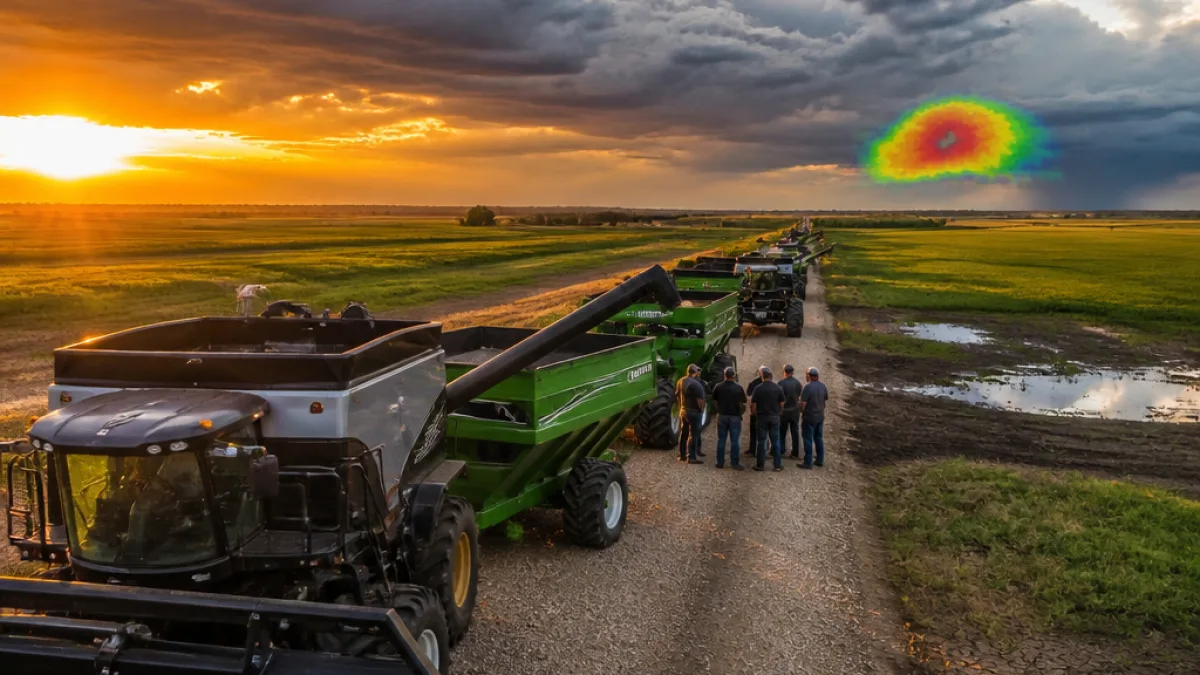
Prince Albert — With combines poised and crews on standby, Saskatchewan farmers are balancing optimism and caution as harvest begins after a season marked by both too much water and not enough.
Mixed growing season leaves patchwork of results
On family-run acres east of Prince Albert, one producer says crops are looking “relatively good,” but the scars of a variable season remain. Early summer rains inundated some low-lying fields, while a dry spell in July reduced yield potential in other areas.
“We do have a significant amount of farmland that was flooded in the early season rains. Significant crop damage and yield loss occurred from those rains,” said Ryan Scragg, a farmer about 20 minutes east of Prince Albert and a director with the Agricultural Producers Association of Saskatchewan for District 5.
Scragg grows a roster of Prairie staples — canola, wheat, barley, oats and peas — and also serves as Reeve of the RM of Garden River. He said timing of moisture has been critical: while the July dry stretch hurt potential yields, it helped dry out saturated ground and improved access for harvest equipment.
Early harvest progress and the role of the weather
The provincial crop report for the period Aug. 4 to 10 showed harvest progress at 2 per cent complete, largely confined to cereals and early-seeded pulse crops. For many producers, peas will be the first off the fields.
“We should be starting to harvest our peas within the next week here, which is about normal time for us to start,” Scragg said. “Our other crops like the wheat and canola are still several weeks away.”
He added that recent rain has not substantially changed outcomes on his land because most crops are past the point where additional moisture would boost final yields. “It’s at the point where now we want the crop to start ripening up,” he said, noting canola remains an exception because it can still respond to later moisture.
What farmers are watching)
Producers across the province are monitoring:
- short-term forecasts for warm, dry weather to speed ripening;
- localized soil moisture and the condition of previously flooded fields;
- field access and the ability to run combines and grain trucks without causing further damage.
Even where crops survived early flooding, subsoil damage and patchy stands can reduce yields, meaning some fields will require selective harvesting or alternative management during the off-season.
| Metric | Value |
|---|---|
| Provincial harvest progress (Aug. 4–10) | 2% |
| Primary early harvest crops | cereals, early-seeded pulses (peas) |
Local impacts and practical considerations
Beyond yields, weather-driven variability affects timing for custom harvesters, storage logistics and delivery windows at grain terminals. Farmers who face patchy fields often adjust by prioritizing straight-cut and swathed acres differently and by coordinating crews to take advantage of narrow windows of favourable weather.
For communities that depend on agriculture for local employment and services, an uneven harvest can ripple through labour demand, fuel and repair services, and short-term cash flow for farm operations.
Looking ahead
Producers will keep watching both short-range forecasts and the longer-term outlook through August and into September. For many, the next few weeks will determine whether a difficult season produces reasonable returns or whether flood-damaged acres and heat stress will cut deeply into yields.
As harvest ramps up, farmers and local officials say safety will also be a priority: lowered grain truck speeds on rural roads, equipment maintenance to avoid breakdowns during peak demand, and clear communication between farmers and custom operators.
The coming weeks will show how well Saskatchewan’s mixed season translates into bin-busting yields or tighter supplies. For now, producers remain pragmatic — ready to work when weather and field conditions allow.