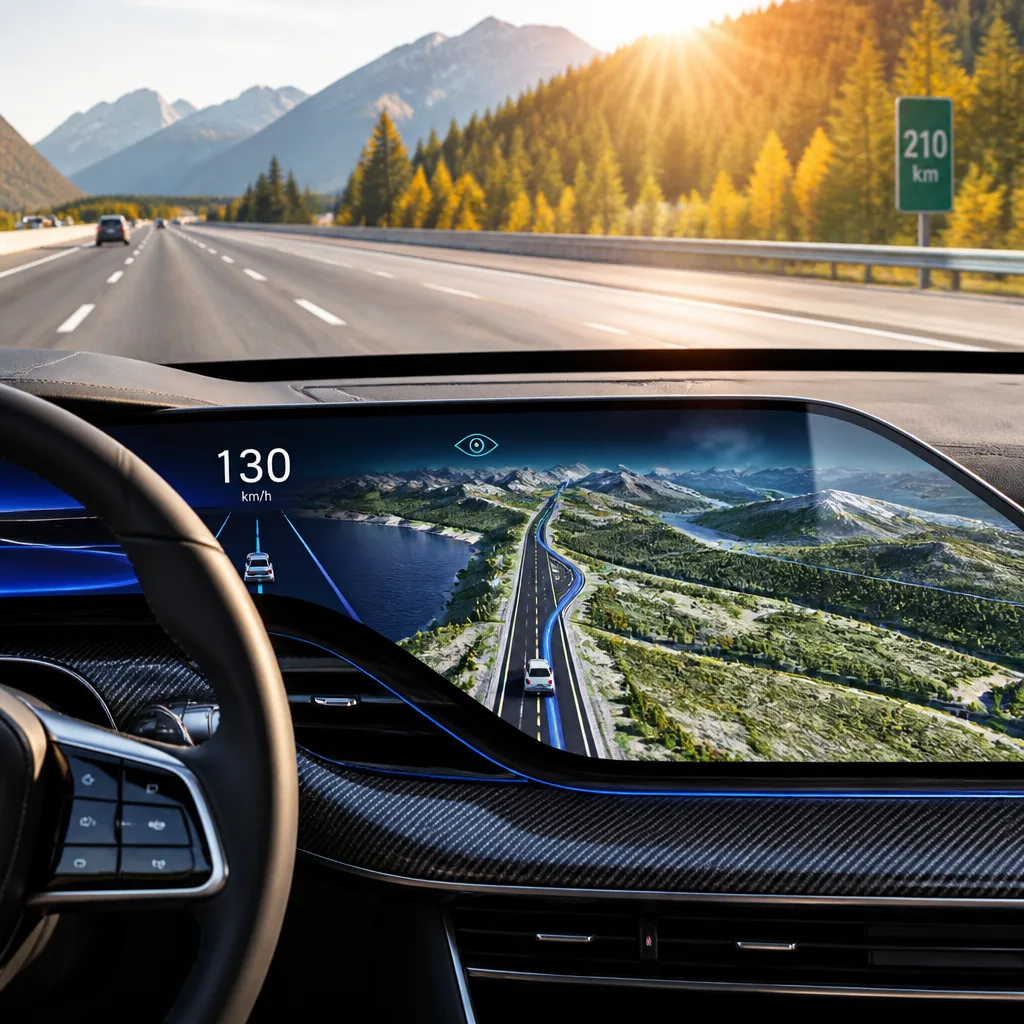
BMW said it will merge navigation and driver-assistance visuals into a single three-dimensional map display, a change that the company says aims to make advanced driver-assistance systems easier to understand and to help pave the way toward higher levels of automation. The feature, called BMW Maps with Driver Assistance, will appear on vehicles running Operating System X beginning in October 2026 and was developed in partnership with mapping provider Mapbox.
What the new display does
Rather than separating turn-by-turn guidance and assistance-system status across different instruments or head-up displays, BMW Maps with Driver Assistance will render the vehicle’s lane position and assistance prompts inside the same 3D map used for navigation. BMW positions the change as more than cosmetic — the integrated visuals are intended to link navigation data and active-safety systems so they operate in concert.
"An important step toward highly automated driving is the intelligent interaction between navigation and driver assistance," said Stephan Durach, senior vice-president of digital services, infotainment and connected company at BMW Group.
Highway use and hands-free driving
The most concrete capability tied to the new display is on highways. BMW says its Highway Assistant will use the shared 3D view to support hands-free driving up to 130 km/h (81 mph). The assistant can also carry out automated lane changes after the driver confirms the manoeuvre with a glance, rather than by a steering input. BMW already offers a hands-free highway mode with gaze-confirmation lane changes on select models; the new maps approach brings the driver-assistance prompts directly into the navigation view.
Why integration matters
Automakers have long presented navigation and driver-assistance information on different screens: a central infotainment map for routing and a cluster or head-up display for active-safety status. BMW argues that presenting both in the same 3D context reduces ambiguity about why the vehicle plans to change course or make a manoeuvre, and should help drivers understand system behaviour more quickly. The company frames the work as part of its long-term automated driving strategy by improving how systems interact and communicate intent.
- Feature name: BMW Maps with Driver Assistance
- Platform: BMW Operating System X
- Partner: Mapbox
- Availability: Rolling out from October 2026
- Highway capability: Hands-free driving up to 130 km/h with gaze-confirmed lane changes
Practical implications
For drivers, the immediate change is visual: a single, richer 3D environment that aims to show both routing and assistance intent. For regulators and safety analysts, the change will raise questions about how effectively the combined display communicates system limitations and driver responsibilities — particularly in situations where hands-free operation is offered but full autonomy is not. For the wider industry, BMW’s move highlights how mapping companies and automakers are converging on tighter integration between navigation datasets and active-safety logic.
| Item | Detail |
|---|---|
| Maximum hands-free speed | 130 km/h (81 mph) |
| Driver confirmation for lane change | Gaze (look confirmation) |
| Release window | Starting October 2026 |
BMW’s announcement does not change the underlying safety and legal framework: drivers remain responsible for supervising driver-assistance systems where required by law and by the systems’ operating rules. But by pulling navigation and assistance into a single visual plane, BMW is betting that clearer intent signalling will improve driver comprehension and make semi-automated features easier to use.
Whether that pays off in safer road outcomes or better uptake of driver-assistance functions will depend on execution — both in the quality of the 3D mapping and on the effectiveness of driver monitoring when the car requests confirmation. The partnership with Mapbox suggests BMW is relying on third-party mapping expertise to render the combined view, while retaining control over how assistance behaviours are presented and triggered.
The October 2026 rollout will be the first real-world test of the idea across the vehicles that get Operating System X. Observers and regulators in Canada and abroad will likely watch to see if the single-view approach reduces driver confusion or, conversely, consolidates too much information in one place.