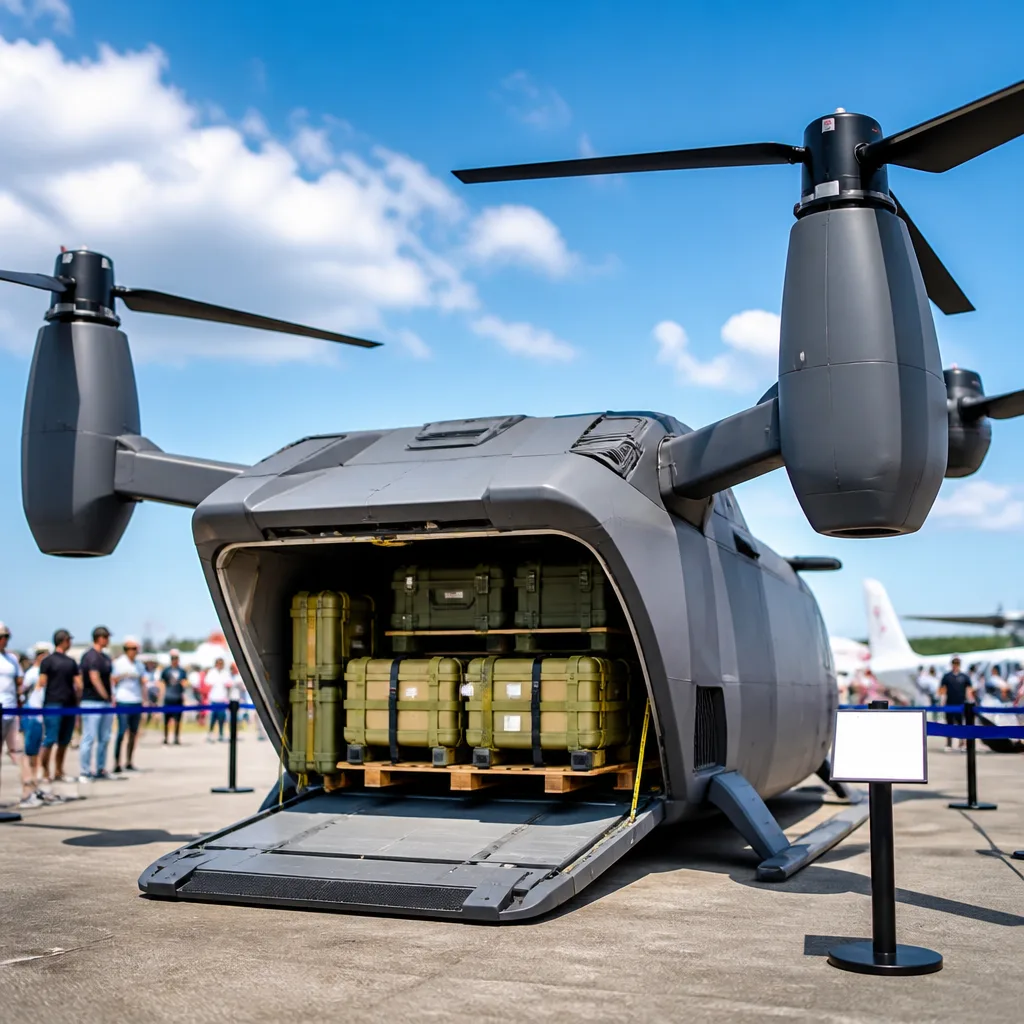
Beta Technologies has publicly introduced the MV250, a hybrid-electric aircraft that combines vertical takeoff and landing capability with autonomous flight and a cargo capacity of up to one tonne. The company displayed the MV250 at the Farnborough Airshow in July as it pivots technology originally developed for civil air taxis toward military logistics.
From city air taxis to battlefield resupply
Beta started by designing electric vertical takeoff and landing (eVTOL) vehicles aimed at urban air mobility. Its Alia-250 — an all-electric conventional takeoff and landing design — has been part of that portfolio. Earlier this year, Beta deployed the Alia during NATO’s Exercise Aurora 26 in Sweden, and the company has since adapted aspects of that technology into the military-focused MV250.
The MV250 is described by Beta as a hybrid-electric platform that can perform vertical takeoffs and landings, operate with no pilot aboard, and transport payloads into high-risk areas. That combination of features positions the aircraft as a potential tool for commanders who need to move supplies into contested environments without endangering crewed aircraft or ground convoys.
Why the military interest matters
As modern armed forces increasingly consider autonomy and distributed logistics, companies that developed passenger-focused eVTOLs see a pathway into defence markets. The MV250 is one such example: retaining the low-noise, rotor-driven characteristics of eVTOLs while adding hybrid propulsion and cargo-centric design choices.
Beta’s transition underlines two broader trends:
- Civil-to-defence technology transfer: Suppliers from commercial air mobility are repurposing their systems for military needs.
- The push for uncrewed logistics: Militaries want platforms that can enter dangerous zones without placing pilots at risk.
“Why do we all want autonomy? I'm a pilot. No pilot wants to see their job go away," said Gen. Jim McConville, a former chief of staff of the U.S. Army and a member of Beta’s board. "But what we want to do is give commanders the ability to go into situations at extremely high risk.
The quote — supplied by Beta at the Farnborough show — captures the tension between preserving human roles and leveraging autonomy to reduce risk for service personnel.
What is known about the MV250
Public details emphasised a few core capabilities rather than full technical specifications. From Beta’s demonstration and prior company activity, the following points are clear:
| Characteristic | Public detail |
|---|---|
| Propulsion | Hybrid-electric |
| Takeoff/landing | Vertical capability (eVTOL) |
| Flight mode | Autonomous operation possible (uncrewed) |
| Cargo | Up to one tonne |
Beta’s earlier ALIA-250 and its CTOL (conventional takeoff and landing) variant have been used in demonstration and exercise contexts, providing the company with operational references as it adapts designs for military logistics.
Implications and questions ahead
The MV250’s public debut will prompt a number of follow-up queries from defence procurement officials and regulators. Chief among them will be:
- How the aircraft’s hybrid-electric architecture performs in contested or austere environments.
- How autonomy will be certified and controlled when operating over friendly or neutral territory.
- Potential integration with existing battlefield logistics chains and allied exercises.
Beta’s move reflects a larger recalibration in aerospace: electric and hybrid propulsion technologies originally pitched for quiet, urban air mobility are now being assessed for their capacity to reduce human risk and increase operational flexibility on the battlefield. The MV250 offers a concrete example of that shift — and a test case for how civil innovators can respond to evolving defence needs.
For policymakers and military planners, the questions will be pragmatic: can a hybrid eVTOL reliably deliver a tonne of supplies where they are needed, and can it do so safely, legally and at acceptable cost? The Farnborough unveiling begins that conversation with a visible demonstration, but further testing and formal evaluations will determine whether the MV250 moves from concept to capability.