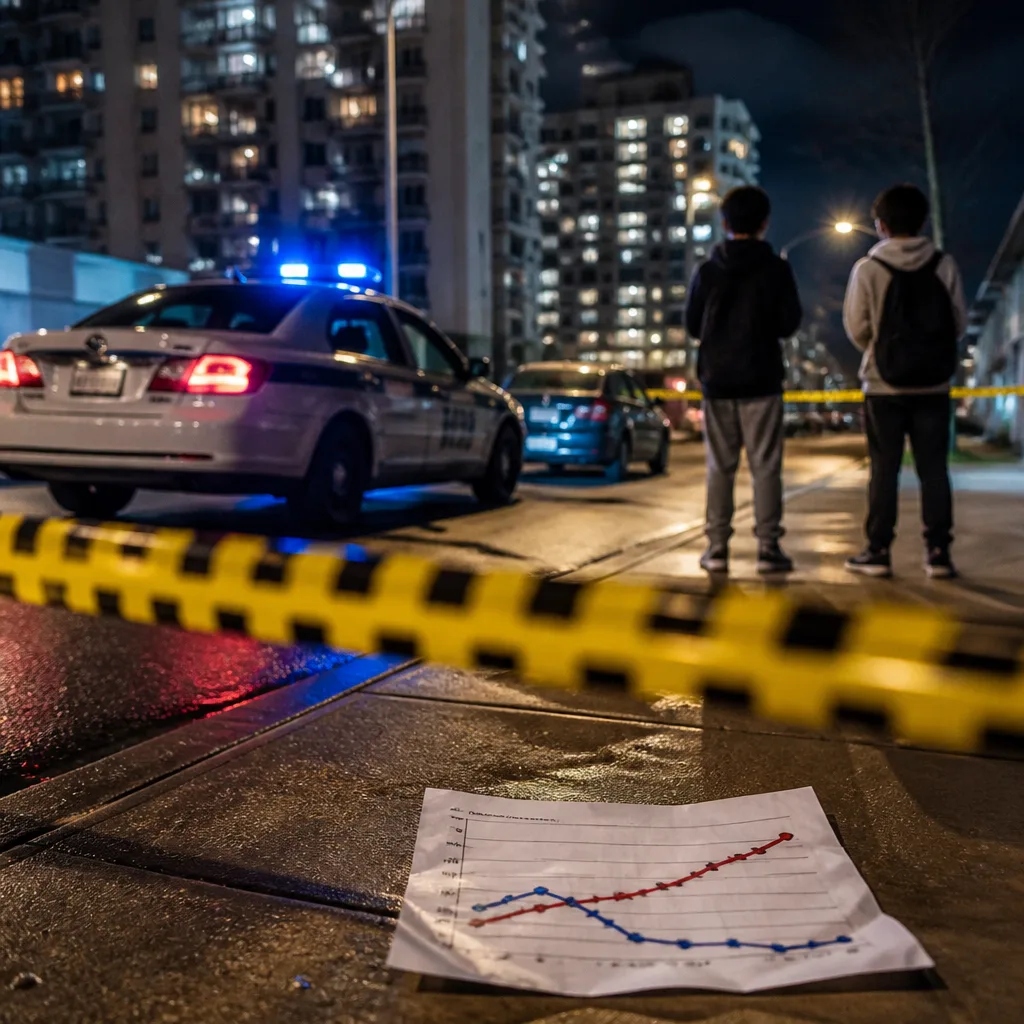
British Columbia’s most recent crime numbers present a complicated picture for the province’s government, with headline indicators moving in opposite directions: the overall Crime Severity Index fell slightly from 2024 to 2025, but measures of violent and youth crime rose, and early 2026 police figures from major cities show worsening trends.
Government points to declining CSI; critics underscore violent crime increases
The provincial government has highlighted Statistics Canada data showing the province’s Crime Severity Index (CSI) dropped year‑over‑year. Public safety officials credited enforcement and intervention investments for progress.
“B.C.’s Crime Severity Index is down for the second year in a row, nearly 12% lower than in 2023 and at its lowest level in years,”
That statement was cited by the minister of public safety and solicitor general in public remarks about the government’s record. But researchers and analysts point to other figures in the same data release that complicate the narrative.
- The province’s overall CSI decreased by 1.6 per cent in 2025 compared with 2024.
- The Violent Crime Severity Index (VCSI) rose by 2.2 per cent over the same period.
- Youth crime indicators showed increases in both the overall CSI and the VCSI in 2025 relative to 2024.
Longer‑term trends and regional developments
Beyond the year‑over‑year change, the data point to wider shifts since the provincial administration took office. The overall CSI for B.C. in 2025 was reported as 6.1 per cent higher than in 2017. The province’s VCSI grew markedly over the same interval, increasing by 31.7 per cent from 2017 to 2025.
Police statistics for 2026 from B.C.’s two largest municipalities provide further nuance. The Vancouver Police Department’s figures comparing the first half of 2026 with the first half of 2025 show increases across several categories:
| Category | Change (first half 2026 vs first half 2025) |
|---|---|
| Violent crime incidents | +6.0% |
| Property crime incidents | +4.3% |
| Total crime incidents | +4.4% |
The Vancouver statistics also show a mixed pattern within violent offences: while the number of culpable homicides fell to five in that period from 16 a year earlier, the counts of sexual offences, assaults and robberies rose.
Surrey Police data for the first half of 2026 indicate a sharp year‑over‑year increase in homicide: 13 homicides were recorded compared with four in the same span of 2025. The source material reports that total reported "persons crimes" have also shifted, though detailed category breakdowns were not provided in the summary.
Implications for policy and public debate
The coexistence of a modest decline in the overall CSI with increases in violent and youth crime presents a challenge for policymakers and communicators. Measures that reduce volume or severity in some offence categories may not register as improvements if other categories — notably violent offences — rise. Likewise, year‑to‑year changes can mask longer‑term trends: the cumulative increases in the VCSI since 2017 underscore a different trajectory than a single year’s CSI decline.
Public safety officials have linked recent reductions in the overall CSI to provincial investments in enforcement and intervention. Critics counter that the upward movement in violent and youth crime, together with worsening mid‑2026 indicators in Vancouver and Surrey, undercut claims that the province has become safer overall.
As the debate continues, the differing metrics and timelines in the Statistics Canada release and municipal police reports illustrate how complex it can be to assess public safety through aggregated indices alone. Policymakers, researchers and the public will be watching whether the patterns seen in early 2026 persist through the rest of the year and how authorities respond.