
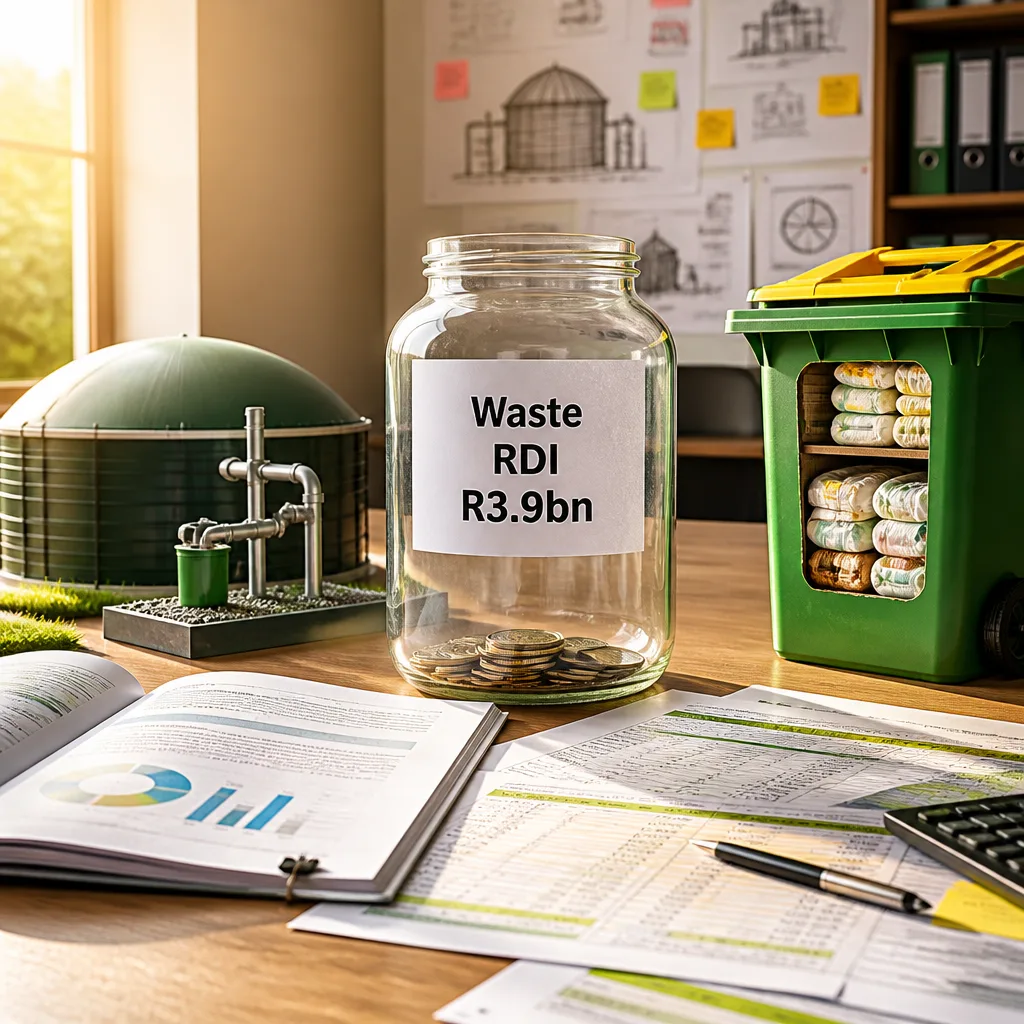
The government’s waste research and innovation programme ran on a fraction of its planned budget, limiting its reach even as projects produced tangible technology transfers, Science, Technology and Innovation Minister Blade Nzimande has confirmed.
Responding to parliamentary questions from MK Party MP Thembinkosi Mjadu, Nzimande said an independent evaluation found the Waste RDI Roadmap — intended to run from 2015 to 2024 — received just 3.2% of its targeted R3.9 billion over the ten-year period. He said the shortfall meant the initiative functioned largely as seed funding rather than a fully funded, comprehensive innovation programme.
“The evaluation revealed that, while the Waste RDI Roadmap was conceptually sound and strategically aligned with national waste priorities, it was severely underfunded, receiving only 3.2% of the targeted R3.9 billion budget over ten years.” — Blade Nzimande
What was achieved despite limited funds
Although the roadmap fell well short of its aspirational budget, the evaluation described several positive outcomes. Nzimande said researchers managed to leverage more than R102 million in additional resources, and that the programme strengthened capacity across the National System of Innovation.
Specific outputs cited in the evaluation included:
- Support for research activity across 17 institutions.
- Delivery of over 50 research projects through nine strategic grant calls.
- Work in priority waste areas such as electronic waste and marine plastic debris.
- Technology-transfer outcomes, including collection systems for disposable nappies in low-income communities and biogas systems for rural schools.
Nzimande characterised the original R3.9 billion figure as an aspirational request based on the programme’s ambitions, and said the funding constraints primarily reduced the scale of activities rather than excluding them entirely.
Why the shortfall matters for national technology and waste strategy
A technology-focused RDI roadmap is intended to move research from proof-of-concept to implementation. By operating with seed-level financing, projects risk stalling before they can be tested at scale or taken up by municipalities, industry or community partners. The evaluation’s finding that researchers were nevertheless able to leverage additional funding is important, but leverage alone rarely substitutes for sustained public investment when national infrastructure, regulation and procurement pathways are needed to scale solutions.
The roadmap’s work across electronic waste and marine debris aligns with growing national and global concern about these streams, which require cross-sector responses — from design and producer responsibility to collection logistics and recycling technologies. Progress on pilot technologies such as nappie collection systems and school biogas is useful, but widespread roll-out will demand dedicated funding, procurement commitment and municipal capacity.
| Metric | Figure |
|---|---|
| Target budget (2015–2024) | R3.9 billion |
| Actual funding received | 3.2% of target |
| Additional resources leveraged | R102 million+ |
| Institutions involved | 17 |
| Research projects funded | 50+ |
For policy-makers and funders, the evaluation provides both reassurance and a warning: the roadmap’s design and strategic alignment with national waste priorities were sound, but without adequate funding the ability to scale promising technologies and influence sector-wide change is limited.
How government responds — whether by allocating new funds, redirecting existing programmes, or strengthening partnerships with industry and development finance institutions — will shape whether pilots turn into practical, city- or province-wide interventions that reduce environmental harm and create economic value from waste.
The full evaluation and Nzimande’s parliamentary reply set a benchmark for future RDI planning: clear strategic intent must be matched by realistic funding pathways if innovation is to translate into measurable improvements in waste management nationwide.










