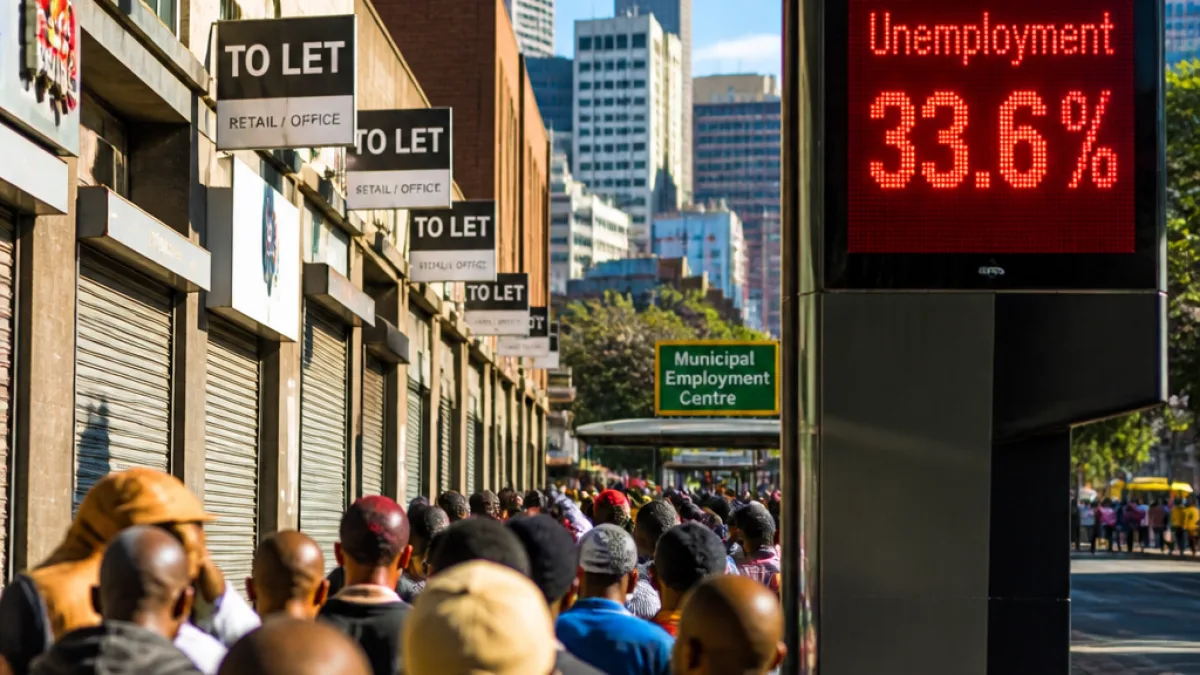
South Africa’s official unemployment rate rose to 33.6% in the second quarter of 2026, as the labour market weakened and 345,000 more people joined the ranks of the unemployed, according to the latest Quarterly Labour Force Survey (QLFS) released by Statistics South Africa.
"South Africa’s unemployment rate has risen to 33.6% in the second quarter of 2026, with 345 000 more people joining the ranks of the unemployed as employment continued to decline."
Gauteng: already under pressure, loses more jobs
Gauteng—long the country’s economic engine—recorded 5.094 million employed people in Q2 2026, a figure that includes formal and informal sector workers as well as private‑household employees. The province saw employment fall by 22,000 between Q1 and Q2 and is down 92,000 compared with the same quarter last year. Its unemployment rate remained high at 33.5% in Q2.
Those declines come against a broader national deterioration. Stats SA’s numbers show a mixed picture across metros: while eThekwini recorded employment growth, Cape Town and Gauteng saw reductions.
How the metros fared
The QLFS highlighted divergent trends among the largest metros:
- eThekwini: employed people increased from about 1.259 million in Q1 to 1.290 million in Q2 — a quarterly gain of 30,000; it also had 90,000 more employed people year‑on‑year.
- Cape Town: employment slipped by 19,000 quarter‑on‑quarter, from 1.863 million to 1.843 million, and its unemployment rate rose slightly to 21.9%.
- KwaZulu‑Natal: the province’s unemployment rate rose from 31.2% to 32.5%; employed numbers were reported at 2.725 million, up by 3,000 quarter‑on‑quarter and 22,000 year‑on‑year.
| Region | Q1 employed | Q2 employed | Quarter change |
|---|---|---|---|
| Gauteng | — | 5.094 million | -22,000 |
| eThekwini | 1.259 million | 1.290 million | +30,000 |
| Cape Town | 1.863 million | 1.843 million | -19,000 |
What this means for Gauteng residents
For households across Gauteng the numbers translate into real strain. A quarterly drop of 22,000 jobs in the province will be felt in townships and suburbs alike — from fewer informal traders earning daily income to increased competition for scarce vacancies in formal firms. The province’s unemployment rate sitting at roughly one‑third of the labour force outlines the scale of the challenge facing policymakers.
Labour market experts have repeatedly argued that headline unemployment figures mask underemployment and discouraged jobseekers. The QLFS shows a visible contraction in employment even as the national economy struggles to recover fully from structural weak points and constrained growth.
Policy pressure and public response
The sharp rise in the number of unemployed people nationally — an increase of about 345,000 in a single quarter — has intensified calls for swift policy responses. Civil society, business and some political leaders are expected to press for an expanded national jobs programme, incentives for private investment, and more effective measures to support small enterprises and young jobseekers.
For Gauteng, where a large share of South Africa’s formal jobs are located, interventions that focus on skills development, connectivity for township enterprises and support for labour‑absorbing projects will be crucial. But any recovery will also depend on broader macroeconomic improvements and confidence in investment.
Statistics South Africa’s QLFS provides a snapshot that underlines the fragility of the current labour market. For many households the coming months are likely to require tighter budgeting and continued reliance on social networks while they wait for clear policy action that can reverse job losses and open fresh opportunities.
— Reported from Johannesburg.