
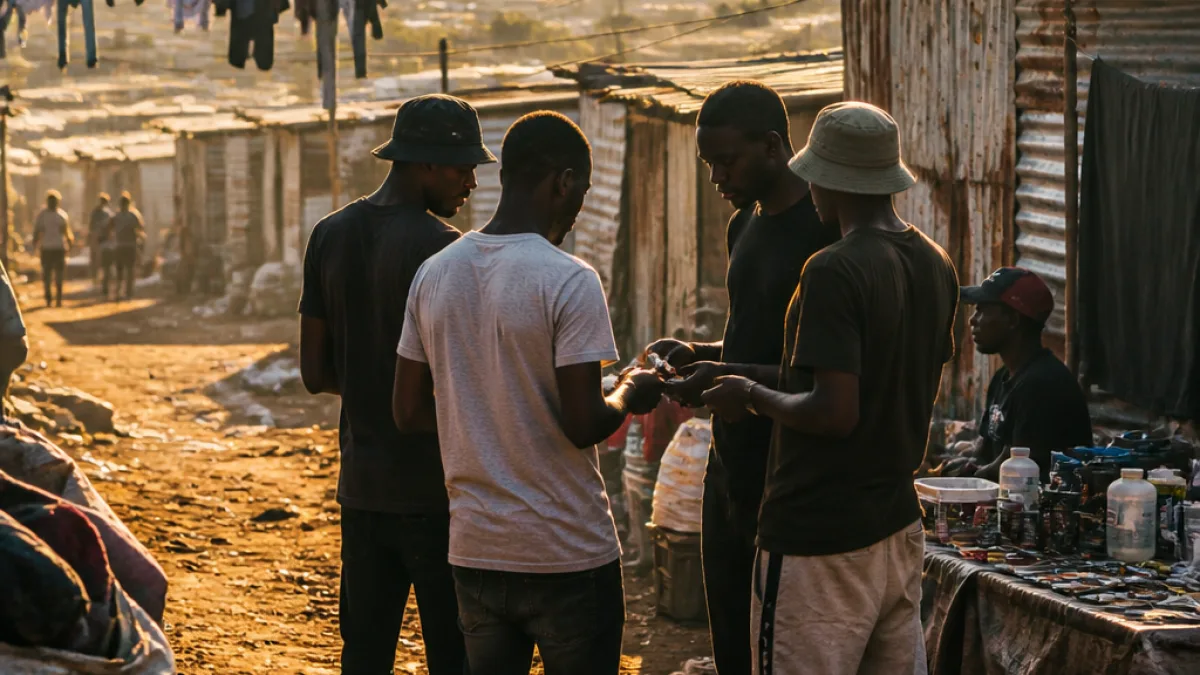
Young men, informal economies and the everyday work of survival in Johannesburg
Making a Life: Young Men on Johannesburg’s Urban Margins, published by Wits University Press in 2025, draws readers into Zandspruit, an informal settlement on the outskirts of Johannesburg, and offers a granular account of how young men attempt to build livelihoods outside formal employment. The book rests on 14 months of ethnographic fieldwork and reframes questions about unemployment by tracking the detailed practices that sit beyond official statistics.
The research, reported on in an interview with broadcaster Stephen Grootes, challenges the simple equation of work with formal jobs. Instead, the book documented a wide range of strategies — from informal trading and casual labour to more precarious or borderline activities — framed by social networks and claims to dignity and belonging.
- Location: Zandspruit, an informal settlement on Johannesburg’s outskirts
- Research duration: 14 months of ethnographic fieldwork
- Publisher: Wits University Press (2025)
| Aspect | Detail |
|---|---|
| Author | Hannah J. Dawson |
| Subject | Young men, informal economy, identity |
| Research approach | Ethnography (14 months) |
Discussing the book on The Money Show, Bronwyn Williams, a trend translator and future finance specialist at Flux Trends, emphasised that Dawson’s repeated visits and long-term engagement revealed how people adapt when formal placements are not available. Williams said the study shows “what happens when society doesn't have place in the formal economy, and what happens when these shadow economies pop up.”
“...she talks about people being able to not just eek out, but actually make a better living in the 'grey economy'. The grey economy is border line criminality, lots of extortion going on, lots of patronage, lots of nepotism, lots of grey areas taking place.” — Bronwyn Williams, Flux Trends
The phrase "grey economy" used in the conversation captures the moral and legal ambiguity that can surround survival strategies in contexts of high unemployment and limited opportunities. Dawson’s account, as described in the interview, does not flatten Zandspruit into a single story of deprivation. Instead, it treats the settlement as a complex social and economic environment where people are actively constructing futures despite structural constraints.
For Johannesburg residents and officials, the book underscores several practical considerations. First, unemployment rates alone do not tell the full story of livelihoods: many residents combine multiple informal activities, caregiving responsibilities and community obligations as part of their economic lives. Second, social networks and local forms of exchange are central to how opportunities are accessed and risks are managed. Third, the boundary between legal and illegal activity can be porous where state support and formal labour markets fail to reach.
These observations have consequences for local policy. Interventions that focus solely on formal job creation without acknowledging the realities of informal and ‘grey’ economies risk missing where people actually make a living. Programmes that build on existing community networks, provide safe and legal pathways for small-scale entrepreneurship, and address corruption and extortion may be more effective at improving livelihoods than top-down solutions that do not engage with local practices.
Readers and policymakers in Johannesburg should also note the methodological lesson in Dawson’s work: long-form, on-the-ground research can surface everyday strategies invisible to surveys and headline unemployment figures. That deeper picture helps explain why people make the choices they do and points to how support measures can be better tailored to lived realities.
Making a Life does not offer easy answers. It asks readers to recognise the resourcefulness of young men on Johannesburg’s margins while also confronting the harsh trade-offs they face. For anyone concerned about the city’s future — from community leaders and social practitioners to municipal planners and employers — the book provides a useful, evidence-based window into life at the edges of the urban economy.
As Johannesburg continues to wrestle with unemployment, inequality and spatial exclusion, studies like Dawson’s sharpen the conversation about what it means to create opportunity that is both decent and accessible.











