
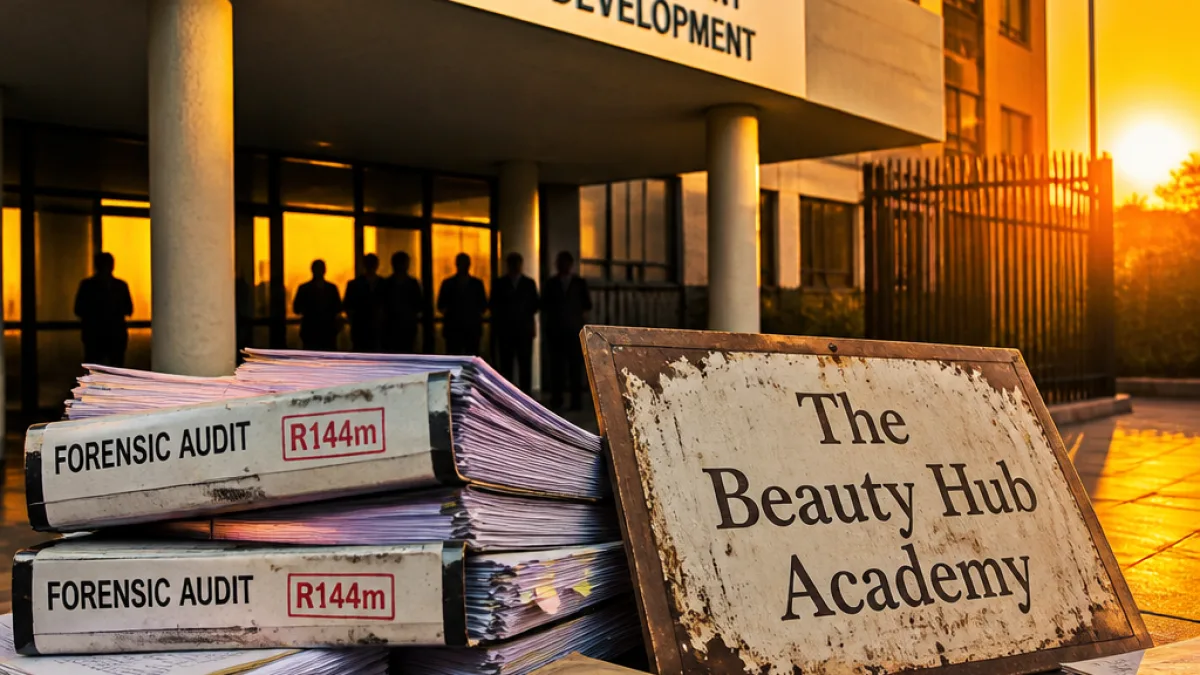
Gauteng — A 2024 forensic audit has found that the Gauteng Department of Social Development (GDSD) transferred about R144-million to The Beauty Hub Academy over seven years, money intended to train young beauticians and provide services for older residents. The auditors flagged serious irregularities, including payments to linked private entities, and recommended disciplinary action against senior officials — action that remains incomplete more than two years later.
Audit finds public funds routed to private companies
The Beauty Hub Academy, registered as a non-profit organisation (NPO), was one of the department’s highest-funded service providers. The forensic review by FSG Africa found that funds were moved from the NPO to a private company using the same name — a transfer that contravenes funding rules because for-profit entities are not eligible for these subsidies.
Auditors also documented substantial expenditure on renovations, rentals and catering. At least one property that benefited from renovation and rental payments was owned by a property company that shares directors with The Beauty Hub Academy. The academy’s caterer was paid R8.4-million over three years and was owned by the daughter of one of the academy’s directors.
Disciplinary recommendations but slow progress
FSG Africa recommended disciplinary action against four senior GDSD officials: Onkemetse Kabasia, Solly Ndweni, Themba Msimanga and Mbali Ndlovu. According to the audit, several of these officials had previously been implicated in an earlier 2019 forensic audit.
More than two years on, the recommended disciplinary processes have not been concluded. The audit’s findings prompted the department to discontinue funding to the academy in the 2024/25 financial year.
Officials previously implicated and further probes
Three of the officials named — Ndlovu, Msimanga and Kabasia — were already implicated in the 2019 forensic audit. That older investigation is reportedly under investigation by the Hawks, the SAPS unit that handles serious organised crime and corruption.
Despite these findings, the audit noted that one of the implicated officials, Onkemetse Kabasia, has since been appointed to head the KwaZulu‑Natal Department of Social Development.
"Money was transferred from the Beauty Hub Academy, a non-profit organisation, to a private company with the same name," the forensic audit reported.
How the funding compared with other providers
The audit said The Beauty Hub Academy’s allocation was far larger than the typical subsidies given to organisations providing social welfare services to Gauteng’s most vulnerable people. The academy was funded to train about 1,800 students over seven years.
| Item | Detail |
|---|---|
| Period covered | Seven years |
| Total funds identified | R144-million |
| Students to be trained | 1,800 |
| Catering payments | R8.4-million over three years |
Questions for accountability and service delivery
The audit raises two central concerns for provincial oversight: whether public monies were used in line with legislative and departmental funding rules, and whether internal controls and procurement processes failed to prevent related-party transactions.
Residents and social service stakeholders in Gauteng rely on the department to prioritise the province’s most vulnerable. When large subsidies are channelled disproportionately to a single organisation and payments are made to linked private entities, it reduces the pool of resources available to other non-profit providers delivering critical services.
- FSG Africa found transfers from an NPO to a private company operating under the same name.
- Payments were made for renovations and rentals to a property company with shared directors.
- A caterer owned by a director’s daughter was paid R8.4-million over three years.
The department’s decision to end funding to the academy for 2024/25 followed the audit’s release, but the recommended disciplinary measures against senior officials remain in limbo. That delay leaves unanswered questions about internal accountability and the recovery of funds, where applicable.
For communities in Gauteng who depend on social development services, the case underscores the need for prompt, transparent disciplinary processes and tighter financial controls. The involvement of the Hawks in related, earlier matters suggests there are multiple strands of investigation; however, the lack of finalised outcomes more than two years after the audit weakens public confidence.
Provincial officials have not published a full status update on the disciplinary proceedings. The audit was explicit in its recommendations; the next step is for the department and oversight bodies to act decisively to restore trust and ensure that subsidies reach qualified, properly governed non-profit organisations.
Coverage will continue as more documentation and official responses become available.













