
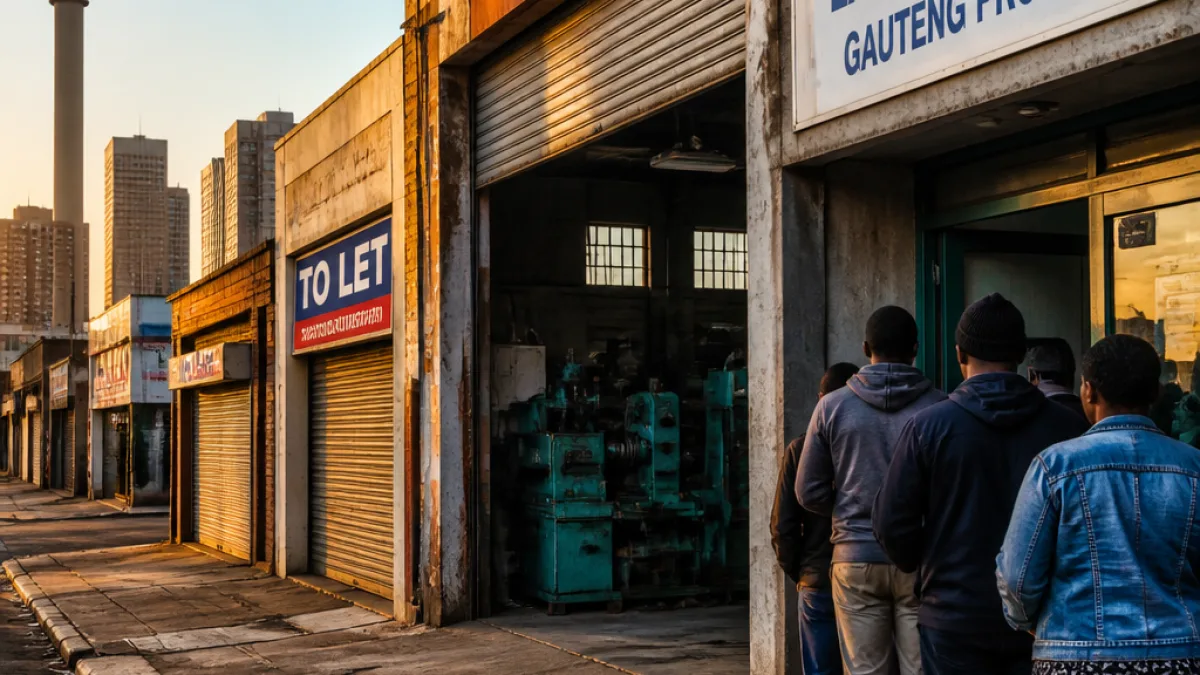
Gauteng has lost 22,000 jobs in the second quarter of 2026, according to the latest labour figures released by Statistics South Africa and reported this week. Nationally, the narrow unemployment rate rose to 33.6%, an increase of 0.9 percentage points, while the expanded unemployment rate edged up to 43.8%.
Numbers behind the slide
Stats SA’s report, summarised in the recent coverage, shows the number of unemployed people nationally climbed by 345,000 in the quarter. Overall employment fell by 16,000.
| Indicator | Change (Q2 2026) |
|---|---|
| Narrow unemployment | 33.6% (+0.9 pp) |
| Expanded unemployment | 43.8% (+0.1 pp) |
| Unemployed persons | +345,000 |
| Employed persons | -16,000 |
Which sectors and provinces were hardest hit?
The detailed breakdown in the report highlights deep pain in specific sectors. The largest job losses were in:
- Community and social services: -57,000
- Mining: -26,000
- Agriculture: -15,000
- Manufacturing: -15,000
Not all industries contracted. Gains were recorded in:
- Trade: +70,000
- Construction: +39,000
- Finance: +11,000
At provincial level, job losses were concentrated in a few provinces. The worst performers were the Western Cape (-48,000), Gauteng (-22,000) and North West (-15,000). Positive employment shifts were seen in Mpumalanga (+41,000), the Eastern Cape (+13,000) and the Free State (+9,000).
Why the labour market is under pressure
Congress of South African Trade Unions (COSATU) parliamentary coordinator Matthew Parks described the findings as “beyond depressing” and warned the outlook remains weak. He linked the losses partly to global shocks, writing that the ongoing war in the Middle East has driven up oil and fuel prices and damaged growth prospects.
“This has seen economic growth projections for South Africa for 2026, slashed from an already meagre 1.4% to 1.1%,”
Parks also pointed to rising transport inflation and warned of knock-on effects for households. The report referenced inflation pressures, noting transport inflation had reached 5% in June 2026 — a development that could prompt further interest rate action from the Reserve Bank and squeeze indebted households.
What this means for Gauteng residents
Gauteng remains the economic heartland of the country, and job losses here ripple through households and services in Johannesburg, Ekurhuleni and Tshwane. A drop of 22,000 jobs will affect income, consumer spending and municipal revenue streams, with consequences for small businesses and informal traders who rely on commuter and office workers.
Policy responses at national and provincial level will be watched closely. COSATU called for a bold stimulus package to revive growth, arguing incremental measures will not reverse entrenched unemployment, poverty and inequality.
Practical implications and what to watch next
- Households should sign up for municipal and NGO job-linkage programmes where available and check SASSA and local government announcements for support options.
- Workers in hard-hit sectors — social services, mining and manufacturing — may face longer searches for replacement work; skilling and re-training programmes may become essential.
- Watch for further updates from Stats SA and commentary from Treasury and the Reserve Bank on growth projections and possible policy adjustments.
The new figures underline a fragile recovery that is vulnerable to global shocks and domestic structural challenges. For many Gauteng families, the short-term focus will be finding immediate income while policymakers debate longer-term stimulus and labour strategies.
Reporting from Johannesburg.














