Scientific progress transformed daily life on an exceptional scale between 1870 and 1970, but the discoveries that drove that change may not be endlessly repeatable. That is the central question raised by a historical examination of how science and technology altered ordinary life, from household services and transport to medicine and communications.
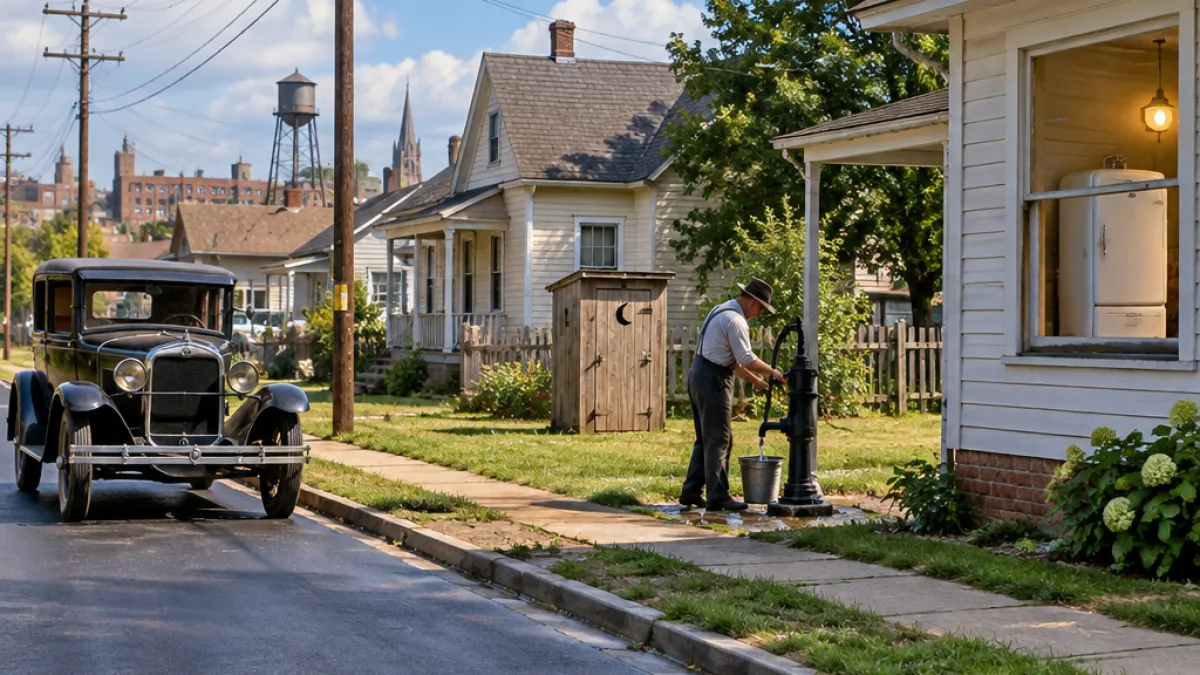
The comparison begins with the United States in 1926. By present-day standards, many homes and communities still lacked basic infrastructure. West of the Mississippi, paved roads were rare. Fewer than one in 10 homes had an electric refrigerator, and one of the typical appliances would have cost the equivalent of about US$10,000 today.
Conditions varied even within established communities. In Muncie, Indiana, there was a one-in-four chance that a home had no running water, while the likelihood of lacking a sewer connection was one in three. These figures help illustrate an important point: technological progress does not mean that every person benefits at the same time. New systems can spread rapidly in some places while basic services remain absent in others.
A period of rapid change
At the same time, the direction of change was unmistakable. Thousands of new hospitals were being built, including facilities with advanced X-ray departments. Among Iowa’s farmers, 93 per cent owned automobiles, even though the motor vehicle had only appeared roughly 30 years earlier.
The year also marked milestones that had been beyond the reach of ordinary people. Air travel became possible for the general public, while Clarence Birdseye perfected a method for freezing food. That development made fish more affordable for people living far from the coast. The examples are different in scale, but together they show how scientific knowledge becomes socially significant when it is converted into reliable services, products and infrastructure.
| Example | What it signalled |
|---|---|
| Electric refrigerators | Modern household convenience remained uncommon |
| Automobiles | Transport technology could spread quickly |
| X-ray departments | Scientific discoveries were entering medical care |
| Frozen food | Technology could widen access to food |
The five foundations of the transformation
The economist Robert J. Gordon, writing in his 2016 book The Rise and Fall of American Growth, describes the century from 1870 to 1970 as an “epochal transformation”. He links it to five major areas of invention:
- electricity;
- urban sanitation;
- chemicals and pharmaceuticals;
- internal-combustion engines; and
- signal transmission.
These technologies did not appear in isolation. They rested on discoveries across physics, biology, medicine, chemistry and mathematics. The germ theory of disease, advanced by Louis Pasteur in the 1880s, reshaped understanding of illness and supported wide-ranging changes in public health and medical practice. Electromagnetism, meanwhile, provided a basis for technologies including engines and radios.
“What makes the period 1870–1970 so special is that these inventions cannot be repeated,” Gordon writes.
Can science keep accelerating?
The argument is not that scientific work has stopped, nor that future discoveries are impossible. Rather, it questions whether later advances can produce the same broad, visible improvement in living conditions as the foundational breakthroughs of the earlier period.
A discovery such as the germ theory of disease could happen only once. Once a fundamental principle has been identified, it can be developed and applied in many ways, but the original breakthrough cannot be made again. The same reasoning applies to electromagnetism: its importance lies not only in the initial discovery, but in the large family of technologies that followed.
This creates a distinction between discovering a new principle and improving an existing technology. Both can be valuable, but they do not necessarily have the same effect on everyday life. A more efficient product, a faster system or a refined medical tool may represent real progress without matching the scale of a new foundation for modern society.
The historical record therefore offers both an achievement and a warning. It shows how deeply science can alter living conditions when discoveries connect with engineering, investment and public infrastructure. It also suggests that the most dramatic changes may be linked to a limited number of foundational insights. Whether the next era will produce another comparable transformation remains an open question, rather than a conclusion that can be settled by celebrating every new advance as a revolution.