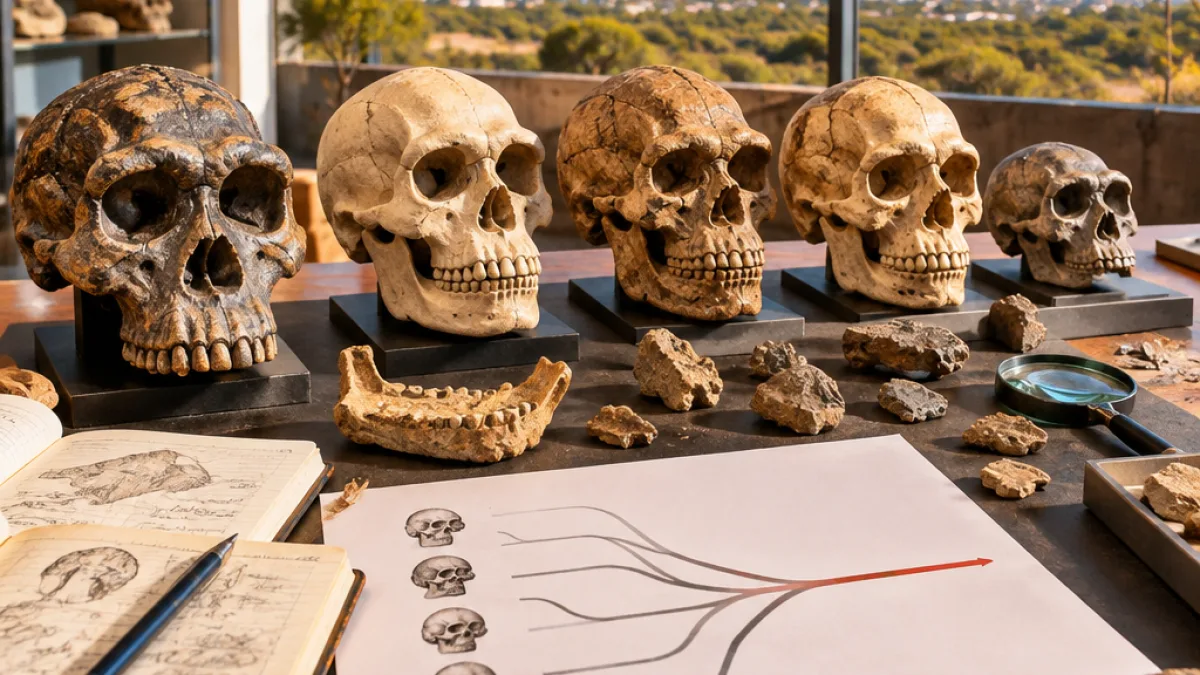
A new study from Monash University has proposed a major change to the way scientists classify ancient human relatives, arguing that species traditionally placed in groups such as Australopithecus and Paranthropus may belong within the same genus as modern humans.
The proposal would redraw the human family tree across the past 4 to 5 million years. Instead of treating several familiar fossil groups as separate from the human genus, the researchers argue that all human species and their closely related fossil relatives should be classified within Homo.
This is a change in scientific classification rather than a claim that all ancient human relatives looked or behaved in the same way. The study acknowledges that these groups differed in appearance, anatomy and behaviour. Its central argument is that the boundaries used to separate them have become increasingly difficult to defend as new fossils and comparisons reveal traits shared across groups.
A family tree with many branches
Human evolution is often presented as a neat sequence. In that familiar picture, ape-like ancestors are followed by species such as Australopithecus, then early members of Homo, and eventually modern humans, Homo sapiens. The research challenges that simplified view.
The fossil record instead shows a more complicated pattern, with multiple branches and species that existed during overlapping periods. Evolution did not proceed as a straight line in which one species simply replaced another. The study says the relationships between these groups remain difficult to establish, and that each new fossil discovery can make the picture more complex rather than resolving every question.
That matters because scientific names are intended to organise evidence. When characteristics once thought to distinguish one group from another are found in several groups, it becomes harder to decide where one genus should end and another should begin. The Monash researchers say this problem affects not only species already classified within Homo, but also members of Australopithecus and Paranthropus.
What the proposed change would mean
Dr Ian Towle, a research fellow at the Monash Biomedicine Discovery Institute and the study’s lead researcher, argues that discoveries are exposing weaknesses in the existing classification system. The proposed approach would place a broader range of ancient human species under one genus, while still recognising that they could have been markedly different from one another.
A genus is a level of biological classification used to group closely related species. Changing the boundaries of a genus therefore affects how scientists label fossils, describe evolutionary relationships and explain the development of the human lineage. It would also alter the terminology used in educational material, research discussions and displays based on the traditional division between early human relatives and members of Homo.
| Traditional approach | Proposal in the study |
|---|---|
| Australopithecus and Paranthropus are generally treated as separate from Homo. | Human species and closely related fossil relatives from the past 4 to 5 million years would be grouped within Homo. |
| Human evolution is often illustrated as a progression between successive groups. | The evidence is interpreted as a complex, branching family tree with overlapping species. |
Classification remains open to revision
The proposal does not remove the uncertainty surrounding human evolution. Rather, it reflects an argument that the present system no longer fits the available evidence well enough. The study’s position is that the differences used to maintain separate genera are becoming less clear as scientists identify traits shared between fossil groups.
For readers, the main lesson is that the human family tree is not a fixed diagram. It is a scientific model that can change when new fossils are found or when existing evidence is examined in a different way. The researchers’ suggested grouping is therefore a substantial proposal, not an established replacement for the current classification.
- The study proposes including Australopithecus and Paranthropus within Homo.
- It covers human species and closely related fossil relatives from the past 4 to 5 million years.
- Its argument is based on the difficulty of maintaining clear evolutionary boundaries between traditional groups.
Whether the wider scientific community accepts the proposal will depend on how researchers assess the evidence and the usefulness of the revised naming system. For now, the study adds to a continuing debate about how best to describe the many branches that make up human evolution.