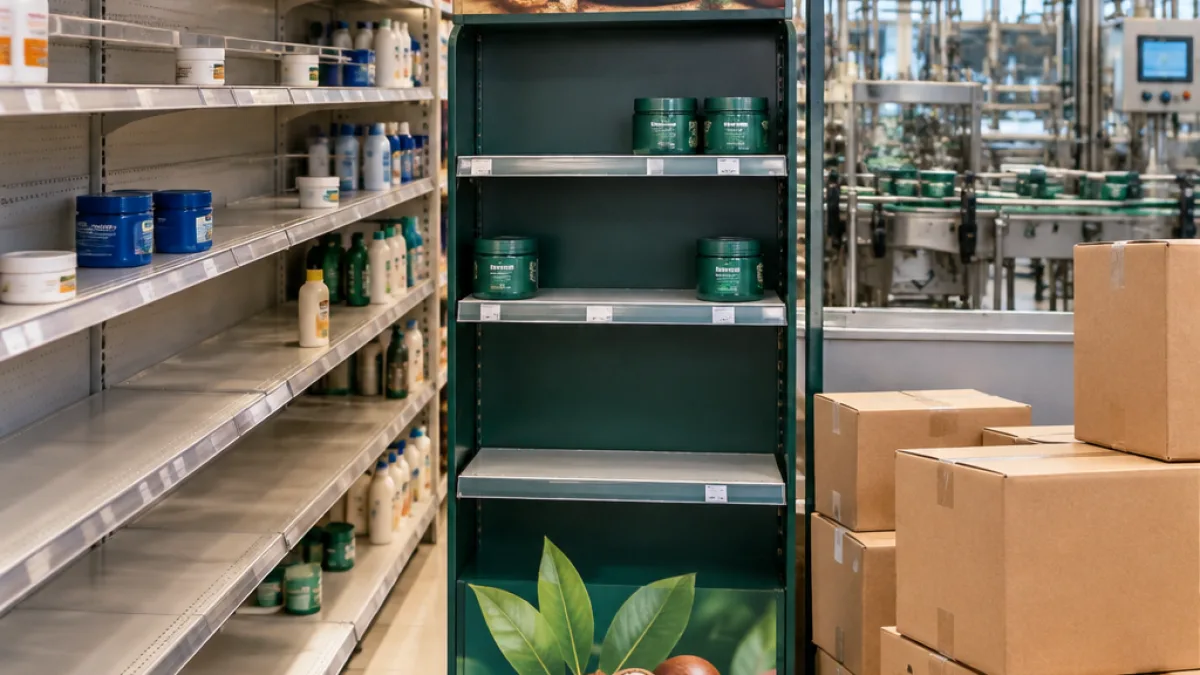
Tiger Brands’ home and personal care division recorded a sharp deterioration in the year to the end of September, after supplier and production problems disrupted the relaunch of its Ingram’s brand. The setback contributed to lower sales volumes, weaker operating income and a narrower margin in a business that includes products used by households across South Africa.
Revenue in the division fell 14.9% to R2.2 billion, while volumes declined by 16.6%. Price increases of 1.7% offered only limited protection against the reduction in sales. For consumers, the figures illustrate the pressure facing a business where higher prices did not compensate for fewer products being sold.
Ingram’s recovery becomes a priority
Tiger Brands said the performance of its personal care operations was hurt by difficulties involving suppliers and production during the Ingram’s relaunch. The company said those supply-chain problems have now been resolved, but the brand did not deliver the expected performance during the reporting period.
The group plans to make the recovery of Ingram’s a central focus in the 2027 financial year. Its approach will seek to expand the product’s appeal beyond its traditional specialist positioning, while preserving its established strength in moisturising products. Tiger Brands also intends to increase the brand’s presence in the market and attract a wider consumer base.
- Division revenue declined to R2.2 billion.
- Sales volumes dropped 16.6%, while prices rose 1.7%.
- Operating income fell 24% to R400 million.
- The operating margin narrowed to 18.3%, from 20.4% previously.
Lower output raises cost pressure
Operating income in the division fell by 24% to R400 million. Its operating margin contracted from 20.4% in the previous financial year to 18.3%. Tiger Brands attributed part of the pressure to lower production volumes, which reduced the extent to which the business could recover its manufacturing costs.
The result is significant for a manufacturer because factories carry costs that do not necessarily fall in line with output. When production is lower, those costs are spread across fewer units, placing additional pressure on profitability. The company’s account links that effect directly to the decline in output in the home and personal care division; no separate figure was provided for the manufacturing-cost impact.
Group performance remains stronger
The weakness in home and personal care contrasted with improved performance in most of Tiger Brands’ other major businesses. Those operations benefited from stronger volumes, a better product mix and cost savings, helping the group’s normalised revenue rise by 3.3% to R33.4 billion. Normalised figures exclude businesses sold and product lines discontinued during the comparison periods.
| Measure | Reported result |
|---|---|
| Group normalised volume growth | 4.5% |
| Group operating income | Up 12.6% |
| Group operating margin | 12.6% |
| Normalised HEPS | Up 10.5% to 2,087c |
Normalised volumes grew by 4.5%, above the company’s target range of 1% to 3%. Operating income increased by 12.6%, while the group’s operating margin improved to 12.6%. Normalised headline earnings per share from continuing operations rose by 10.5% to 2,087c, after the prior-year figure was adjusted for once-off Carozzi-related earnings and foreign-exchange benefits.
Tiger Brands declared a final shareholder payout of 1,299c. The company’s broader performance therefore masks a sharp divide between the recovering parts of the group and the personal care operation, where restoring supply reliability and rebuilding demand for Ingram’s will be important in the next financial year. The reported numbers describe company performance and should not be treated as financial advice; WE NEWS does not provide financial advice.