Scientists and policymakers have called for a coordinated, science-based response to persistent air pollution in Delhi-NCR and the wider Indo-Gangetic plains, arguing that isolated interventions will not be enough to deliver lasting improvements or prepare the region for climate-related risks.
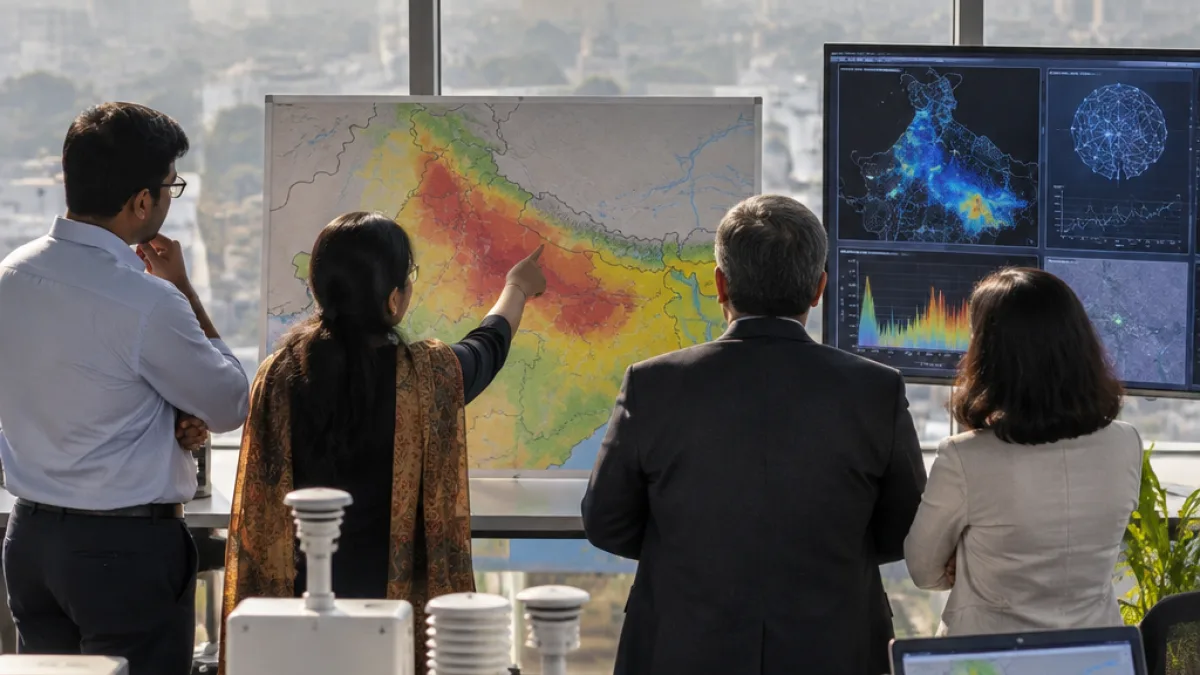
The call followed a brainstorming workshop organised by the CSIR–National Environmental Engineering Research Institute (CSIR-NEERI) at its Delhi Regional Centre. The gathering brought together scientists, policymakers and technical specialists to examine measures that could be applied across the region rather than only in individual cities or locations.
Pollution does not follow administrative borders
A central issue discussed at the meeting was airshed management. An airshed is an area in which air moves and pollutants can be transported across municipal, provincial or other administrative boundaries. This means that action in one locality may be weakened when pollution from elsewhere continues to enter the same air system.
Participants considered pollution sources, health effects and the region’s vulnerability to climate change. They also examined pollution-control technologies, artificial intelligence-based decision-support systems and partnerships between institutions. The stated objective was to identify interventions that could operate on a large scale and produce measurable changes in air quality.
Dr SK Goyal, Scientist-G and chair of the CSIR-NEERI Delhi Regional Centre, highlighted the seriousness of the pollution challenge in Delhi-NCR and the Indo-Gangetic Plains. He supported closer management of the shared airshed, improved air-quality monitoring and an integrated PAN-CSIR mission to turn research findings into practical measures and policy decisions.
From research to field demonstrations
Dr Shailaja Donempudi of CSIR headquarters said greater use should be made of technologies developed within the Council of Scientific and Industrial Research. Particular attention was given to systems assessed at Technology Readiness Level, or TRL, 6 and above. In simple terms, this indicates technologies that have progressed beyond early laboratory work and are ready for demonstration in relevant real-world conditions, although wider deployment still requires testing and implementation.
The workshop’s discussions covered several proposed areas of work:
- Coordinated airshed management across Delhi-NCR and the wider Indo-Gangetic plains;
- Expansion and strengthening of air-quality monitoring networks;
- Field demonstrations of CSIR technologies with a TRL of 6 or higher;
- Use of artificial intelligence-based decision-support systems; and
- Closer institutional cooperation to support climate resilience and pollution control.
A policy brief is planned
Dr S Venkata Mohan, director of CSIR-NEERI, said the institute would consolidate the scientific and institutional recommendations from the workshop into a policy-level brief. The document is expected to set out priority interventions, the readiness of relevant technologies, possible demonstration projects and opportunities for collaboration.
The proposed brief is intended to assist decision-makers with coordinated action on air quality and climate resilience. Its significance will depend on how the recommendations are translated into implementation, including the selection of projects, the availability of monitoring data and cooperation between the institutions responsible for different parts of the response.
| Area discussed | Intended purpose |
|---|---|
| Airshed management | Address pollution across shared air systems |
| Monitoring networks | Improve the information available for decisions |
| CSIR technologies | Move suitable systems towards field deployment |
| Artificial intelligence tools | Support analysis and pollution-related decisions |
Dr N Subrahmanyam of the Ministry of Environment, Forest and Climate Change emphasised the need to establish a technical committee for the Indo-Gangetic plains. The source material does not provide further details about the committee’s proposed membership or mandate.
The workshop therefore represents a move towards linking scientific evidence, technology assessment and policy planning. It does not by itself establish that air quality has improved. Rather, it sets out a proposed framework for identifying workable measures and coordinating the institutions needed to apply them across a region where pollution and climate pressures extend well beyond a single urban boundary.