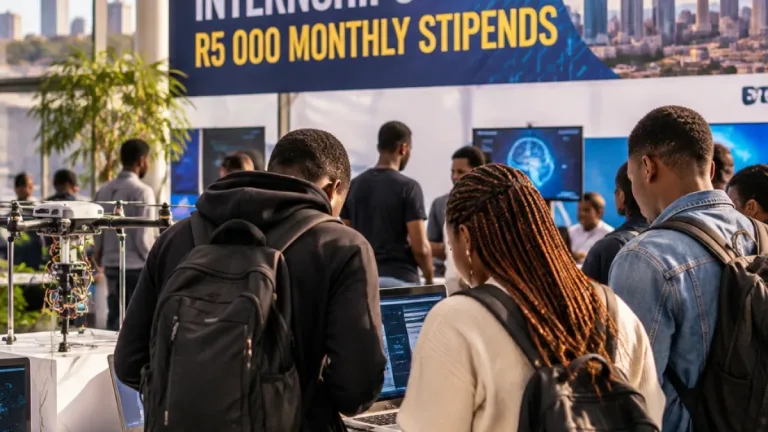

President Cyril Ramaphosa says South African entrepreneurs have proposed a R100-million venture capital fund to help local businesses develop artificial intelligence products, expand into international markets and potentially create jobs.
The proposal follows the President’s week-long visit to Silicon Valley in the United States, where he met technology companies and investors. It comes as South Africa continues to face a severe employment crisis, with 8.6 million people unemployed between July and September 2026.
According to Statistics South Africa, the unemployment rate during that period was 33.7%. Young people face particular difficulty entering the labour market, including those who have completed their studies. The proposed fund is therefore being presented against a wider need to connect technological growth with practical opportunities for people who are currently excluded from formal employment.
A proposed fund, not yet a detailed programme
Ramaphosa said South African entrepreneurs who travelled with the delegation had suggested establishing a venture capital vehicle that would initially have R100 million available. The stated purpose would be to support smaller technology companies as they develop products, grow their operations and possibly employ more people.
“We walk away from Silicon Valley with commitments made by some of our own entrepreneurs that have come up with an idea that we should set up a venture capital fund that will start off with R100 million,”
The announcement does not provide further details on the fund’s structure, eligibility requirements, management or the timing of its launch. It also does not indicate how many businesses or jobs could ultimately benefit. Those details will matter to entrepreneurs and potential employees, particularly in a sector where early-stage companies often need support before they can generate reliable revenue.
The skills gap behind the jobs challenge
A World Bank report published in August 2026 found that South Africa has unemployed graduates while some technology companies struggle to find people with the skills they require. The report identified shortages in computer programming, networking and online security.
It also found that employers are looking for more than technical knowledge. Communication, problem-solving and the ability to work with others were identified as important workplace capabilities. This suggests that investment in technology companies alone will not resolve the employment problem if jobseekers do not have access to the training and experience those businesses need.
The report points towards closer co-operation between schools, colleges, universities and employers. Practical training and work experience could help learners and graduates understand how their skills are used in the workplace, while giving companies a broader pool of potential employees.
What the proposal could mean
Artificial intelligence refers to technology that enables computers to perform tasks such as answering questions, solving problems and working with information. For South African businesses, developing these tools could open opportunities to sell products beyond the domestic market. However, the technology’s contribution to employment will depend on whether local firms can move from an idea to a viable product and build teams with the necessary skills.
- Proposed funding: R100 million in initial venture capital, according to Ramaphosa.
- Unemployment: 8.6 million people between July and September 2026.
- Unemployment rate: 33.7% during that period.
- Skills identified as scarce: programming, networking and online security.
| Issue | What the available information shows |
|---|---|
| Technology investment | Entrepreneurs have proposed a fund for South African AI businesses. |
| Employment pressure | Millions of people remain without work, including many young people. |
| Workforce needs | Companies require technical and broader workplace skills. |
The proposal places entrepreneurship, education and employment in the same conversation. A fund could give smaller businesses a chance to develop products and compete internationally, but its success would need to be measured not only by the amount invested or the number of companies supported. The more important test for households will be whether it contributes to sustainable businesses, useful work experience and jobs that can last.
For young South Africans, the immediate message is that demand is growing in areas such as programming, networking and online security, while employers also value communication and problem-solving. The proposed fund may support the companies creating that demand, but stronger links between education providers and employers will be needed if more jobseekers are to benefit from the technology economy.