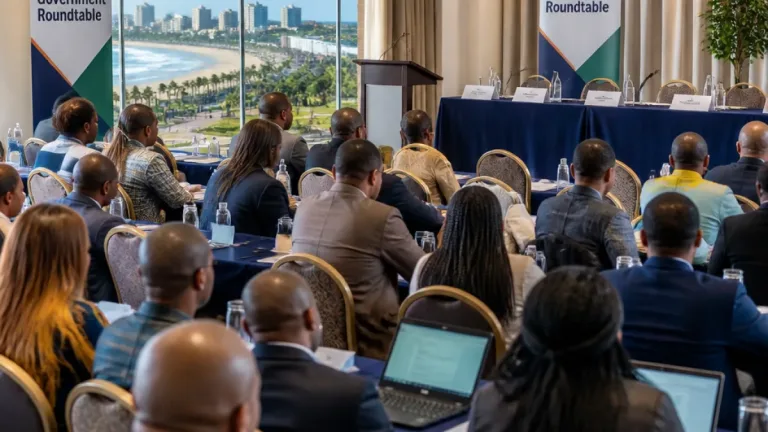
At the ninth BizNews Conference this week, South African businessman Christo Wiese publicly rejected claims that a group of affluent business leaders centred around Stellenbosch controls the country’s economy. Wiese said the label “Stellenbosch Mafia” is inaccurate and that the group “do not control a single market between them.”
Power, perception and a political slogan
Wiese, whose name has frequently been associated with the epithet over the past decade, addressed investors and delegates directly, questioning both the substance of the accusation and the companion phrase “white monopoly capital”. He said he has never been shown what white monopoly capital means in concrete economic terms and described it as a political slogan.
“What monopoly do we have individually or as a collective? … I mean, certainly not the Stellenbosch Mafia,” he told the conference audience.
He recounted a personal anecdote to underscore his point that alleged influence does not automatically translate into policy outcomes. Wiese said he had once been asked to advise a president before a State of the Nation Address but that his advice had not shaped government action. He used that example to argue that being consulted does not equate to exercising control.
Names linked to the label
The description first gained traction in the 2010s and has been applied to a cohort of very wealthy, predominantly Afrikaans businessmen. Public debate about them has been heated: critics argue they constitute an obstacle to economic transformation, while defenders say the claim is exaggerated or politically motivated.
- Prominent figures often associated with the label include Johann Rupert, Jannie Mouton, Koos Bekker, Whitey Basson and the late Markus Jooste.
- Some named individuals have pushed back, saying residence or social ties do not amount to coordinated economic control.
- Wiese’s contribution at the BizNews event continued a trend of high‑profile rebuttals.
Below is a concise reference of individuals most frequently linked to the term:
| Name | Note |
|---|---|
| Christo Wiese | Addressed the BizNews conference rejecting the label |
| Johann Rupert | Has pointed out he lives in Somerset West rather than Stellenbosch |
| Jannie Mouton, Koos Bekker, Whitey Basson, Markus Jooste | Frequently cited in public debate about economic influence |
Local context and wider implications
For Stellenbosch, the phrase carries particular symbolic weight. The university town and surrounding winelands are home to a concentration of wealth, historic privilege and elite networks — factors that feed perceptions of disproportionate influence. Those perceptions have become part of a national conversation about inequality and transformation.
Wiese’s dismissal of the term does not settle that debate. Critics maintain that structural economic patterns and ownership concentration are real, even if there is no formal club exerting coordinated control. Supporters of Wiese’s position argue that naming a loose social network as the engine of national policy oversimplifies complex political and economic realities.
Whatever view one takes, the exchange is a reminder that discourse about power in South Africa is both local and national. Stellenbosch’s association with wealth and elite networks makes it a convenient label in public arguments, but as Wiese emphasised, being associated with each other socially or geographically does not automatically equate to monopoly control over markets or government.
The debate is likely to persist. For local residents and civic leaders in Stellenbosch, the challenge remains to balance acknowledgement of the town’s inequalities with careful analysis of how concentrated power in the economy actually operates — and how policy might address structural disadvantage without relying on simplistic labels.