
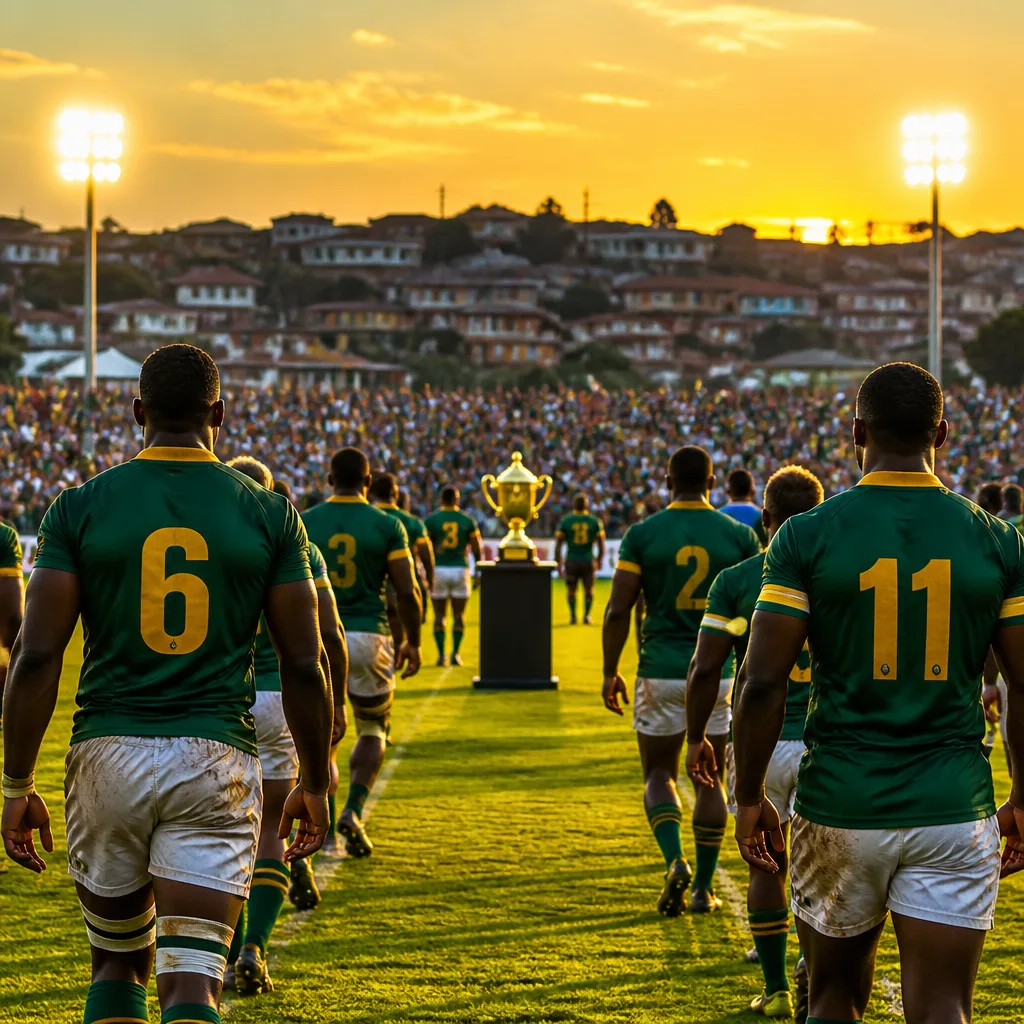
The Springboks’ recent successes have made a compelling case that transformation and high performance need not be opposing forces in South African rugby. That is the central argument advanced by Sipho Ngwema, who traces how the national team has negotiated questions of representation while remaining a global powerhouse.
From the stands to the front line
Ngwema recalls growing up in Gugulethu where rugby and football co-existed and where young people would drift between both codes. Rugby, he says, repeatedly produced moments that drew mixed crowds — a try, a tackle or a piece of individual brilliance — pointing to a long-standing, if complicated, relationship between communities and the game.
Crucially, the piece highlights that rugby traditions were not solely the preserve of white communities. Non-racial rugby activity and tours existed in excluded communities before democracy. What Ngwema identifies as the harder nut to crack was a broader, meaningful ownership of the Springbok emblem itself.
“The Springboks may be the clearest expression yet of the South Africa many imagined in 1994 — a nation that is diverse, united and capable of excellence.”
Transformation without trade-offs
Across the democratic era, debates over quotas, merit and representation framed transformation as potentially at odds with competitiveness. Ngwema argues that experience over the past decade shows otherwise. He points to two successive World Cup victories — in 2019 and 2023 — as evidence that a more representative squad can also be among the best in the world.
The rise of Siya Kolisi is presented as emblematic. Kolisi’s journey from Zwide to becoming the first black Springbok captain and leading the team to a World Cup title is held up as a transformative moment, but one that also delivered at the highest level. Ngwema stresses that this is not simply about one individual: it is about leadership and structures that identify and nurture talent across the country.
Coaching, selection and a pragmatic approach
Ngwema credits people such as Rassie Erasmus with pursuing excellence while not treating transformation as a zero-sum game. In his telling, seeking the best players in the country — regardless of background — strengthened the player pool and ultimately benefited the national team.
- World Cup wins: 2019 and 2023 — used as markers of combined transformation and success.
- Leadership: Siya Kolisi’s captaincy is highlighted as a landmark for representation and performance.
- Approach: Integration of new players with established stars is cited as evidence of a winning model.
| Year | Outcome |
|---|---|
| 2019 | World Cup winners |
| 2023 | World Cup winners |
For fans and administrators alike, the takeaway is practical: transformation need not compromise standards if talent identification, coaching and selection are properly aligned. Ngwema’s view is that transformation has been a route to uncovering talent rather than a concession that undermines competition.
This argument reframes familiar debates. Instead of seeing transformation as a policy burden or an external imposition, Ngwema invites readers to regard it as an active strategy that broadens the talent base and strengthens the team.
Whether one agrees with every detail of the prescription, the national conversation around rugby is changing. The Springboks’ achievements have provided fresh evidence that representation and excellence can coexist — and that sporting success can reinforce social progress rather than stand apart from it.
For rugby followers, coaches and administrators, the challenge is now to keep delivering the structures and pathways that turn potential into performance — without treating transformation and excellence as rivals at all.














