
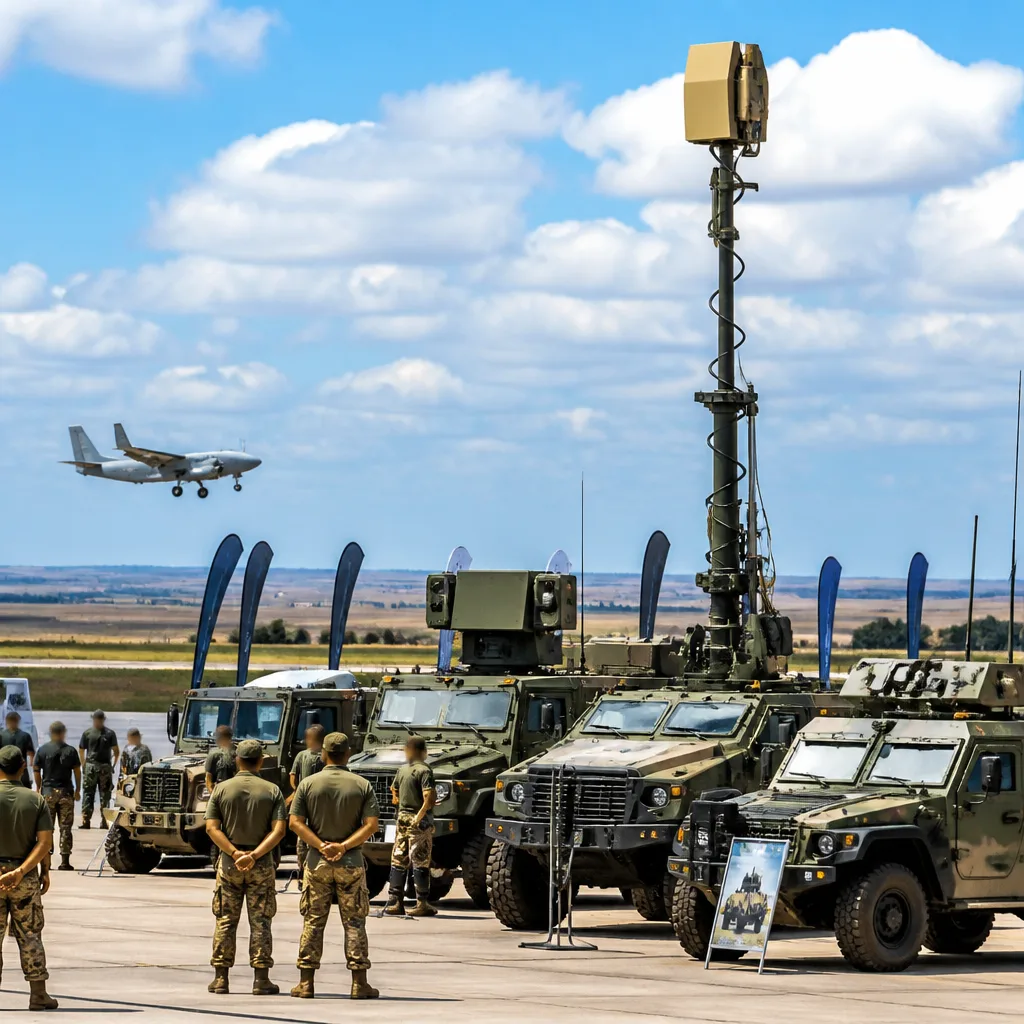
South Africa used the Africa Aerospace and Defence (AAD) exhibition at Waterkloof to place locally developed defence systems on public display, underscoring a growing emphasis on homegrown technology even as funding limits persist. The event brought together military equipment, surveillance systems and demonstrations intended to show that the country can design and produce advanced defence hardware.
Local engineering on show
Visitors saw a range of equipment from the South African defence sector, including armoured vehicles, light aircraft flypasts and mobile surveillance systems developed in-country. The Department of Defence showcased a multi-role mobile radar created in collaboration with Waytech Defence, and officials presented the work as a response to operational problems raised by military leaders.
- Mobile surveillance radar — developed jointly by the Defence Materiel Governance office and Waytech Defence, capable of surveying up to 200–300 nautical miles.
- Armoured vehicles and simulated combat — local manufacturers displayed platforms used for troop protection and battlefield scenarios.
- Aerial demonstrations — both locally produced and operated aircraft took part in flypasts and manoeuvres.
Why it matters
The show was designed to challenge perceptions that Africa cannot produce advanced defence technology, and to signal that South Africa remains a significant industrial player on the continent. The presence of companies such as Denel, Paramount Group and Milkor — long-established contributors to the national industry — reinforces that narrative.
Beyond symbolism, domestic production has practical benefits: it supports local skills development, creates manufacturing jobs and reduces reliance on foreign suppliers for key systems. For a country facing economic constraints and limited industrial capacity in many sectors, sustaining a sovereign defence industrial base can also provide technological spill-overs into civilian fields.
Funding remains a constraint
Officials at the exhibition acknowledged that budget restrictions limit how quickly prototypes and concepts can be moved into full production and deployment. Kopano Peter Lebelo, Chief Director of Materiel Governance, said many of the projects shown originated from requirements raised by military leaders and were subsequently translated into development projects.
“Chiefs tell us what difficulties they have, and we convert those difficulties into projects,” Kopano Peter Lebelo, Chief Director of Materiel Governance, said.
While the developmental pipeline is active, the translation of prototypes into fielded capability depends on sustained procurement budgets and long-term acquisition plans. The department’s approach of turning operational challenges into projects highlights a demand-driven pathway for innovation, but scaling that pathway requires financing and supplier confidence.
| System | Described capability |
|---|---|
| Multi-role mobile radar | Surveillance up to 200–300 nautical miles |
| Armoured mobility platforms | Personnel protection and battlefield operations |
Industrial ecosystem and opportunities
South Africa’s defence industry spans state-owned enterprises, private manufacturers and specialist suppliers. Demonstrating systems at AAD aims to boost export prospects and partnerships with African and international buyers. For the sector to grow, industry players will need predictable procurement from the state, access to capital and support for research and development.
For ordinary South Africans weighing the costs and benefits, the argument for a domestic defence industry rests on jobs, high-value technical skill development and the potential for civil-military technology transfer. Radar, sensor and communications work can feed into disaster management, maritime safety and critical infrastructure monitoring — if the state and industry make those linkages part of planning.
The AAD showcase made clear that South Africa still produces advanced defence equipment but also underscored a familiar policy tension: ambitious engineering and limited budgets. The next step for the sector will be converting prototypes and demonstrations into systems that are affordable to operate and maintain — and that deliver tangible value to both the military and the broader economy.










