
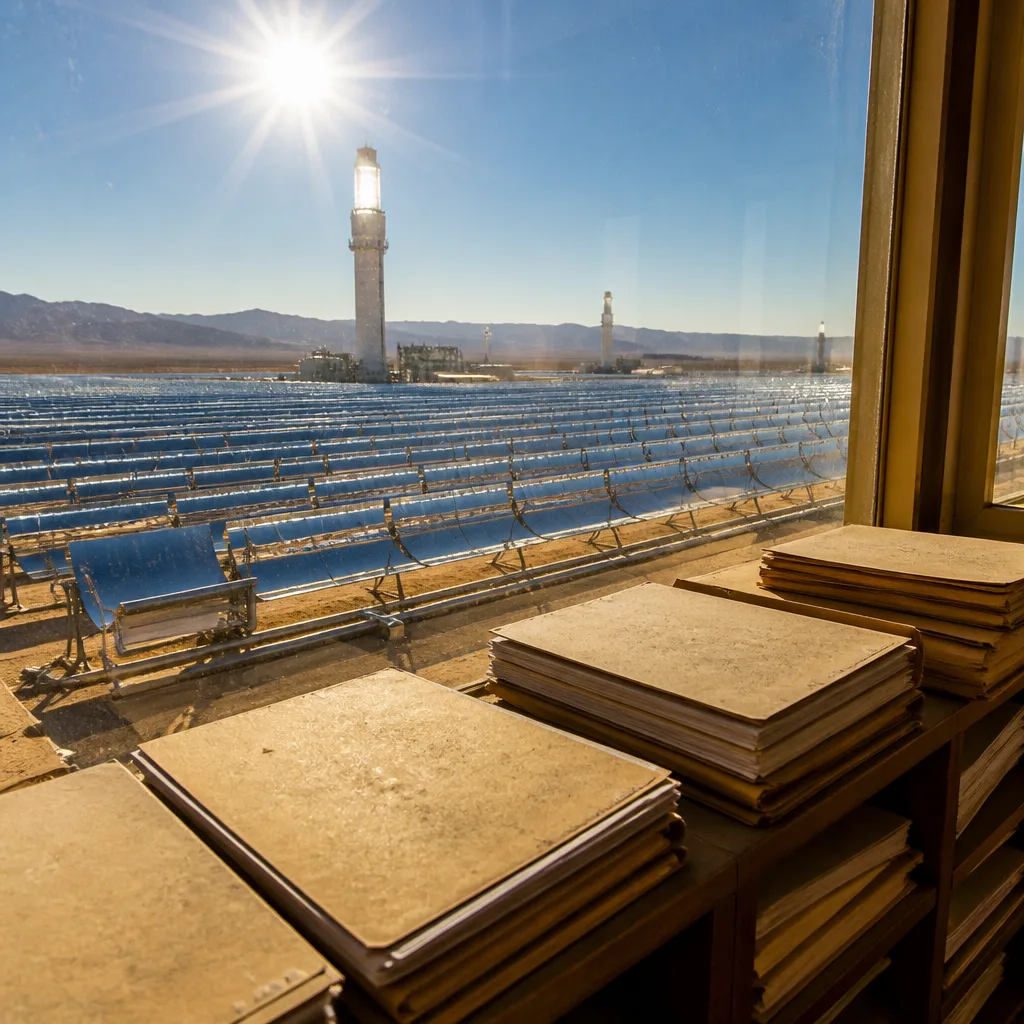
South Africa’s long transition away from coal raises an urgent question: which technologies will supply reliable, affordable electricity when the coal fleet retires? Engineers and researchers argue the national plan has largely overlooked a technology the country is especially well suited to build — concentrating solar power (CSP), which can store heat and keep generating electricity after sunset.
Why CSP matters here
There are two common ways to harvest solar energy. Photovoltaic (PV) panels convert sunlight directly into electricity. CSP uses mirrors to focus direct sunlight into heat, which produces steam to drive a turbine. The critical difference is that CSP can integrate thermal energy storage, allowing the system to continue supplying power once the sun has set — a valuable property for a grid struggling with evening peaks.
South Africa’s climate is a strong natural advantage for CSP. The country receives among the world’s highest levels of direct normal irradiance — sunlight that travels straight from the sun rather than light scattered by clouds — placing it behind only Chile’s Atacama Desert in suitability, according to reporting.
Despite this, the national energy plan has not prioritised CSP. No new CSP projects have been approved since 2014, and earlier plans to expand the technology were gradually scaled back. That matters because existing CSP capacity in South Africa, built through the Renewable Energy Independent Power Producer Procurement Programme, already produces about 600 megawatts — estimated to be enough for roughly 350 000 to 400 000 average three‑bedroom homes annually.
- Coal’s current share: about 74% of South Africa’s electricity.
- Existing CSP capacity: roughly 600 MW.
- Homes served by CSP estimate: 350 000–400 000.
- New CSP approvals: none since 2014.
Engineers who have modelled CSP integration and its construction costs say the technology is straightforward to connect to the national grid and offers reliability benefits that purely daytime PV does not. The argument advanced in recent reporting is that procurement has privileged cheapest daytime electricity from PV without adequately valuing technologies that provide dispatchable or time‑shifted power.
Trade‑offs and policy choices
Choosing energy technologies is ultimately a set of trade‑offs involving cost, reliability, grid stability, and industrial policy. CSP’s strengths in the South African context include:
- Built‑in thermal storage that can serve evening peaks without batteries.
- Good fit with the country’s high direct sunlight levels, especially in the interior.
- Potential to provide stable, dispatchable power to complement variable renewables.
Limitations, recognised in technical literature and cost assessments, include higher upfront capital costs compared with utility‑scale PV and the need for dry cooling in water‑scarce regions if wet cooling cannot be used. The national energy plan’s focus on levelised cost comparisons for daytime PV has made it harder for CSP to compete on paper, even when its value to grid reliability is accounted for.
South Africa faces a significant gap to fill as ageing coal plants come offline over the next two decades. With coal still supplying roughly 74% of electricity, the scale of replacement required is large. Policymakers must weigh whether buying the cheapest kilowatt‑hour during daylight is worth potential extra costs for storage, balancing and grid upgrades later on.
Recent reporting notes that Stellenbosch University’s Solar Thermal Energy Research Group has been directly involved in work modelling CSP systems and construction costs. Those technical assessments matter because they inform how the technology would integrate with the grid, what storage durations are feasible, and where CSP might best be sited.
For South Africans struggling with frequent load‑shedding and rising energy costs, the debate is practical: does the country want more of the cheapest daytime power today, or should procurement frameworks start paying for technologies that deliver electricity when it’s needed most — after sunset and during peak demand?
| Metric | Figure |
|---|---|
| Coal share of electricity | 74% |
| Existing CSP capacity | 600 MW |
| Estimated homes powered by CSP | 350 000–400 000 |
| New CSP approvals since | 2014 |
As the grid transition proceeds, procurement and planning decisions will determine whether a home‑grown CSP industry grows, and whether its reliability benefits are captured on the grid. The choice is not just about technology; it is about valuing time‑shifting and reliability as part of a broader energy strategy.
“South Africa abandoned this clean electricity that is so easy to connect to the national grid because it valued the wrong thing (cheap daytime electricity instead of reliable electricity),” a researcher involved in CSP studies said in reporting.
Policymakers and energy planners must now decide whether CSP will be relegated to niche status or revived as part of a diversified, resilient electricity system that replaces retiring coal capacity over the coming decades.










